India Energy Security and US Sanctions on Russian Oil Firms
Source:Indian Express ↗
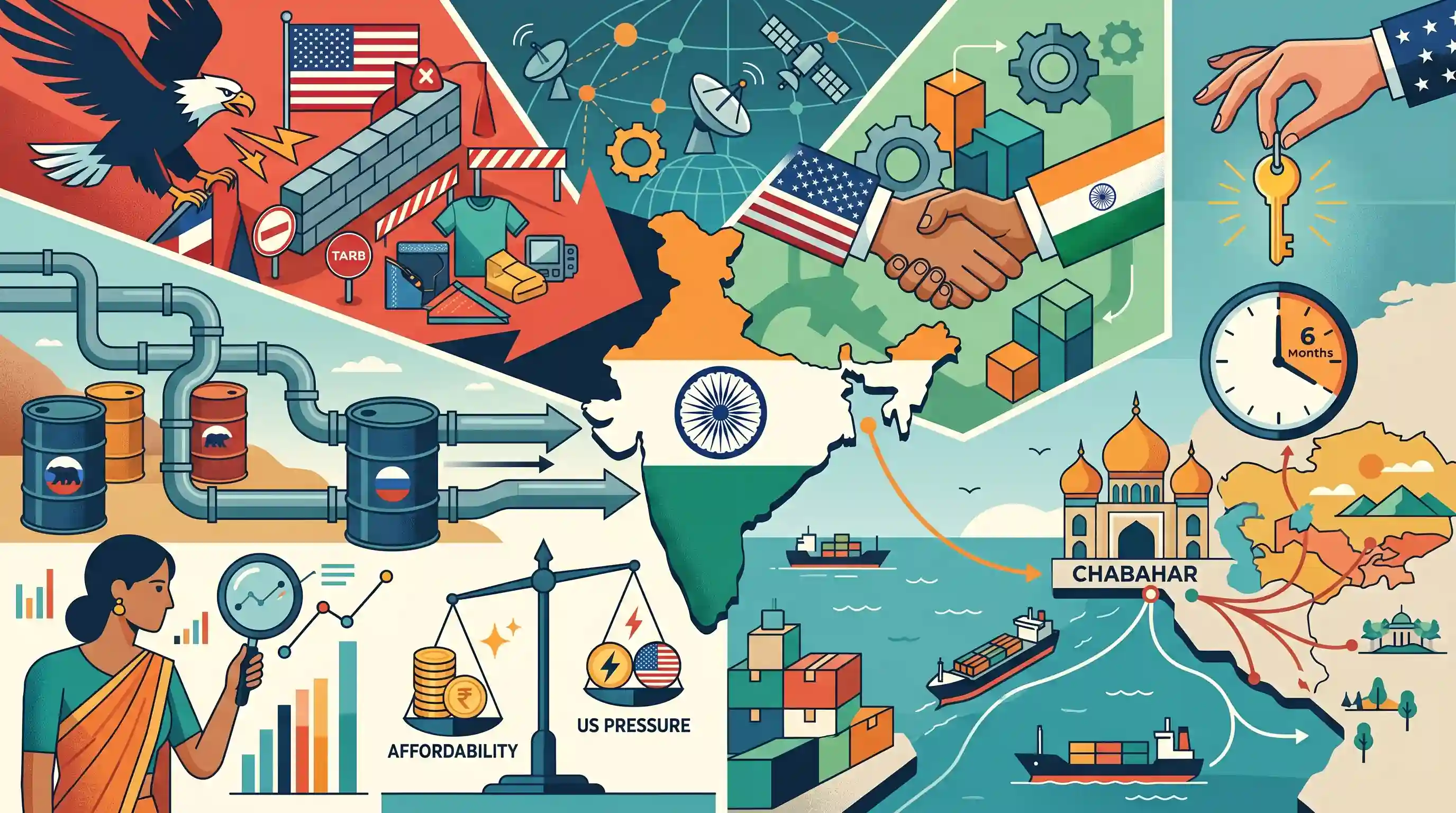
Why It Matters
The article highlights the core dilemma of India's strategic autonomy: balancing essential energy security (cheap Russian oil) against mounting pressure and tariffs from a crucial strategic partner (the US). It also illustrates the transactional and complex nature of modern geopolitics, where trade friction coexists with strategic waivers like the Chabahar port exemption.
Summary
India is evaluating the impact of recent US sanctions on major Russian oil companies, reiterating that its foreign policy and energy procurement are driven by the need to ensure affordable energy security for its 1.4 billion citizens. The geopolitical friction has escalated with the US imposing significant tariffs on Indian goods linked to its Russian oil imports, which New Delhi has criticized as unjustified. Nevertheless, the India-US bilateral relationship exhibits strategic nuance; both countries are actively negotiating a comprehensive trade pact, and Washington has simultaneously granted India a six-month sanctions waiver for the critical Chabahar port project in Iran, acknowledging India's regional connectivity interests.
Key Points
- India is studying the implications of new US sanctions on major Russian oil companies, including Rosneft and Lukoil.
- The Ministry of External Affairs emphasized that India's energy procurement decisions are guided by the imperative to ensure energy security and affordable fuel for its 1.4 billion citizens.
- The US has leveraged economic pressure by imposing 50% tariffs on Indian goods, plus an additional 25% levy specifically linked to India's import of Russian oil, a move India termed "unfair and unreasonable."
- Despite tariff disputes, India and the US are actively negotiating a proposed bilateral trade pact to resolve economic frictions.
- In a strategic carve-out, the US granted India a six-month sanctions waiver for the development of the Chabahar port in Iran, underscoring its importance for regional connectivity.
Important Terms
India-US Bilateral Trade Agreement (BTA)

A proposed framework to reduce tariffs and enhance market access, negotiated to balance the trade deficit and foster deeper economic cooperation between New Delhi and Washington.
UPSC context
GS Paper 2/3: Bilateral agreements and economic relations; tests India's trade diplomacy and market access strategies.
Energy Security
The reliable and affordable availability of energy sources, currently prioritized by India through diversified imports to support the needs of its 1.4 billion citizens.
UPSC context
GS Paper 3: Infrastructure and Energy; tests understanding of India's resource dependency and foreign policy drivers.
Chabahar Port
A strategic maritime facility in Iran, critical for India's connectivity to Afghanistan and Central Asia; it often requires US sanctions waivers to operate due to Iranian sanctions.
UPSC context
GS Paper 2: Regional connectivity and strategic interests; tests India’s efforts to bypass regional rivals like Pakistan.
Strategic Autonomy
The foreign policy principle of making independent sovereign decisions based on national interest, allowing India to maintain ties with both the US and Russia.
UPSC context
GS Paper 2: International Relations; tests India’s "multi-alignment" strategy and resistance to external economic coercion.
Secondary Sanctions
US punitive measures targeting third-party entities (like Indian refiners) that trade with primary sanctioned targets (like Russian oil giants Rosneft and Lukoil).
UPSC context
GS Paper 2: Effects of policies of developed countries on India; tests understanding of global trade laws and economic warfare.
Ministry of External Affairs (MEA)
The Indian government body responsible for formulating and implementing foreign policy, currently managing the fallout from US sanctions on Russian energy imports.
UPSC context
GS Paper 2: Institutional framework of Indian foreign policy; tests knowledge of India's diplomatic representation and responses.
Prelims Trap
"US sanctions on Russian oil companies are binding on UN member states, legally prohibiting India from procurement."
UPSC tests sanction enforceability. India legally recognizes only multilateral UN Security Council sanctions, not unilateral US sanctions. Corporate compliance is to avoid economic fallout, not due to international legal obligation.
Static Concepts Connected
How does Chabahar Port fit into India's Eurasian connectivity strategy?
- Geographic Location: Situated in Iran's Sistan-Baluchistan province on the Gulf of Oman, bypassing the congested Strait of Hormuz.
- Bypassing Pakistan: Provides India direct maritime access to Afghanistan and Central Asia without relying on Pakistani land transit.
- INSTC Linkage: Serves as a critical southern gateway for the International North-South Transport Corridor (INSTC) connecting India to Eurasia.
What is the difference between primary and secondary economic sanctions?
- Primary Sanctions: Prohibits citizens and domestic companies of the sanctioning nation from doing business with the targeted entity.
- Secondary Sanctions: Extraterritorial measures targeting third-party nations or foreign companies, threatening economic penalties if they trade with the target.
- India's Stance: India officially does not recognize unilateral secondary sanctions, maintaining that only UN-mandated sanctions carry international legal weight.
Cross-Topic Patterns
Energy Security & De-dollarisation
Procuring sanctioned Russian oil drives India to explore alternative payment mechanisms like Special Rupee Vostro Accounts (SRVAs) to bypass SWIFT and reduce vulnerability to dollar dominance.
Compartmentalized Diplomacy
The US leveraging tariffs over Russian oil while simultaneously granting a sanctions waiver for Chabahar illustrates the highly transactional, issue-based nature of modern multi-alignment.

Expect a multi-statement Prelims question contrasting UN multilateral sanctions with US unilateral secondary sanctions in 2026.
Linked PYQs · 3
Linked PYQs · 3
- 2025MainsGS2
"Energy security constitutes the dominant kingpin of India's foreign policy, and is linked with India's overarching influence in Middle Eastern countries.” How would you integrate energy security with India's foreign policy trajectories in the coming years?
- 2017PrelimsGS1
What is the importance of developing Chabahar Port by India?
- 2012MainsGS2
How have the US sanctions against Iran affected India's bilateral relations with Iran?
