India Faces Persistent Challenges in Curbing Leprosy Transmission
Source:The Hindu ↗
Why It Matters
It highlights structural gaps in public health delivery, disease surveillance, and the management of neglected tropical diseases like leprosy, which are critical for evaluating India's progress toward universal health coverage and SDG targets.
Summary
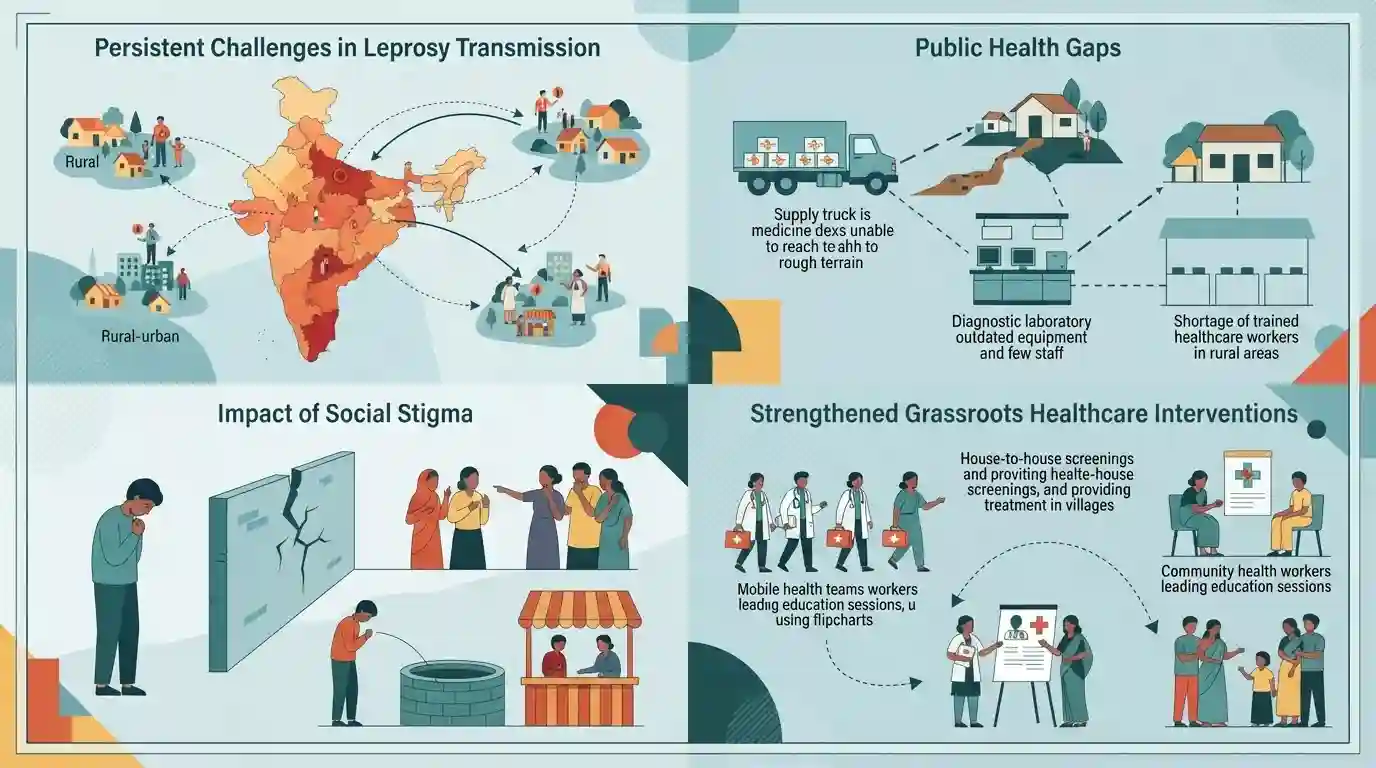
An analysis of data indicating that India continues to face persistent challenges in curbing leprosy transmission, highlighting public health gaps, the impact of social stigma, and the need for strengthened grassroots healthcare interventions.
Key Points
- India continues to struggle with active leprosy transmission, contributing significantly to the global burden of new cases despite achieving elimination status at the national level in 2005.
- Persistent transmission is driven by challenges such as social stigma, delayed diagnosis, hidden cases in urban and rural pockets, and gaps in grassroots public healthcare surveillance.
- Addressing leprosy transmission requires revitalising primary healthcare surveillance, community-level awareness campaigns, and destigmatisation efforts to ensure early detection and complete multidrug therapy (MDT) compliance.
Important Terms
National Leprosy Eradication Programme (NLEP)

A centrally sponsored public health scheme aimed at eliminating leprosy as a public health problem through early case detection, free treatment with multi-drug therapy, and community awareness campaigns.
UPSC context
GS Paper II (Social Sector - Health): Tests knowledge of government interventions, public health infrastructure, and disease elimination strategies in India.
World Health Organization (WHO)
A specialized agency of the United Nations responsible for international public health, setting global health standards, guidelines, and disease elimination targets.
UPSC context
GS Paper II (International Organizations / Health): Evaluates understanding of global health governance, international treaties, and multilateral public health frameworks.
Ministry of Health and Family Welfare
The apex government body in India responsible for formulating, implementing, and monitoring national health policies, family welfare programs, and central public health schemes.
UPSC context
GS Paper II (Governance - Statutory Bodies and Ministries): Tests familiarity with administrative machinery handling public health and welfare delivery in India.
Static Concepts Connected
What is the difference between disease elimination and eradication in public health?
- Eradication definition: Reduction to zero of the incidence of infection globally caused by a specific agent as a result of deliberate efforts; no further control measures are required (e.g., Smallpox).
- Elimination definition: Reduction to a specified very low level (e.g., <1 case per 10,000 population) of disease incidence or prevalence in a specific geographical area (e.g., Leprosy in India, 2005).
- Ongoing interventions: Ongoing intervention activities are still required to prevent a rebound or re-emergence of the disease even after elimination is declared.
Cross-Topic Patterns
Public Health vs. Vulnerable Section Welfare
Persistent infectious diseases like leprosy intersect with social vulnerability, testing the reach of National Health Mission (NHM) targets in remote districts.
Vertical vs. Horizontal Healthcare Integration Gaps
The transition from vertical disease eradication programs to horizontal general healthcare delivery often risks surveillance blind spots in primary care.

Distinguish between national 'elimination' status (prevalence <1/10,000) and zero transmission in statements-based MCQs.
Linked PYQs · 2
Linked PYQs · 2
- 2024MainsGS2
In a crucial domain like the public healthcare system the Indian State should play a vital role to contain the adverse impact of marketisation of the system. Suggest some measures through which the State can enhance the reach of public healthcare at the grassroots level.
- 2018MainsGS2
Appropriate local community-level healthcare intervention is a prerequisite to achieve 'Health for All' in India. Explain.
