India Condemns Pakistan Air Strikes on Afghanistan Sovereignty
Source:The Hindu ↗
Why It Matters
The event highlights India's ongoing diplomatic stance regarding the sovereignty of Afghanistan and its consistent condemnation of Pakistan's cross-border military actions. It underscores the fragile geopolitical situation in South Asia and the broader implications for regional peace, security, and India's neighborhood first policy.
Summary
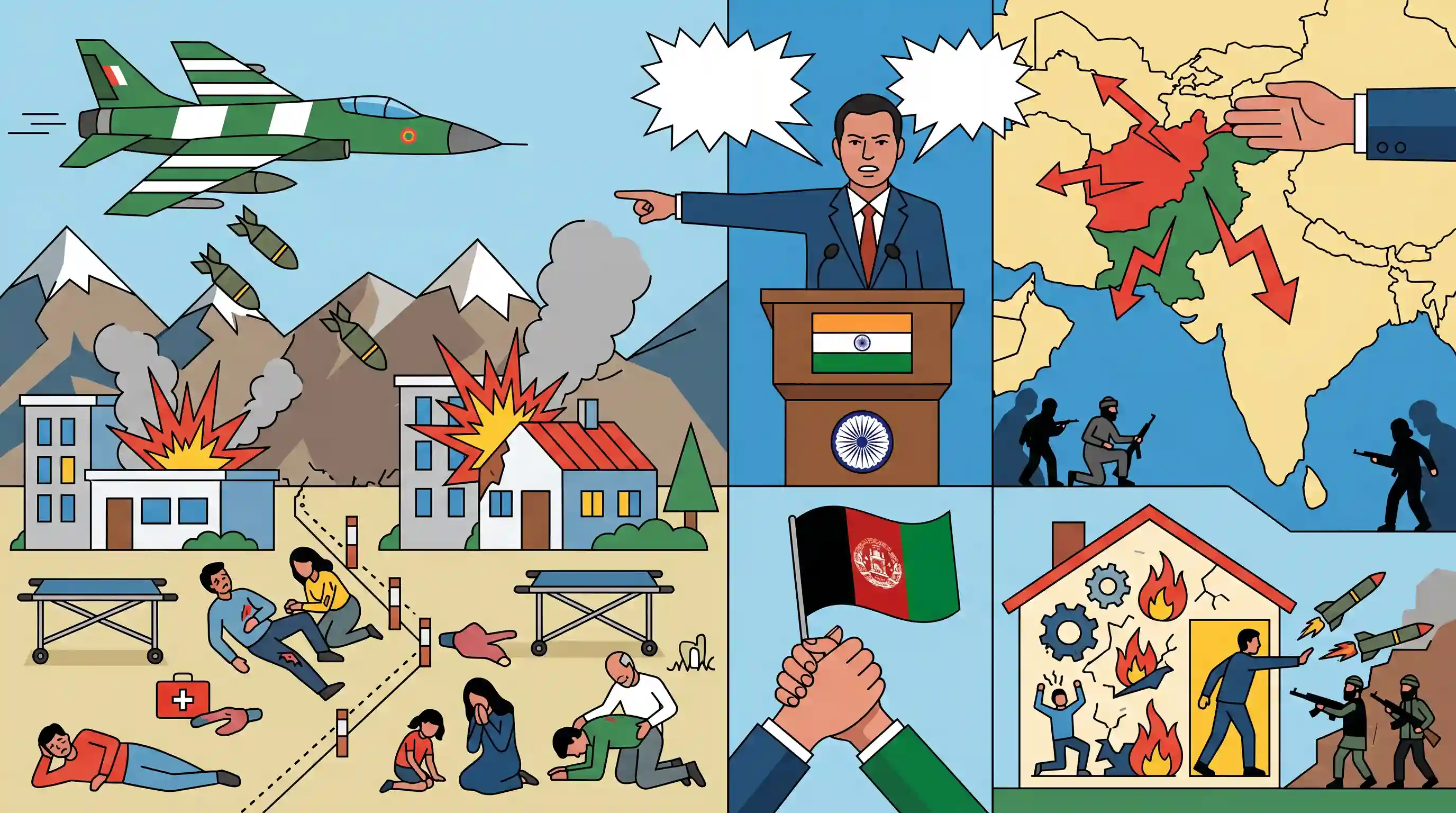
India has strongly condemned recent Pakistani airstrikes on Afghan territory, which reportedly killed 36 civilians and injured over 160 others. The Ministry of External Affairs (MEA) described the strikes as a "blatant act of aggression," violating Afghanistan's sovereignty and directly threatening regional peace and stability. While Pakistan claimed it targeted militants, the Afghan foreign ministry argued residential areas were hit, leading to diplomatic protests between Kabul and Islamabad. India reiterated its steadfast support for Afghanistan's territorial integrity and criticized Pakistan for attempting to deflect from its internal failures through cross-border violence.
Key Points
- India strongly condemned Pakistan's airstrikes on Afghan territory, which resulted in significant civilian casualties, including women and children.
- The Ministry of External Affairs (MEA) termed the strikes a 'blatant act of aggression', an assault on Afghanistan's sovereignty, and a direct threat to regional peace and stability.
- Pakistan claimed the strikes and a ground operation killed 29 militants, while the Afghan foreign ministry reported 36 civilians dead and 163 injured in residential areas.
- Afghanistan and Pakistan summoned each other's Charge d'affaires to lodge diplomatic protests amid escalating tensions.
- India reiterated its unwavering support for Afghanistan's sovereignty and territorial integrity while criticizing Pakistan's reckless behavior to externalize internal failures.
Important Terms
Ministry of External Affairs (MEA)

The Indian government ministry responsible for managing foreign relations, diplomatic missions, and formulating foreign policy. It acts as the primary interface for India's engagement with the global community.
UPSC context
GS Paper II: International Relations. Tests knowledge of India's diplomatic machinery, foreign policy objectives, and neighborhood relations.
Taliban
An Islamic fundamentalist political and military organization that regained control of Afghanistan in August 2021. It currently functions as the country's de facto government.
UPSC context
GS Paper II: International Relations. Crucial for understanding regional security, non-state actors, and India's "wait and watch" diplomatic approach.
Sovereignty
The supreme authority of a state to govern itself and its territory without external interference. It is a core principle of international law and the UN Charter.
UPSC context
GS Paper II: International Relations & Polity. Tests understanding of statehood, non-interference, and challenges to national autonomy in global politics.
Cross-border Terrorism
Terrorist activities originating in one country and targeted at another across international borders, often used as a tool of proxy warfare to destabilize a region.
UPSC context
GS Paper III: Internal Security. Evaluates knowledge of security threats, border management, and the role of non-state actors.
Territorial Integrity
The principle under international law that nation-states should not attempt to promote border changes or secessions in other sovereign states through force.
UPSC context
GS Paper II: International Relations. Focuses on bilateral disputes, regional stability, and India’s stance on neighboring conflicts.
Durand Line
The 2,670-kilometer international border between Afghanistan and Pakistan, established in 1893, which remains a source of tension and non-recognition by various Afghan administrations.
UPSC context
GS Paper II: International Relations. Important for analyzing historical border disputes and their impact on contemporary South Asian security.
Prelims Trap
India's defense of Afghan sovereignty implies its formal diplomatic recognition of the Taliban regime.
India maintains a 'technical team' in Kabul for humanitarian operations and supports Afghan sovereignty, but explicitly does NOT formally recognize the Taliban as the legitimate government.
Static Concepts Connected
What is the historical context of the Durand Line dispute?
- Origin: Demarcated in 1893 via an agreement between British civil servant Sir Mortimer Durand and Afghan Amir Abdur Rahman Khan.
- The Dispute: Afghanistan vehemently rejects the 2,640-km boundary, arguing it artificially divides the Pashtun ethnic tribal areas, and refuses to accept it as a permanent international border.
- Pakistan's Stance: Pakistan considers it a legally binding international border and has fenced major portions to restrict militant movement, frequently sparking cross-border skirmishes with Afghan forces.
What are the core pillars of India's post-2021 Afghan policy?
- No Recognition: India strictly avoids formal political recognition of the Taliban but maintains a functional 'technical team' in Kabul to oversee interests.
- Humanitarian Focus: Focuses heavily on people-centric aid, prioritizing shipments of wheat, vaccines, and disaster relief without directly funding the Taliban administration.
- Strategic Demands: Advocates for an inclusive Afghan government, guarantees that Afghan soil won't be used for anti-India terrorism, and supports territorial sovereignty free from external (Pakistani) interference.
Cross-Topic Patterns
Terror blowback & Strategic Depth
Pakistan's historical policy of using proxy terror groups for 'strategic depth' in Afghanistan has backfired, as the TTP now leverages Afghan soil to launch kinetic attacks against the Pakistani state.
Artificial colonial borders
The Durand Line mirrors the McMahon Line—arbitrarily drawn colonial boundaries that ignore ethnic distributions, creating permanent fault lines that continue to trigger modern geopolitical and military conflicts.

Map question on the Durand Line/Paktia province, or a Mains question on India's pragmatic Afghan engagement despite no formal recognition.
Linked PYQs · 2
Linked PYQs · 2
- 2016MainsGS2
Increasing cross-border terrorist attacks in India and growing interference in the internal affairs of several member-states by Pakistan are not conducive for the future of SAARC (South Asian Association for Regional Cooperation)." Explain with suitable examples.
- 2015MainsGS2
Terrorist activities and mutual distrust have clouded India-Pakistan relations. To what extent the use of soft power like sports and cultural exchanges could help generate goodwill between the two countries? Discuss with suitable examples.
