Diplomatic Responses to Maritime Incidents in West Asia
Source:Indian Express ↗
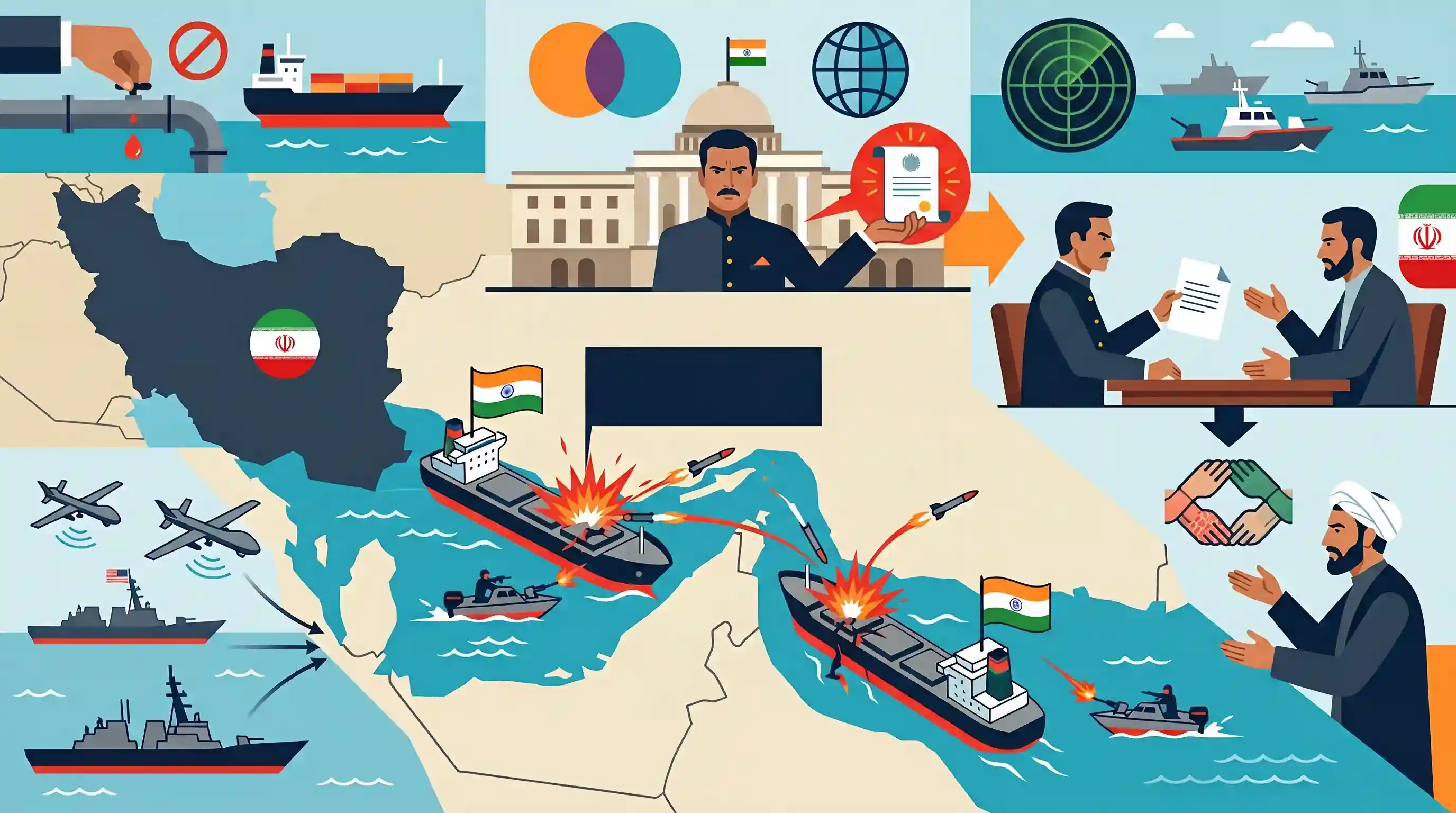
Why It Matters
The Strait of Hormuz is one of the world's most vital maritime choke points for crude oil shipments. Disruptions there threaten global and Indian energy security. Furthermore, India must delicately balance its strategic partnership with the US against its long-standing historical, energy, and connectivity interests with Iran.
Summary
India launched a strong diplomatic protest after Iranian forces reportedly fired on two Indian-flagged merchant vessels in the Strait of Hormuz. The Ministry of External Affairs summoned Iran's Ambassador, Dr Mohammad Fathali, to express its concerns over the incident, which took place amidst an ongoing US CENTCOM maritime interdiction effort against Iran. While acknowledging the incident, an Iranian representative framed it as a misunderstanding and emphasized that robust India-Iran bilateral relations would not be affected. The event underscores the geopolitical volatility of the critical energy transit route.
Key Points
- Tensions escalated in the Strait of Hormuz after Iranian forces reportedly fired on two Indian-flagged merchant vessels.
- India's Ministry of External Affairs lodged a formal and strong protest by summoning the Iranian Ambassador to India.
- The maritime standoff is occurring against the backdrop of US CENTCOM enforcing a full maritime interdiction targeting Iranian coastal operations.
- Iranian representatives described the firing as a 'misunderstanding' and emphasized the resilience and strength of India-Iran bilateral relations.
Important Terms
Strait of Hormuz

A narrow, strategically vital waterway between Iran and Oman connecting the Persian Gulf to the Gulf of Oman. It is the world's most important energy chokepoint.
UPSC context
GS Paper-1 (Geography) & GS Paper-2 (International Relations). Tests knowledge of maritime chokepoints and geopolitical flashpoints.
Ministry of External Affairs (MEA)
The Indian government ministry responsible for the conduct of foreign relations. It manages diplomatic missions and represents India at international forums like the UN.
UPSC context
GS Paper-2 (Governance/IR). Tests understanding of India’s foreign policy apparatus and diplomatic engagement mechanisms.
US Central Command (CENTCOM)
A major U.S. military command responsible for operations in the Middle East and Central Asia, frequently engaging in regional security and maritime enforcement.
UPSC context
GS Paper-2 (International Relations). Tests understanding of global military architectures and their impact on India’s regional interests.
Maritime Interdiction
Naval operations aimed at intercepting, inspecting, or seizing vessels to enforce sanctions, blockades, or prevent the transport of contraband in international waters.
UPSC context
GS Paper-3 (Internal Security). Tests understanding of maritime law, security operations, and the legalities of international naval blockades.
Energy Security
The uninterrupted availability of energy sources at affordable prices, vital for national economic stability, especially for energy-import-dependent nations like India.
UPSC context
GS Paper-3 (Economy/Security). Tests understanding of India's strategic vulnerabilities and the link between global geopolitics and domestic energy needs.
Bilateral Relations
The diplomatic, economic, and strategic interactions between two sovereign states, such as the complex energy and infrastructure-driven ties between India and Iran.
UPSC context
GS Paper-2 (International Relations). Tests knowledge of India's specific partnerships and regional diplomatic balancing.
Prelims Trap
"Chabahar Port is located inside the Persian Gulf, requiring vessels to transit through the Strait of Hormuz."
Chabahar is strategically situated on the Gulf of Oman, strictly outside the Strait of Hormuz. This allows India to bypass the volatile chokepoint entirely.
Static Concepts Connected
What are the key geographical markers of the Strait of Hormuz?
- Connectivity: Connects the Persian Gulf in the west to the Gulf of Oman and the Arabian Sea in the east.
- Bordering nations: Bounded by Iran to the north and the Musandam Peninsula (shared by Oman and the UAE) to the south.
- Energy transit: Functions as a vital global chokepoint handling approximately 20% of the world's petroleum liquids consumption.
How does UNCLOS regulate navigation in international straits like Hormuz?
- Transit Passage: Grants all ships and aircraft the freedom of navigation solely for the purpose of continuous and expeditious transit.
- Non-suspension: Unlike "innocent passage" in territorial waters, coastal states bordering international straits generally cannot suspend transit passage.
- Submarine transit: Submarines are permitted to transit submerged, unlike in standard territorial seas where they must navigate on the surface.
Cross-Topic Patterns
US alignments vs Strategic Autonomy
India balancing participation in US-led maritime initiatives while protesting CENTCOM-triggered disruptions to its Iranian assets highlights a core GS-II triangular diplomacy theme.
SLOCs and Macroeconomic Stability
The direct link between GS-III Maritime Security (SLOC vulnerability) and GS-III Economy (imported crude inflation) is starkly exposed whenever Strait of Hormuz transit is disrupted.

Map-based pairing of Middle Eastern chokepoints (Hormuz, Bab-el-Mandeb) with bordering states is highly probable in the 2026 Prelims.
Linked PYQs · 3
Linked PYQs · 3
- 2017MainsGS2
The question of India's Energy Security constitutes the most important part of India's economic progress. Analyze India's energy policy cooperation with West Asian countries.
- 2012MainsGS2
How have the US sanctions against Iran affected India's bilateral relations with Iran?
- 2018MainsGS2
In what ways would the ongoing US-Iran Nuclear Pact Controversy affect the national interest of India? How should India respond to this situation?
