India Climate Policy and Strategic Posture
Source:The Hindu ↗
Why It Matters
The article provides essential updates on India's environmental policy, specifically the introduction of the Climate Finance Taxonomy and the National Adaptation Plan submitted to the UNFCCC. It also connects foreign policy posturing with domestic economic and environmental development, relevant for Mains GS2 (IR) and GS3 (Environment/Economy).
Summary
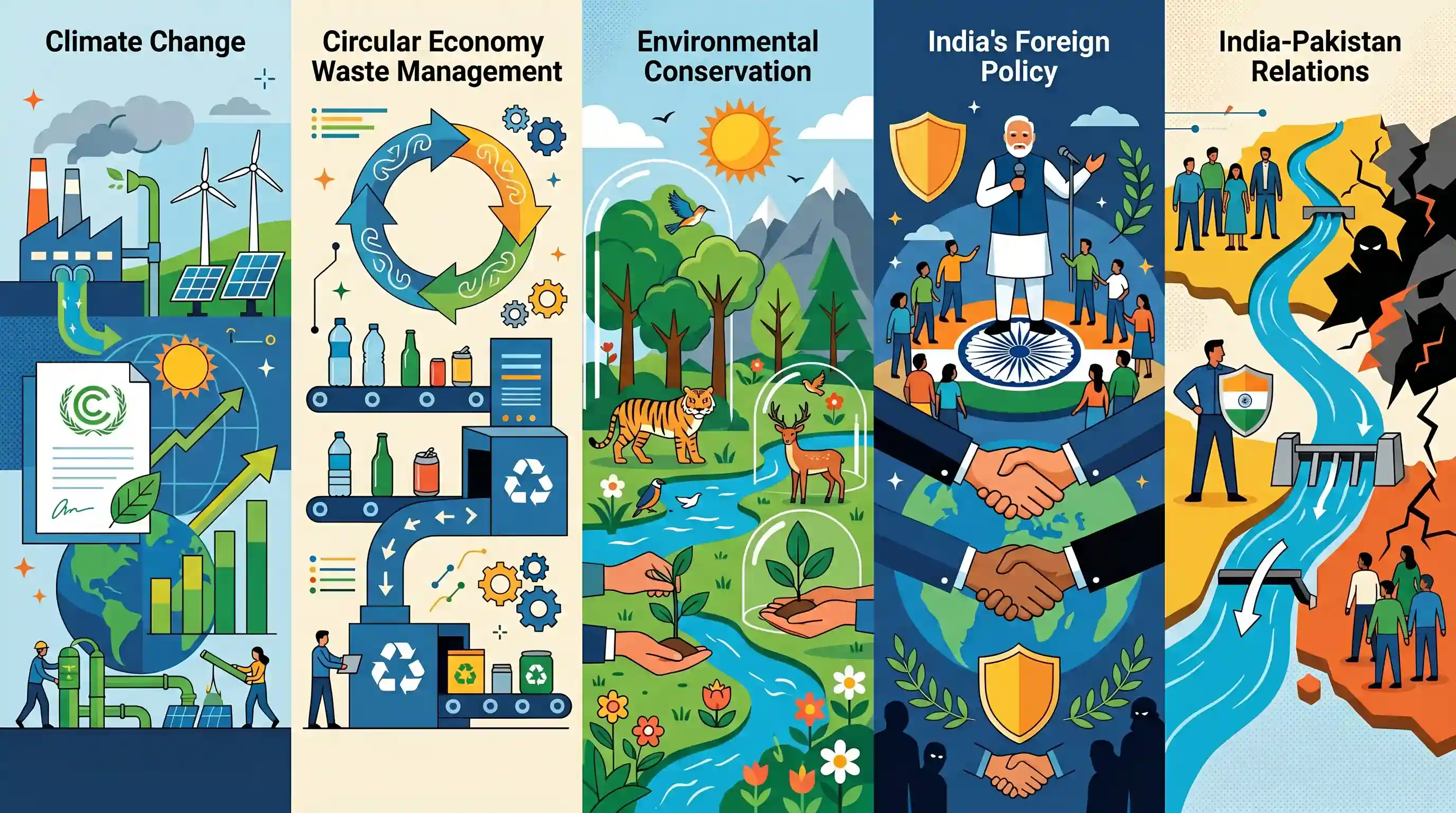
Speaking at a CII conclave, Union Environment Minister Bhupender Yadav articulated the 'India story' as a blend of assertive foreign policy, strong democratic values, and robust development. Highlighting India's tough stance on terrorism (referencing the Indus Water Treaty), he also outlined the nation's emergence as a voice for the Global South. A significant portion of his address focused on India's environmental strategy, detailing initiatives like the Draft Climate Finance Taxonomy, the submission of the first National Adaptation Plan to the UNFCCC, and the promotion of a circular economy through comprehensive Extended Producer Responsibility (EPR) guidelines in the recycling sector.
Key Points
- Union Environment Minister Bhupender Yadav defined the 'India story' as a combination of kindness towards friends, might against adversaries, and walking the path of democracy alongside development.
- He referenced a tough stance on cross-border terrorism from Pakistan, asserting that 'water and blood did not flow together', alluding to India's position on the Indus Water Treaty.
- India has developed a unique climate policy architecture balancing economic development with climate goals, including the recent submission of its first National Adaptation Plan to the UNFCCC and the release of a Draft Framework of the Climate Finance Taxonomy.
- The government is heavily focusing on a circular economy, implementing Extended Producer Responsibility (EPR) guidelines for tyres, batteries, plastics, and e-waste, which has helped generate investments of ₹10,000 crore in the recycling sector.
Important Terms
Indus Water Treaty (IWT)

A 1960 water-sharing agreement between India and Pakistan, brokered by the World Bank, governing the distribution and use of the Indus River system’s six rivers.
UPSC context
GS Paper-II (International Relations); tests knowledge of transboundary water diplomacy and India-Pakistan bilateral ties.
Extended Producer Responsibility (EPR)
A policy framework making manufacturers responsible for the entire lifecycle of their products, particularly post-consumer waste collection and recycling, to promote a circular economy.
UPSC context
GS Paper-III (Environment); tests understanding of waste management rules and resource efficiency strategies.
Climate Finance Taxonomy
A standardized classification system identifying environmentally sustainable economic activities to guide green investments, prevent greenwashing, and help achieve Net Zero targets.
UPSC context
GS Paper-III (Economy/Environment); focuses on sustainable finance frameworks and mobilizing capital for climate action.
National Adaptation Plan (NAP)
A strategic framework outlining national actions to reduce climate vulnerability, build resilience, and integrate adaptation into long-term development planning for submission to the UNFCCC.
UPSC context
GS Paper-III (Environment); covers climate resilience strategies and India’s commitments under the Paris Agreement.
UNFCCC
The 1992 international environmental treaty established to stabilize greenhouse gas concentrations and coordinate global responses to climate change, including COP summits.
UPSC context
GS Paper-III (Environment); fundamental for global environmental governance and international climate negotiations.
Confederation of Indian Industry (CII)
A non-government, industry-led organization that partners with the Indian government to shape policies and foster an environment conducive to industrial development.
UPSC context
GS Paper-III (Economy); represents the role of industry bodies in policy advocacy and national growth.
Prelims Trap
India has no water utilization rights over the Western rivers (Indus, Jhelum, Chenab) under the Indus Water Treaty.
India is permitted limited non-consumptive, domestic, agricultural use, and run-of-the-river hydroelectric projects on the Western rivers.
Static Concepts Connected
What is Extended Producer Responsibility (EPR) and its notified domains in India?
- Core principle: Producers bear financial and physical accountability for the end-of-life disposal or recycling of their manufactured products.
- Notified domains: Currently legally mandated in India for four specific waste streams: plastics, e-waste, batteries, and waste tyres.
- Policy goal: Drives the transition from a linear to a circular economy while formalizing the domestic recycling sector.
How are rivers allocated under the 1960 Indus Water Treaty (IWT)?
- Eastern Rivers: Ravi, Beas, and Sutlej are allocated to India for unrestricted, exclusive use.
- Western Rivers: Indus, Jhelum, and Chenab are allocated to Pakistan. India retains limited non-consumptive and hydroelectric rights.
- Institutional broker: The World Bank brokered the treaty and maintains a role in the dispute resolution mechanism.
Cross-Topic Patterns
Climate Taxonomy & Sovereign Green Bonds
The Draft Climate Finance Taxonomy provides the defining framework for RBI's Sovereign Green Bonds, preventing 'greenwashing' and steering domestic markets toward Paris Agreement targets.
Hydro-diplomacy in internal security
Fast-tracking run-of-the-river projects on Western rivers (Jhelum, Chenab) marks a shift where India leverages geographic advantages and environmental treaties to counter cross-border terrorism.

Expect a 2026 Prelims multi-statement question combining India's new Climate Finance Taxonomy, EPR domains, and Sovereign Green Bonds.
Linked PYQs · 4
Linked PYQs · 4
- 2025MainsGS3
Write a review on India's climate commitments under the Paris Agreement (2015) and mention how these have been further strengthened in COP26 (2021). In this direction, how has the first Nationally Determined Contribution intended by India been updated in 2022?
- 2021MainsGS3
Describe the major outcomes of the 26th session of the Conference of the Parties (COP) to the United Nations Framework Convention on Climate Change (UNFCCC). What are the commitments made by India in this conference?
- 2015MainsGS2
Terrorist activities and mutual distrust have clouded India-Pakistan relations. To what extent the use of soft power like sports and cultural exchanges could help generate goodwill between the two countries? Discuss with suitable examples.
- 2019MainsGS3
Define the concept of carrying capacity of an ecosystem as relevant to an environment. Explain how understanding this concept is vital while planning for sustainable development of a region.
