Meteorological Factors Behind India June Monsoon Deficit
Source:The Hindu ↗
Why It Matters
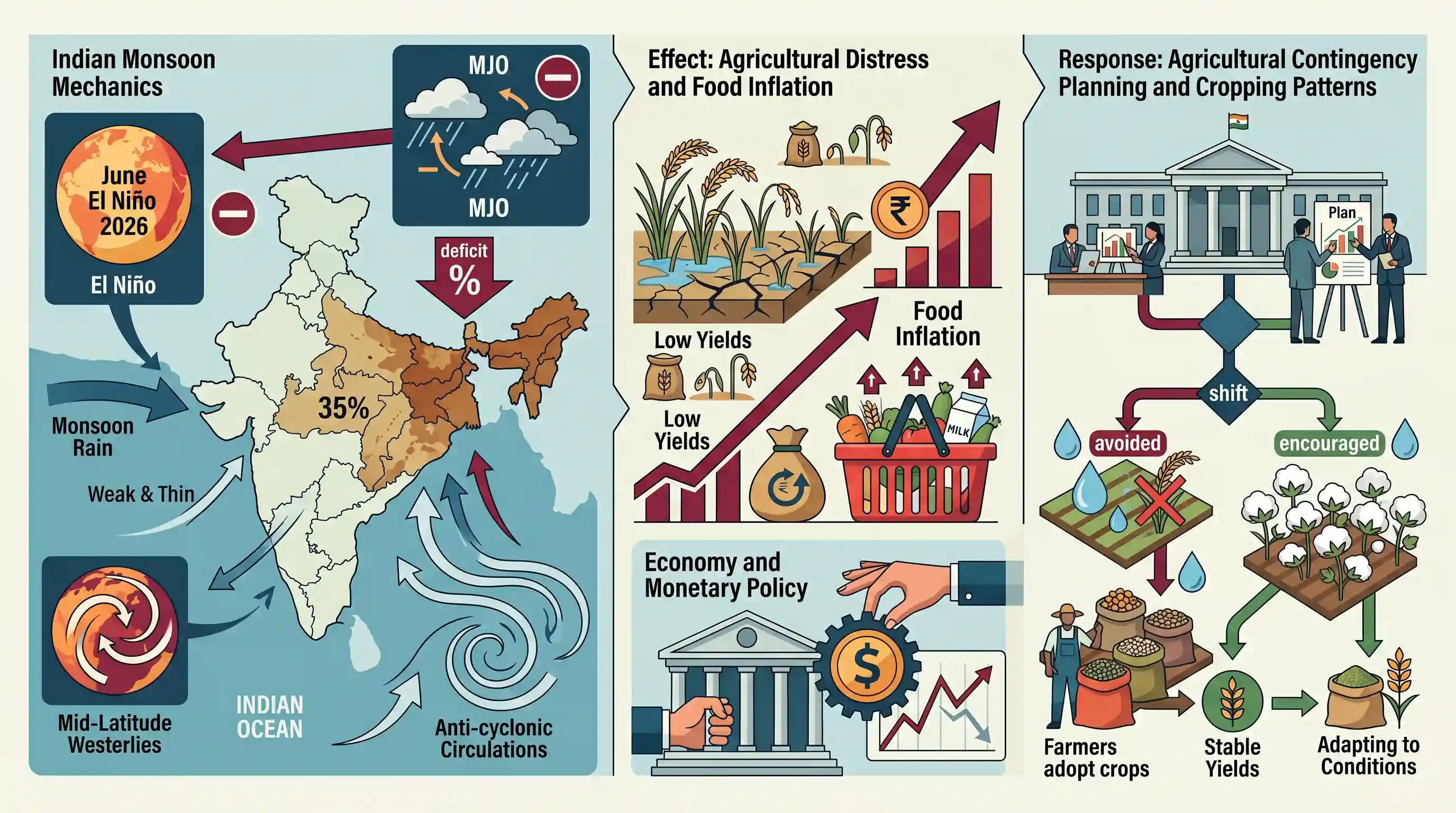
This article serves as a classic case study integrating GS1 physical geography (monsoon mechanisms, El Nino, MJO) with GS3 agriculture and economy (cropping patterns, contingency planning, food inflation). It is highly relevant for both Prelims conceptual questions on climate patterns and Mains questions evaluating the socio-economic impacts of erratic weather on Indian agriculture.
Summary
India is facing a projected 35% deficit in the southwest monsoon for June 2026, with the shortfall heavily concentrated in central and eastern/northeastern regions. Meteorological experts attribute the sluggish progress of the monsoon to a confluence of factors, notably the lingering effects of El Niño, mid-latitude westerlies, anti-cyclonic circulations, and an unfavorable Madden-Julian Oscillation (MJO) phase. Anticipating agricultural distress, the Agriculture Ministry has initiated contingency planning, urging farmers to shift their cropping patterns toward less water-intensive kharif crops such as cotton and pulses. The deficit raises serious concerns regarding crop yields, potential spikes in food inflation, and subsequent impacts on the broader economy and monetary policy.
Key Points
- India is confronting a significant 35% monsoon deficit in June 2026, with central India experiencing a severe 63% shortfall.
- The monsoon's stalling is driven by complex meteorological dynamics, including the Super El Niño effect, an anti-cyclonic circulation, intruding mid-latitude westerlies, and an unfavorable Madden-Julian Oscillation (MJO) phase.
- In response, the Agriculture Ministry has mandated crop-specific contingency plans, advising a shift away from water-intensive crops.
- Farmers are being encouraged to cultivate alternative kharif crops like cotton and pulses to mitigate the impact of delayed rains.
- The sustained deficit threatens to disrupt agricultural output, raising the specter of persistent food inflation and complicating macroeconomic management.
Important Terms
India Meteorological Department (IMD)

The principal government agency under the Ministry of Earth Sciences responsible for meteorological observations, weather forecasting, and seismology.
UPSC context
GS Paper I and III; vital for weather forecasting, disaster management, and agricultural planning.
El Niño
A climate pattern characterized by the abnormal warming of surface waters in the eastern tropical Pacific Ocean, which typically weakens the Indian monsoon.
UPSC context
GS Paper I (Physical Geography); critical for understanding climate variability and its impact on Indian agriculture.
Madden-Julian Oscillation (MJO)
An eastward-moving atmospheric disturbance of clouds, rainfall, and winds near the equator that influences the intra-seasonal variability of the monsoon.
UPSC context
GS Paper I (Meteorology); tests understanding of sub-seasonal factors affecting monsoon intensity and distribution.
Kharif Crops
Crops sown at the beginning of the southwest monsoon (June-July) and harvested in autumn, such as rice, maize, cotton, and pulses.
UPSC context
GS Paper III (Agriculture); essential for questions on cropping patterns, irrigation, and food security.
Food Inflation
A sustained increase in the prices of food items, frequently triggered by supply-side shocks like monsoon deficits or crop failures.
UPSC context
GS Paper III (Economy); central to understanding inflation targeting, monetary policy, and rural distress.
Reserve Bank of India (RBI)
India's central bank and monetary authority responsible for regulating the money supply and managing inflation through the policy (repo) rate.
UPSC context
GS Paper III (Economy); relevant for monetary policy responses to supply-side inflationary shocks.
Southwest Monsoon
Seasonal winds that blow from the southwest across the Indian subcontinent from June to September, providing the majority of India's annual rainfall.
UPSC context
GS Paper I (Indian Geography); fundamental for understanding India's climate, agriculture, and water resources.
Ministry of Agriculture and Farmers Welfare
The nodal government body responsible for agricultural policy, farmer welfare, and implementing contingency plans during seasonal rain deficits.
UPSC context
GS Paper III (Governance/Agriculture); focuses on agricultural distress management and food security strategies.
Prelims Trap
Anti-cyclonic circulations during the monsoon actively enhance rainfall through moisture convergence.
Anti-cyclones are high-pressure systems with descending (subsiding) air currents. This subsiding air warms and dries, inhibiting cloud formation and actively suppressing monsoon rainfall.
Static Concepts Connected
How do El Niño and Madden-Julian Oscillation (MJO) differ in their Indian Monsoon impacts?
- Temporal scale: El Niño is inter-annual (lasting months/years); MJO is an intra-seasonal eastward-moving pulse (30-60 days).
- Spatial nature: El Niño involves stationary ocean warming in the Pacific; MJO is a traveling atmospheric band of clouds across the tropics.
- Monsoon impact: An unfavorable MJO phase causes temporary monsoon breaks, while El Niño typically drives a broader seasonal rainfall deficit.
What characterizes Kharif contingency crops like Pulses and Cotton?
- Water requirement: Pulses and cotton require significantly less water (~350-550 mm) compared to water-intensive paddy (~1200+ mm).
- Drought tolerance: Deep root systems in crops like pigeon pea (tur) allow them to tap deeper soil moisture during prolonged dry spells.
- Soil suitability: Cotton thrives in moisture-retentive black soils (Regur), making it resilient to erratic early-season rains.
Cross-Topic Patterns
Monsoon deficit dictating RBI's repo rate
Delayed monsoons trigger food inflation (cereals/vegetables), directly impacting the RBI's inflation targeting framework and often delaying anticipated repo rate cuts.
Climate shifts driving MSP & crop diversification
Shifting from paddy to pulses connects geographical monsoon deficits with the National Food Security Mission and government MSP strategies for crop diversification.

Expect a multi-statement question pairing El Niño/MJO mechanisms with subsequent RBI monetary policy challenges and crop substitution.
Linked PYQs · 5
Linked PYQs · 5
- 2014MainsGS1
Most of the unusual climatic happenings are explained as an outcome of the El-Nino effect. Do you agree?
- 2023MainsGS3
Explain the changes in cropping pattern in India in the context of changes in consumption pattern and marketing conditions.
- 2024MainsGS3
What are the causes of persistent high food inflation in India? Comment on the effectiveness of the monetary policy of the RBI to control this type of inflation.
- 2017PrelimsGS1
With reference to 'Indian Ocean Dipole (IOD)' sometimes mentioned in the news while forecasting Indian monsoon, which of the following statements is/are correct? 1. IOD phenomenon is characterised by a difference in sea surface temperature between tropical Western Indian Ocean and tropical Eastern Pacific Ocean. 2. An IOD phenomenon can influence an El Nino's impact on the monsoon. Select the correct answer using the code given below:
- 2002PrelimsGS1
For short-term climate prediction, which one of the following events, detected in the last decade, is associated with occasional weak monsoon rains in the India subcontinent?
