India and Sri Lanka Begin Joint Military Exercise Mitra Shakti
Source:The Hindu ↗
Why It Matters
Joint military exercises such as Mitra Shakti are standard factual questions in Prelims (as seen in 2024) and also form the bedrock of defence diplomacy discussed in Mains GS2 (International Relations) and GS3 (Security) concerning India's strategic partnerships in its immediate neighborhood.
Summary
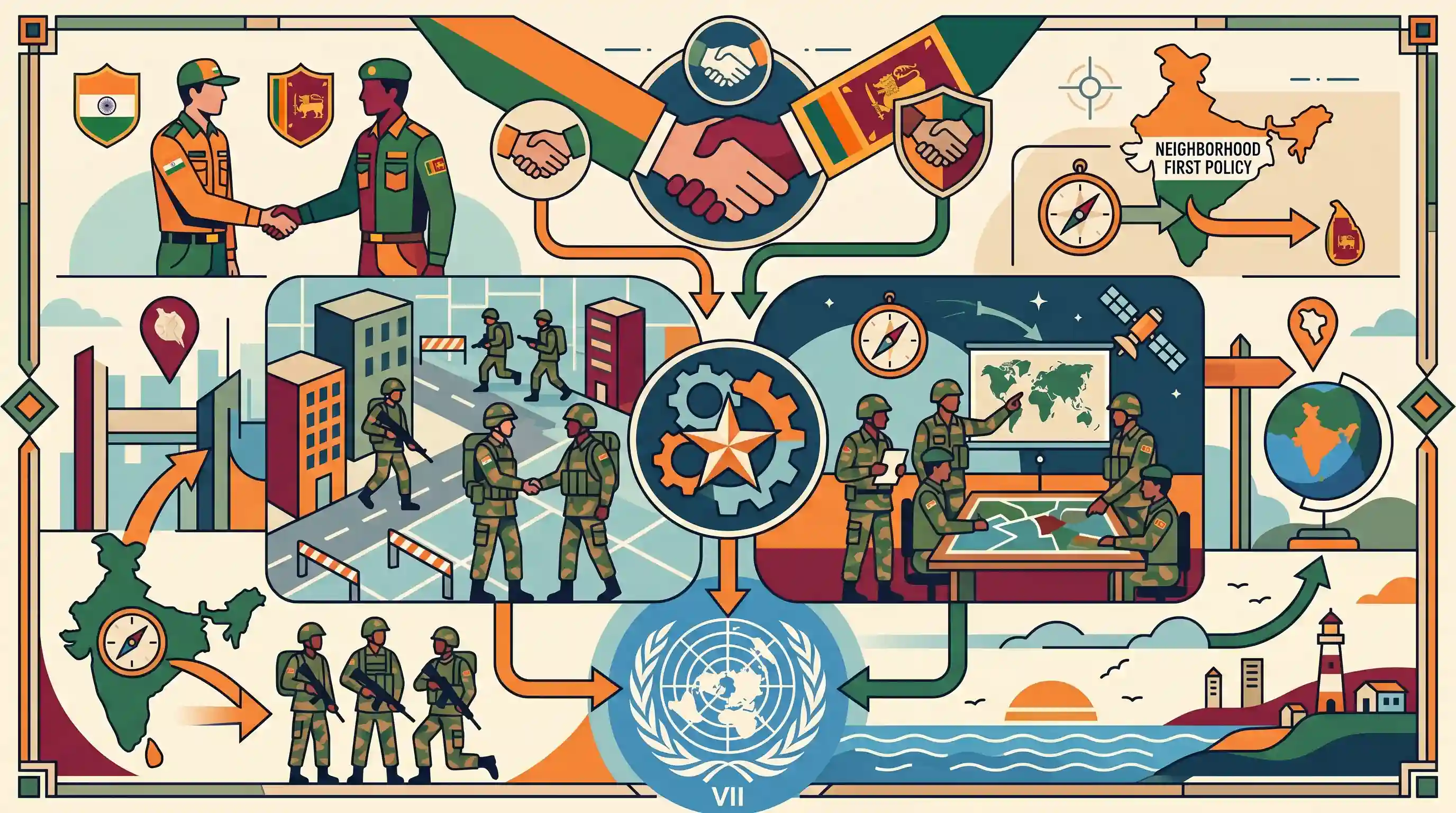
The 11th edition of the 'Mitra Shakti' joint military exercise between India and Sri Lanka has commenced at the Foreign Training Node in Belagavi, Karnataka. The primary objective is to enhance interoperability and operational synergy for joint operations in urban and semi-urban environments under Chapter VII of the United Nations Charter. This exercise is a key element of the strategic partnership and defence diplomacy between India and Sri Lanka, reinforcing bilateral ties and regional security cooperation.
Key Points
- The 11th edition of the joint military exercise 'Mitra Shakti' between India and Sri Lanka commenced at the Foreign Training Node in Belagavi.
- The exercise focuses on enhancing operational synergy and interoperability for joint military operations in urban and semi-urban environments.
- The joint operations are simulated under the mandate of Chapter VII of the United Nations Charter.
- Mitra Shakti serves as a crucial platform to strengthen bilateral defence cooperation and solidify the strategic partnership between the two neighboring countries.
Important Terms
Exercise Mitra Shakti

An annual bilateral military exercise between the Indian and Sri Lankan armies. It focuses on counter-terrorism and sub-conventional operations to enhance interoperability and regional security cooperation.
UPSC context
GS II/III; tests India’s strategic depth in the Indian Ocean Region and defense cooperation with its immediate neighbors.
Chapter VII of the United Nations Charter
The section of the UN Charter empowering the Security Council to maintain peace through enforcement measures, including sanctions and military force, against threats to international security.
UPSC context
GS II (International Institutions); critical for understanding the legal mandate behind international peacekeeping and counter-terrorism operations.
Neighborhood First Policy
A core Indian foreign policy pillar prioritizing stable, non-reciprocal, and prosperous relations with immediate neighbors through economic cooperation, connectivity, and development assistance.
UPSC context
GS II (International Relations); central to analyzing India's regional leadership and strategic engagement in South Asia.
Defence Diplomacy
The peaceful use of military capabilities—such as joint exercises, training, and personnel exchanges—to strengthen bilateral ties, build trust, and advance national foreign policy objectives.
UPSC context
GS II/III; highlights the role of armed forces in fostering strategic partnerships and regional stability.
Interoperability (Military)
The capacity of different military forces to operate together seamlessly by sharing common equipment, communication systems, and tactical doctrines during joint missions.
UPSC context
GS III (Security); a primary objective of joint exercises, testing India's military readiness for multinational peacekeeping.
Sub-conventional Operations
Military actions involving counter-insurgency, counter-terrorism, and unconventional warfare that occur below the threshold of traditional full-scale interstate war.
UPSC context
GS III (Security); examines India's tactical preparedness against hybrid threats and regional instability.
Prelims Trap
Operations under Chapter VII of the UN Charter are strictly limited to peaceful dispute resolution.
Chapter VII of the UN Charter authorizes the use of armed force (peace enforcement) to restore peace, unlike Chapter VI, which relies on the pacific settlement of disputes.
Static Concepts Connected
How does UN Charter Chapter VII differ from Chapter VI in peacekeeping?
- Chapter VI: Focuses on the pacific settlement of disputes through negotiation, mediation, and traditional observer missions requiring host consent.
- Chapter VII: Authorizes the UN Security Council to take enforcement actions, including military force and sanctions, to counter threats to peace or acts of aggression.
- Military Application: India conducts exercises like Mitra Shakti under Chapter VII mandates to simulate robust, forceful counter-terrorism and urban operations.
What are the key mechanisms of India-Sri Lanka defence cooperation?
- Joint Exercises: Mitra Shakti (Army), SLINEX (Navy), and the 'Dosti' trilateral coast guard exercise (with Maldives).
- Strategic Doctrines: Aligns with India's 'Neighbourhood First' policy and SAGAR vision to maintain influence and counter extra-regional presence in the IOR.
- Capacity Building: India regularly provides training, intelligence sharing, and maritime surveillance equipment to the Sri Lankan military.
Cross-Topic Patterns
Defence Exercises + Emerging Tech
Modern bilateral exercises like Mitra Shakti now explicitly integrate Counter-UAS (C-UAS) and drone operations, reflecting the shift from conventional infantry tactics to tech-driven counter-insurgency in urban warfare.
SAGAR meets Global Peacekeeping
By training regional neighbors under robust UN mandates, India reinforces its 'Net Security Provider' role in the IOR while simultaneously enhancing South Asia's interoperable footprint in global UN peacekeeping.

Questions on UN Peacekeeping will likely shift from generic force contributions to distinguishing specific mandates like Chapter VII.
Linked PYQs · 2
Linked PYQs · 2
- 2024PrelimsGS1
Which of the following statements about 'Exercise Mitra Shakti-2023' are correct? 1. This was a joint military exercise between India and Bangladesh. 2. It commenced in Aundh (Pune). 3. Joint response during counter-terrorism operations was a goal of this operation. 4. Indian Air Force was a part of this exercise. Select the answer using the code given below :
- 2022MainsGS2
India is an age-old friend of Sri Lanka.’ Discuss India's role in the recent crisis in Sri Lanka in the light of the preceding statement.
