India and Sri Lanka Sign Defense and Energy Cooperation Pacts
Source:The Hindu ↗
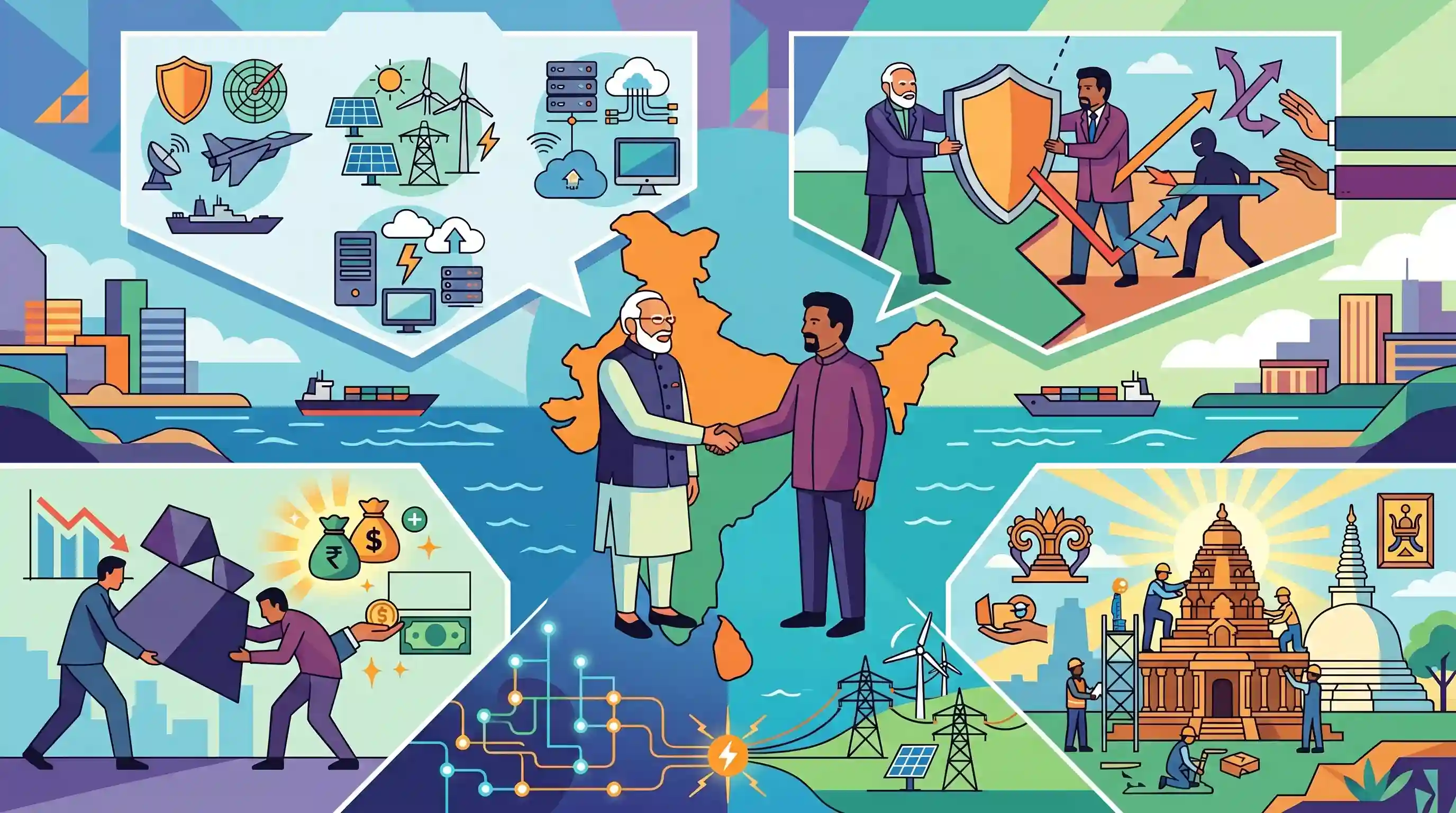
Why It Matters
The agreements highlight India's 'Neighbourhood First' policy and its proactive role in stabilizing Sri Lanka's economy post-crisis. The explicit security assurance from Sri Lanka is crucial for India's maritime security in the Indian Ocean Region amid growing external footprint. Furthermore, energy grid connectivity and cultural diplomacy underscore India's comprehensive approach to regional integration.
Summary
During Prime Minister Narendra Modi's visit, India and Sri Lanka elevated their bilateral ties by signing seven MoUs across key sectors including defence, energy, and digital infrastructure. A pivotal security commitment from Sri Lankan President Anura Kumara Dissanayake assured that Sri Lankan soil would not be used against Indian interests. Economically, India eased Sri Lanka's debt burden by reducing loan interest rates and converting over $100 million into grants. The partnership also emphasized regional energy security through proposed grid connectivity and cultural diplomacy via the renovation of shared heritage sites.
Key Points
- India and Sri Lanka signed seven Memorandums of Understanding (MoUs) spanning defence, energy, digitisation, and health sectors.
- Sri Lanka reaffirmed a crucial strategic commitment that its territory will not be used to undermine India's security interests.
- India provided economic relief to Sri Lanka by reducing interest rates on existing loans and converting over $100 million of debt into grants.
- The two nations agreed to connect their energy grids and develop Trincomalee as a regional energy hub in partnership with the UAE.
- Cultural ties were strengthened through Indian support for the renovation of key Hindu and Buddhist heritage sites in Sri Lanka, such as the Thirukoneswaram and Mahabodhi temples.
Important Terms
Neighbourhood First Policy

India's diplomatic framework prioritizing immediate neighbors to enhance regional stability, economic integration, and security. It emphasizes "non-reciprocity" and "consultative engagement" to build trust within South Asia.
UPSC context
GS II (International Relations); tests understanding of regional strategic priorities and neighborhood diplomacy.
Sri Lanka Mitra Vibhushana
Sri Lanka’s highest honor for foreign leaders, conferred on PM Modi in 2025. It symbolizes extraordinary friendship and shared cultural heritage, featuring symbols like the Dharma Chakra.
UPSC context
Prelims (International Awards) / GS II; tests knowledge of bilateral honors and symbolic diplomacy.
India-Sri Lanka Grid Interconnection
A proposed High-Voltage Direct Current (HVDC) transmission link connecting the power grids of Madurai (India) and Anuradhapura (Sri Lanka) to enable bidirectional electricity trade and regional energy security.
UPSC context
GS II/III (Infrastructure/Energy Security); tests regional energy integration and cross-border cooperation.
SAGAR Vision
Security and Growth for All in the Region—India’s strategic vision for the Indian Ocean, focusing on maritime security, disaster relief, and sustainable blue economy development.
UPSC context
GS II (IOR Geopolitics); tests India's maritime doctrine and "net security provider" role.
Colombo Security Conclave (CSC)
A regional security framework involving India, Sri Lanka, Maldives, and Mauritius. It focuses on maritime safety, counter-terrorism, cyber security, and combating transnational organized crime.
UPSC context
GS II (Security Groupings); tests maritime security collaboration and regional institutional frameworks.
Debt Restructuring
Modifying existing debt terms to provide relief; India assisted Sri Lanka by converting $100 million+ in loans into grants and reducing interest to ensure economic sustainability.
UPSC context
GS II/III (Economy/International Relations); tests India's role in regional economic stability and development assistance.
Prelims Trap
"The Trincomalee regional energy hub is a strictly bilateral infrastructure project."
The Trincomalee energy hub agreement is actually trilateral, involving the UAE. UPSC often tests awareness of third-party involvement in regional projects.
Static Concepts Connected
What is the historical significance of the Anuradhapura and Thirukoneswaram temples?
- Anuradhapura (Buddhism): Houses the Jaya Sri Maha Bodhi tree, grown from a sapling of the original Bodh Gaya tree brought by Emperor Ashoka's daughter, Sanghamitra.
- Thirukoneswaram (Hinduism): One of the five historical Pancha Ishwarams (Shiva temples) in Sri Lanka, situated on Swami Rock, reflecting deep-rooted Tamil-Hindu civilizational linkages.
Why is Trincomalee strategically vital in the Indian Ocean Region (IOR)?
- Deep Natural Harbour: It possesses one of the world's deepest and largest natural harbours, making it highly valuable for naval docking and large-scale maritime logistics.
- SLOC Proximity: Located on Sri Lanka's eastern coast, it provides a strategic vantage point overlooking critical Sea Lanes of Communication (SLOCs) in the Indian Ocean.
Cross-Topic Patterns
Trilateral energy diplomacy in the IOR
The inclusion of the UAE in Trincomalee's development highlights India's broader strategy of leveraging West Asian capital to counter Chinese infrastructure dominance in the immediate neighborhood.
Ashokan diplomacy as modern soft power
India's funding of the Anuradhapura Mahabodhi complex explicitly leverages Mauryan-era Buddhist linkages (Sanghamitra's historical mission) to cement modern strategic trust and counter debt-trap narratives.

Expect a 2026 Prelims pair-matching question linking ancient Sri Lankan sites (Anuradhapura, Pancha Ishwarams) with their Indian origins.
Linked PYQs · 2
Linked PYQs · 2
- 2022MainsGS2
India is an age-old friend of Sri Lanka.’ Discuss India's role in the recent crisis in Sri Lanka in the light of the preceding statement.
- 2020PrelimsGS1
Consider the following statements: 1. The value of Indo-Sri Lanka trade has consistently increased in the last decade. 2. "Textile and textile articles" constitute an important item of trade between India and Bangladesh. 3. In the last five years, Nepal has been the largest trading partner of India in South Asia. Which of the statements given above is/are correct?
