Buddhist Diplomacy and Civilisational Ties Between India and Sri Lanka
Source:The Hindu ↗
Why It Matters
The article is crucial for both GS1 (Ancient History/Culture) due to the mention of the Devnimori archaeological site, Sharira Stupa, and Brahmi script, and GS2 (International Relations) as it illustrates India's use of soft power and cultural diplomacy in its 'Neighbourhood First' policy.
Summary
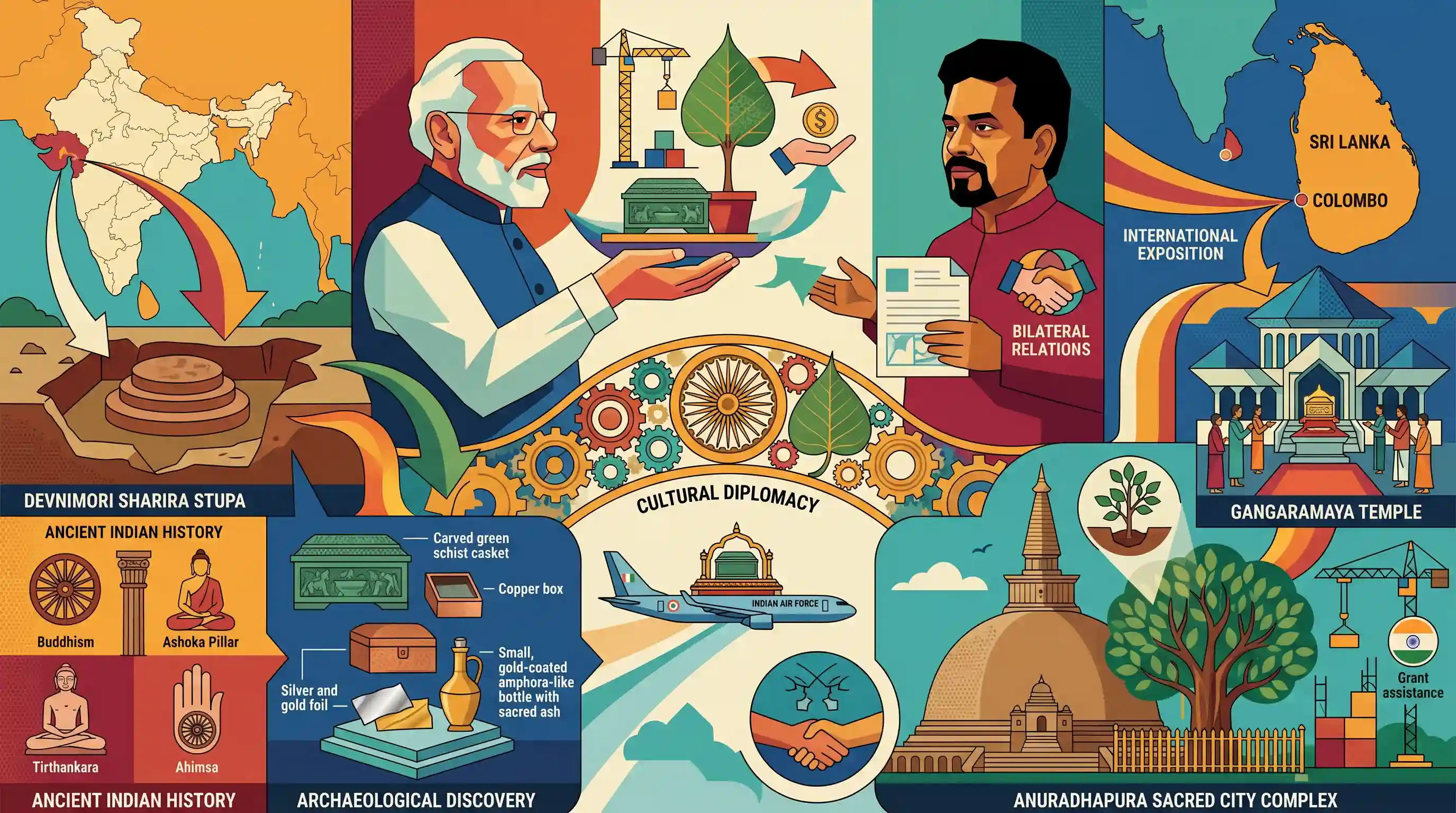
The first-ever international exposition of the holy Devnimori relics of Lord Buddha, excavated from a Sharira Stupa in Gujarat, is taking place in Colombo, Sri Lanka. The event underscores the deep-rooted civilisational and spiritual ties between India and Sri Lanka, as highlighted by Prime Minister Narendra Modi and President Anura Kumara Dissanayake. This initiative, along with India's grant assistance for the Anuradhapura Sacred City Complex, reflects a strong emphasis on Buddhist cultural diplomacy to bolster bilateral relations.
Key Points
- The holy Devnimori relics of Lord Buddha from Gujarat are being exhibited internationally for the first time at the Gangaramaya Temple in Colombo, Sri Lanka.
- The relics were excavated from a Sharira Stupa at the Devnimori archaeological site and feature an inscription in Brahmi script and Sanskrit reading 'DashabalaShariraNilaya'.
- Prime Minister Narendra Modi and Sri Lankan President Anura Kumara Dissanayake highlighted the event as a reflection of deep civilisational and spiritual ties.
- India is leveraging Buddhist diplomacy to strengthen bilateral relations, including providing grant assistance for the Sacred City Complex project in Anuradhapura.
Important Terms
Devnimori Relics

Sacred bodily remains of Lord Buddha found in Gujarat's Aravalli district, enshrined in an inscribed green schist casket discovered during the 1960s excavations.
UPSC context
GS Paper I (Art & Culture) and GS Paper II (International Relations). Tests knowledge of Buddhist archaeology and spiritual diplomacy.
Sharira Stupa
A type of stupa built specifically to enshrine the physical remains (sharira) of the Buddha or his disciples; the Devnimori site contains a significant 4th-century CE example.
UPSC context
GS Paper I (Ancient Indian History/Architecture). Tests classification of stupas and the spread of Buddhism in Western India.
Gangaramaya Temple
One of Colombo’s most iconic Buddhist temples and a center for learning; it served as the venue for the 2026 international exposition of Indian Buddhist relics.
UPSC context
GS Paper II (India-Sri Lanka Relations). Tests awareness of regional religious institutions facilitating bilateral people-to-people ties.
Cultural Diplomacy
The use of cultural exchanges—such as religious relics and heritage restoration—to enhance a nation's soft power and strengthen foreign relations, particularly with neighboring Buddhist nations.
UPSC context
GS Paper II (International Relations). Tests understanding of soft power strategies and India’s 'Neighborhood First' policy.
Anuradhapura Sacred City Complex
A UNESCO World Heritage site and ancient Sri Lankan capital; India provides significant grant assistance for its infrastructure and heritage preservation to bolster civilizational links.
UPSC context
GS Paper II (Bilateral Relations/Developmental Assistance). Tests knowledge of Indian aid projects and regional cultural cooperation.
Maharaja Sayajirao University of Baroda
A premier educational institution in Vadodara, Gujarat; its Department of Archaeology excavated the Devnimori site and remains the permanent custodian of the Buddha relics.
UPSC context
GS Paper I (Modern Institutions/Archaeology). Highlights the role of Indian academic research in preserving and sharing national heritage.
Prelims Trap
"Devnimori is a Mauryan-era Buddhist stupa located in Uttar Pradesh, associated with Emperor Ashoka."
Devnimori is located in Gujarat along the Meshwo River and dates to the 3rd-4th century CE (Western Kshatrapa era), long after the Mauryan period.
Static Concepts Connected
What are the three conceptual classifications of Buddhist stupas?
- Sharirika: Built to house the actual physical, bodily relics of the Buddha or his chief disciples.
- Paribhogika: Constructed over objects personally used by the Buddha, such as his alms bowl or robes.
- Uddeshika: Shrines created as commemorative structures to mark important events or places in the Buddha's life.
How did Emperor Ashoka initiate Buddhist ties with ancient Sri Lanka?
- Royal Emissaries: Ashoka sent his son Mahinda and daughter Sanghamitra to Ceylon as 'Dhammadutas' to preach Buddhism.
- Sacred Bodhi Tree: Sanghamitra transported a sapling of the original Mahabodhi tree from Bodh Gaya to Anuradhapura.
- King Tissa's Patronage: Contemporary Sri Lankan King Devanampiya Tissa embraced the faith, establishing Theravada Buddhism across the island.
Cross-Topic Patterns
Soft Power vs. Debt Trap Diplomacy
India utilizes cultural grants for shared civilisational sites like Anuradhapura as a non-coercive 'soft power' alternative to counter China's heavy infrastructure-based debt-trap diplomacy in the Indian Ocean Region.
Western Kshatrapa Patronage in Gujarat
While Mauryas dominate Buddhist history, the Devnimori site highlights how Western Kshatrapas significantly patronized vital Buddhist stupas and Sanskrit inscriptions in the Gujarat region during the 3rd-4th centuries CE.

Expect a prelims matching question pairing lesser-known Buddhist sites (Devnimori, Kanaganahalli) with their modern states or rivers.
Linked PYQs · 3
Linked PYQs · 3
- 2023PrelimsGS1
With reference to ancient India, consider the following statements: 1. The concept of Stupa is Buddhist in origin. 2. Stupa was generally a repository of relics. 3. Stupa was a votive and commemorative structure in Buddhist tradition. How many of the statements given above are correct?
- 2022MainsGS2
India is an age-old friend of Sri Lanka.’ Discuss India's role in the recent crisis in Sri Lanka in the light of the preceding statement.
- 2015MainsGS2
Terrorist activities and mutual distrust have clouded India-Pakistan relations. To what extent the use of soft power like sports and cultural exchanges could help generate goodwill between the two countries? Discuss with suitable examples.
