Spot electricity market volatility and renewable grid integration
Source:Indian Express ↗
Why It Matters
Understanding the dynamics of power exchanges and grid integration challenges is crucial for GS-3 Infrastructure and Environment sections. It highlights the real-world operational challenges of the renewable energy transition, specifically the mismatch between solar generation profiles and demand curves, and emphasizes the critical need for large-scale energy storage solutions.
Summary
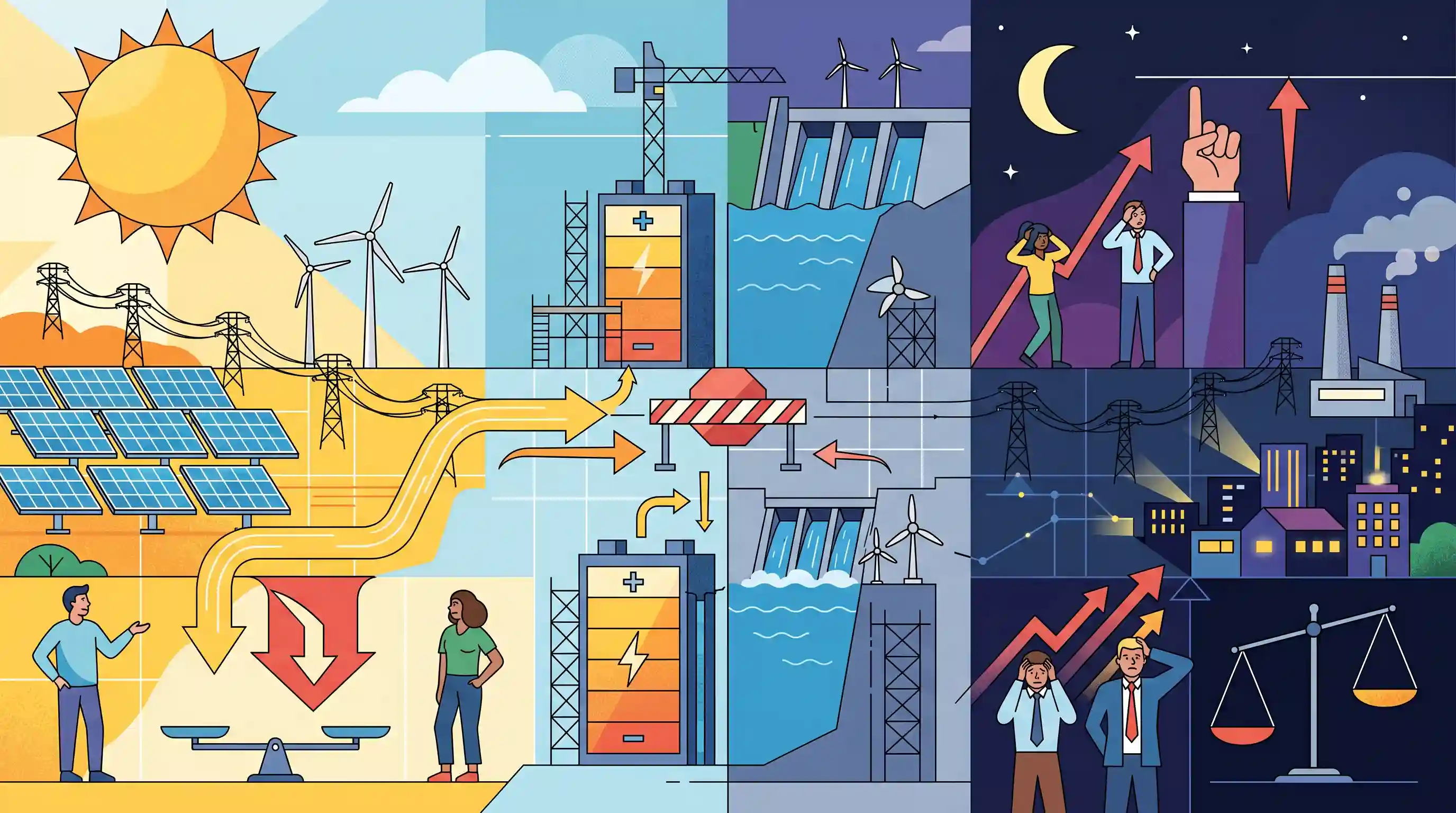
India's spot electricity markets are experiencing extreme price swings, with prices plunging to near-zero during the daytime and hitting the Rs 10/kWh regulatory ceiling at night. This volatility is driven by the rapid expansion of solar power, which floods the grid during peak daylight hours. Because solar power has near-zero variable costs, generators offload excess power cheaply to avoid deviation penalties. Conversely, when the sun sets, power demand remains high, leading to a supply crunch and maximum prices. This situation underscores a critical bottleneck in India's green energy transition: the sluggish expansion of energy storage infrastructure, such as battery storage and pumped hydro, which is necessary to absorb surplus daytime solar energy and dispatch it during nighttime peak hours.
Key Points
- Spot electricity prices on the Indian Energy Exchange (IEX) have been highly volatile this summer, crashing to near-zero during the day and hitting the regulatory ceiling of Rs 10/kWh at night.
- The daytime price crash is driven by an abundance of solar power generation, given India's massive expansion to over 154 GW of installed solar capacity.
- Solar generators, which have near-zero variable costs, prefer selling excess power at marginal prices rather than facing regulatory penalties for deviation from scheduled generation.
- The nighttime price surge occurs because solar generation drops to zero while overall power demand remains high, creating a severe supply crunch met largely by thermal and hydro power.
- This structural volatility highlights a critical gap in India's energy transition: the lack of adequate energy storage capacity (like utility-scale batteries or pumped-storage hydropower) to store surplus daytime solar power for dispatch during peak evening demand.
Important Terms
Day-Ahead Market (DAM)

A physical electricity trading market where participants buy or sell power for delivery in 15-minute blocks for the following day through an anonymous bidding process.
UPSC context
GS III Infrastructure/Energy: Tests understanding of short-term power pricing, demand-supply management, and market-based discovery of electricity rates.
Real-Time Market (RTM)
An organized platform allowing buyers and sellers to trade electricity closer to operation, with delivery occurring one hour after market closure.
UPSC context
GS III Energy/Environment: Critical for integrating intermittent renewable energy and reducing DISCOMs' reliance on deviation penalties.
Indian Energy Exchange (IEX)
India’s premier automated trading platform for the physical delivery of electricity, renewable energy certificates (RECs), and energy-saving certificates (ESCerts).
UPSC context
GS III Economy/Infrastructure: Tests knowledge of the institutional infrastructure facilitating price discovery and competitive trading in the power sector.
Central Electricity Regulatory Commission (CERC)
A statutory body established under the Electricity Act, 2003, responsible for regulating interstate electricity tariffs and ensuring grid security and competition.
UPSC context
GS II/III Governance & Infrastructure: Relevant for understanding regulatory oversight, price caps, and the legal framework of India's power sector.
Grid Controller of India (Grid-India)
The national nodal agency (formerly POSOCO) responsible for the seamless and secure integrated operation of the Indian Power System through load dispatch centers.
UPSC context
GS III Infrastructure: Essential for discussing grid resilience, load management, and the technical challenges of the green energy transition.
Power Purchase Agreements (PPAs)
Long-term legal contracts (typically 25 years) between electricity generators and buyers (DISCOMs) that stipulate fixed prices for power supply.
UPSC context
GS III Economy/Energy: Highlights the financial dynamics between fixed-cost long-term generation and the volatility of modern spot markets.
Term-Ahead Market (TAM)
A market segment on power exchanges that facilitates the purchase or sale of electricity for delivery up to 11 days in advance.
UPSC context
GS III Infrastructure: Tests knowledge of the various trading windows available for utilities to manage short-to-medium-term power contingencies.
Prelims Trap
"The 'Duck Curve' phenomenon in power grids refers to the gradual phasing out of thermal power plants."
The Duck Curve describes the timing imbalance between peak net demand and peak solar generation, creating a midday hollow. It is not about phasing out coal or thermal plants.
Static Concepts Connected
What is the 'Duck Curve' in grid management and why does it occur?
- Definition: A graph of net electricity demand showing a deep midday drop followed by a steep evening ramp-up, resembling a duck's profile.
- Root Cause: A massive influx of utility-scale solar generation floods the grid during peak daylight hours, drastically reducing net demand from other sources.
- Grid Impact: It severely strains grid flexibility, requiring the rapid start-up of thermal or hydro plants to meet surging demand as the sun sets.
How does Pumped-Storage Hydropower (PSH) function as a mechanical grid battery?
- Charging Phase: It utilizes cheap, surplus midday solar electricity to pump water from a lower reservoir to an upper reservoir.
- Discharging Phase: During the nighttime supply crunch, the stored water is released downhill through turbines to generate dispatchable electricity.
- Strategic Advantage: It provides mature, large-scale, and long-duration energy storage at a lower lifecycle cost compared to chemical battery systems.
Cross-Topic Patterns
Solar Volatility & ACC Battery PLI
The daytime solar glut directly justifies India’s PLI scheme for Advanced Chemistry Cell (ACC) battery storage, required to economically absorb surplus grid power and deploy it at night.
DSM Penalties & National Grid Frequency
CERC enforces the Deviation Settlement Mechanism (DSM) to strictly maintain grid frequency at 50 Hz, forcing generators to offload excess power rather than risk destabilizing the national grid.

The 'Duck Curve', DSM penalties, and Pumped-Storage Hydro will likely form a multi-statement grid stability question in Prelims 2026.
Linked PYQs · 3
Linked PYQs · 3
- 2024PrelimsGS1
Consider the following: 1. Battery storage 2. Biomass generators 3. Fuel cells 4. Rooftop solar photovoltaic units How many of the above are considered "Distributed Energy Resources"?
- 2024PrelimsGS1
Recently, the term "pumped-storage hydropower" is actually and appropriately discussed in the context of which one of the following?
- 2020MainsGS3
Describe the benefits of deriving electric energy from sunlight in contrast to the conventional energy generation. What are the initiatives offered by our Government for this purpose?
