Agrivoltaics Integration: Balancing Renewable Energy and Food Security
Source:Indian Express ↗
આ શા માટે મહત્વનું છે
It explores the intersection of two critical priorities for India: expanding renewable energy capacity for net-zero goals while safeguarding agricultural land and enhancing farmers' incomes.
સારાંશ
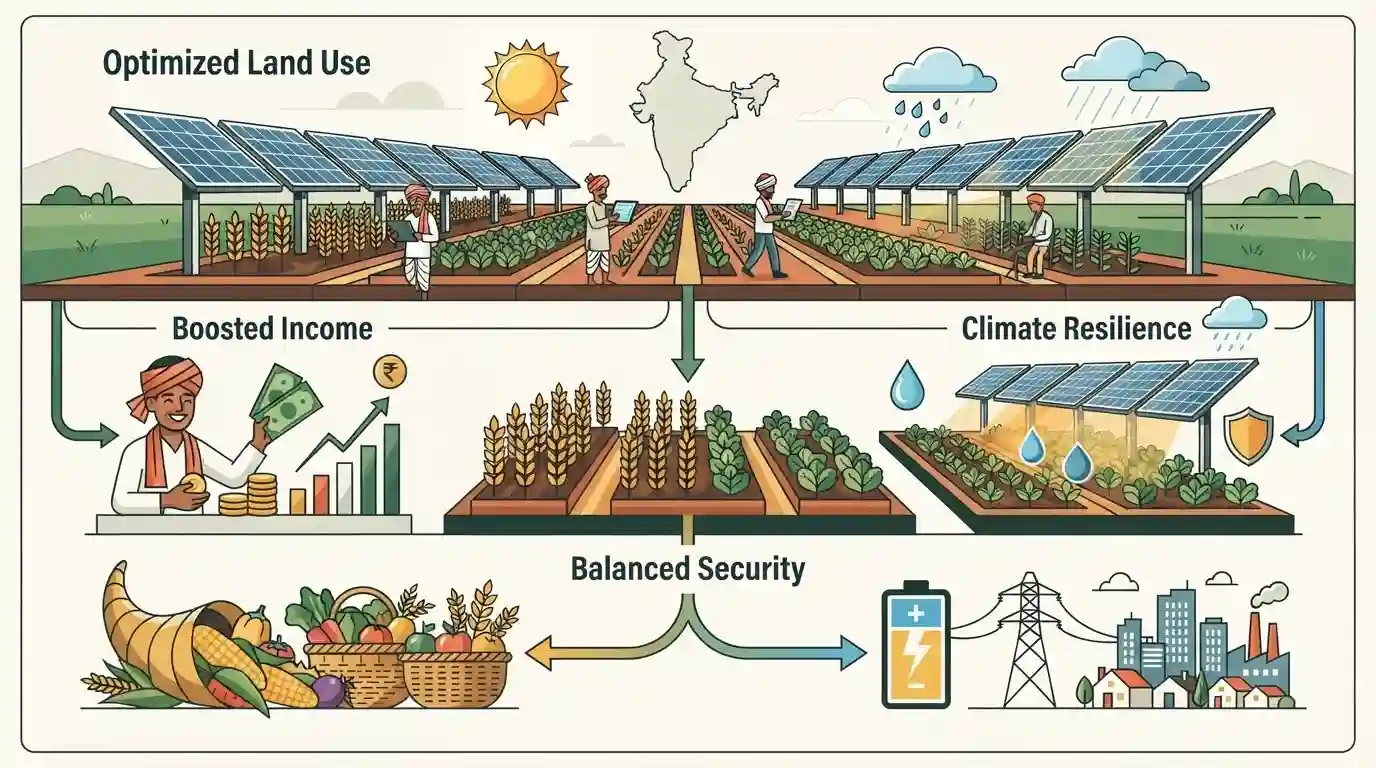
The article discusses the integration of solar farming and agriculture, known as agrivoltaics, as a vital strategy for India's journey toward Viksit Bharat. It highlights how combining solar power generation with crop cultivation optimizes land use, boosts farmers' income, mitigates climate challenges, and balances food and energy security.
મુખ્ય મુદ્દા
- Agrivoltaics combines agricultural crop production and solar photovoltaic power generation on the same piece of land.
- It addresses land scarcity competition between food security and clean energy goals.
- Helps augment farmers' income through clean energy generation while protecting certain crops from excess heat and reducing water evaporation.
- Crucial for achieving India's Viksit Bharat and net-zero carbon emission targets sustainably.
મહત્વપૂર્ણ શબ્દો
Agrivoltaics

The simultaneous use of agricultural land for crop cultivation and solar photovoltaic power generation, optimizing land use, providing dual income streams for farmers, and promoting sustainable clean energy.
UPSC context
Important for UPSC CSE GS Paper III (Agriculture, Infrastructure, Energy Security). Tests knowledge of sustainable dual-use land technologies and renewable integration.
Viksit Bharat
India's strategic national vision to transform into a fully developed nation by 2047, encompassing economic growth, sustainable infrastructure, food security, and green energy transitions.
UPSC context
Relevant for UPSC CSE GS Paper III (Economic Development and Planning). Evaluates understanding of India's long-term developmental goals and policy frameworks.
PM-KUSUM Scheme
A flagship central sector scheme by the Ministry of New and Renewable Energy (MNRE) aimed at providing energy security to farmers through decentralized solar power plants and solarized pumps.
UPSC context
Crucial for UPSC CSE GS Paper III (Government Policies, Agriculture, and Renewable Energy). Frequently tested for its components and impact on rural livelihoods.
સંલગ્ન સ્થિર ખ્યાલો
What are the key objectives and components of the PM-KUSUM scheme in India?
- Component A: Component A installs decentralized grid-connected solar power plants up to 2 MW on barren or agricultural lands.
- Component B: Component B provides standalone solar agriculture pumps for irrigation in off-grid rural areas.
- Component C: Component C solarizes existing grid-connected agriculture pumps to reduce discom subsidy burdens.
આંતર-વિષય પેટર્ન
Agrivoltaics & PM-KUSUM Convergence
Agrivoltaics links sustainable energy goals under PM-KUSUM with doubling farmers' income targets, merging the Ministry of New and Renewable Energy with Ministry of Agriculture mandates.

Agrivoltaics land-use optimization will feature in mains questions on balancing India's net-zero targets with agricultural food security.
સંલગ્ન PYQ · 2
સંલગ્ન PYQ · 2
- 2022MainsGS3
What is Integrated Farming System ? How is it helpful to small and marginal farmers in India?
- 2020MainsGS3
Describe the benefits of deriving electric energy from sunlight in contrast to the conventional energy generation. What are the initiatives offered by our Government for this purpose?
