Global Energy Sanctions and India Energy Security Strategy
Source:The Hindu ↗
ఇది ఎందుకు ముఖ్యం
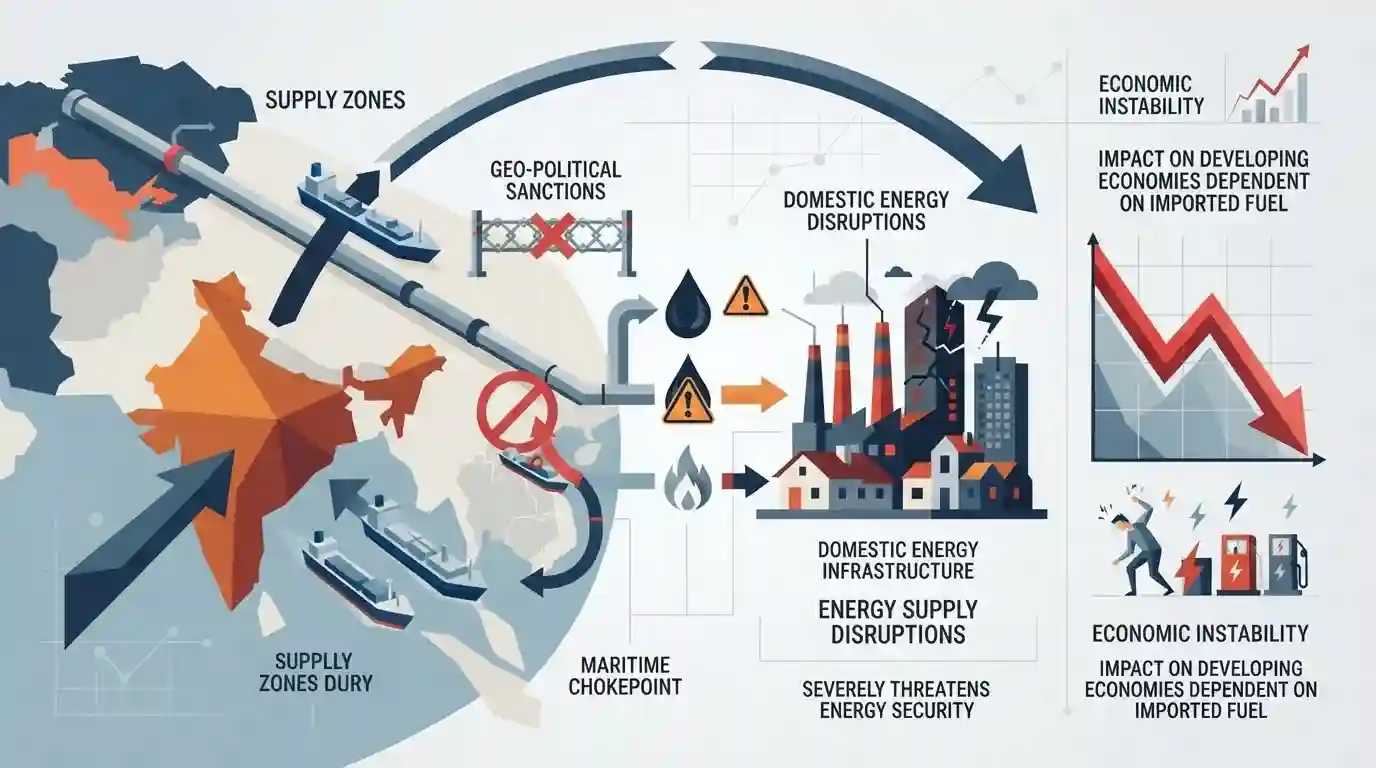
The article highlights India's official stance against geopolitical disruptions and unilateral sanctions in global energy markets, directly feeding into India's core concerns regarding energy security, foreign economic policy, and maritime trade resilience.
సారాంశం
India criticized international energy disruptions driven by geopolitical sanctions and maritime chokepoints, warning that unilateral restrictions severely threaten energy security and economic stability in developing economies dependent on imported fuel.
ముఖ్య అంశాలు
- India strongly criticized global energy disruptions caused by unilateral sanctions, geopolitical conflicts, and maritime chokepoints.
- Highlighted how supply chain weaponization and economic restrictions adversely impact energy-importing developing nations like India.
- Emphasized the need for predictable, stable, and diversified energy flows to secure domestic economic growth and energy security.
- Stressed the vulnerability of critical maritime chokepoints and trade lanes to geopolitical tensions.
ముఖ్యమైన పదాలు
OPEC

A permanent intergovernmental organization of oil-exporting developing nations that coordinates petroleum policies and production quotas to manage global oil markets and secure steady revenues for member states.
UPSC context
UPSC GS Paper II (International Relations) & GS Paper III (Energy Security); tests understanding of global economic groupings and energy diplomacy.
Ministry of Petroleum and Natural Gas
The central government department in India responsible for formulating policies and regulating the exploration, production, refining, distribution, and pricing of petroleum, natural gas, and petrochemicals.
UPSC context
UPSC GS Paper III (Economy and Energy Security); tests knowledge of key government ministries managing domestic fuel supplies and strategic reserves.
ప్రిలిమ్స్ ఉచ్చు
India imports over 85% of its crude oil...
Aspirants often confuse India's import dependence for crude oil (over 85%) with domestic refining self-sufficiency; India is a net exporter of refined petroleum products despite importing most of its crude.
అనుసంధానమైన స్థిర భావనలు
What are India's Strategic Petroleum Reserves (SPR) and how are they structured?
- Implementing Agency: Managed underground storage created as an emergency cushion against external crude oil supply disruptions and extreme price volatility.
- Operational Capacities: Phase-I includes underground rock caverns at Visakhapatnam, Mangaluru, and Padur with a total capacity of 5.33 million metric tonnes.
- Expansion Phase: Phase-II involves constructing additional caverns at Chandikhol (Odisha) and Padur (Karnataka) to expand emergency storage further.
అంతర-అంశ నమూనాలు
Energy Security + Maritime Law (UNCLOS) + SLOCs
India's critique of maritime chokepoints and unilateral sanctions connects energy security directly with international maritime law (UNCLOS) and the security of sea lines of communication (SLOCs) in the Indo-Pacific.
Fossil Fuel Diversification + Renewable Energy Transition
The push to diversify crude import baskets while accelerating domestic renewables highlights the dual-track strategy required to balance immediate macroeconomic stability with long-term net-zero goals.

Expect a multi-statement Prelims question testing India's import dependency ratio, strategic petroleum reserve locations, and choke-points.
అనుసంధాన PYQలు · 3
అనుసంధాన PYQలు · 3
- 2025MainsGS2
"Energy security constitutes the dominant kingpin of India's foreign policy, and is linked with India's overarching influence in Middle Eastern countries.” How would you integrate energy security with India's foreign policy trajectories in the coming years?
- 2025MainsGS3
Why is maritime security vital to protect India's sea trade? Discuss maritime and coastal security challenges and the way forward.
- 2012MainsGS2
How have the US sanctions against Iran affected India's bilateral relations with Iran?
