Special Intensive Revision of Electoral Rolls by Election Commission
Source:The Hindu ↗
Why It Matters
Maintaining accurate electoral rolls is crucial for a functioning democracy. Utilizing the Special Intensive Revision to address illegal migration highlights the overlap between the Election Commission's constitutional duties under Article 324 and India's broader internal security framework regarding border management and demographic shifts.
Summary
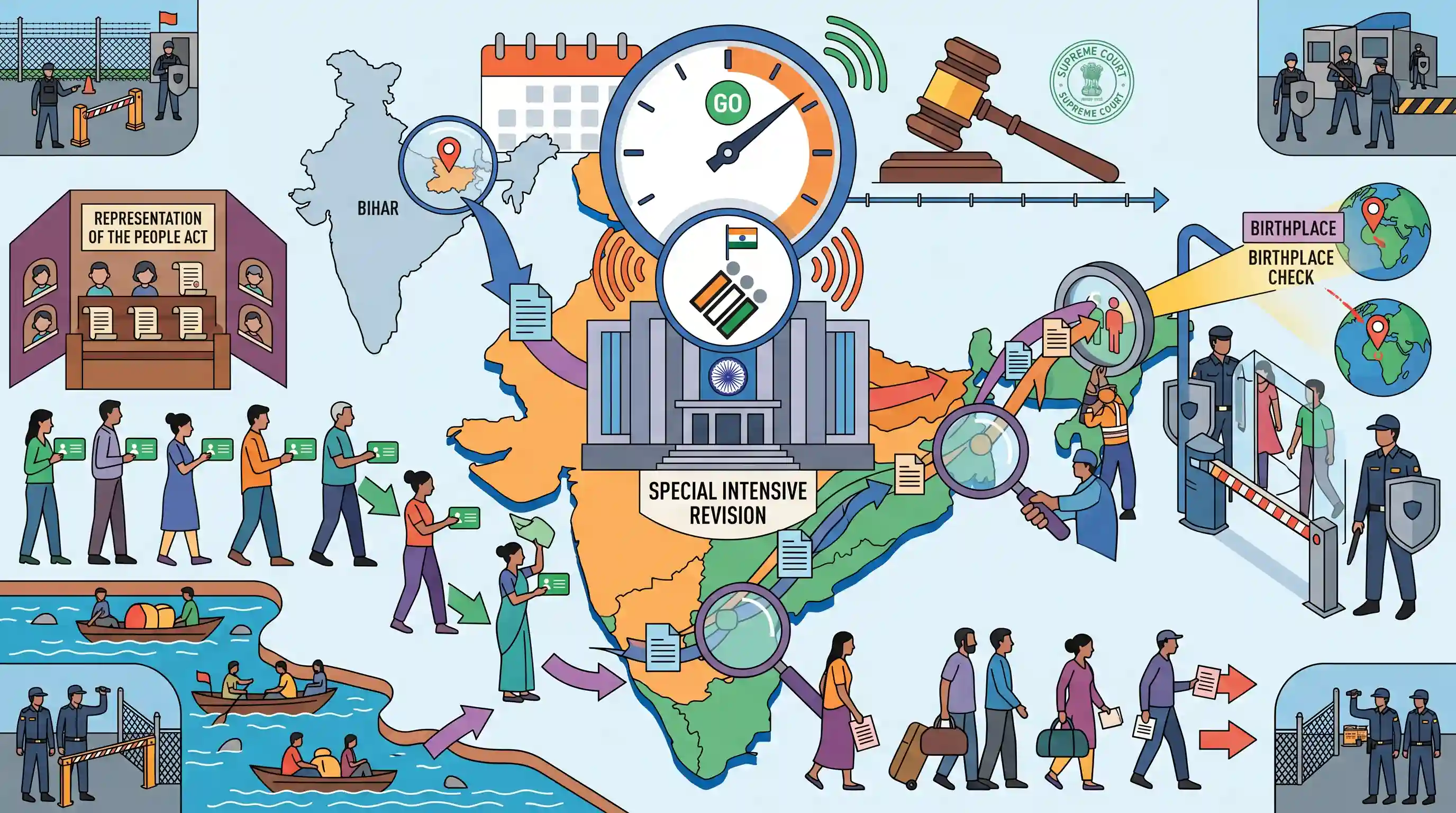
The Election Commission of India (ECI) has directed state election officers to prepare for a nationwide Special Intensive Revision (SIR) of electoral rolls by September 30. Following a pilot in Bihar, the primary objective of this intensive revision is to identify and remove illegal foreign migrants from voter lists by verifying their places of birth. This development is significant in light of ongoing state-level crackdowns on illegal immigrants from countries like Bangladesh and Myanmar, intersecting constitutional electoral mandates with internal security concerns. The Supreme Court has also upheld the ECI's sole authority in deciding the timing of these revisions.
Key Points
- The Election Commission of India (ECI) has set a September 30 deadline for state poll officers to prepare for the nationwide rollout of the Special Intensive Revision (SIR) of electoral rolls.
- The primary aim of the SIR is to weed out illegal foreign migrants from the voter lists by rigorously verifying their places of birth.
- This nationwide expansion follows a similar electoral roll revision previously conducted in Bihar.
- The Supreme Court has reiterated that the ECI holds exclusive authority to determine when to conduct such intensive electoral revisions.
- The measure addresses internal security and demographic concerns amid recent crackdowns on illegal immigrants from Bangladesh and Myanmar.
Important Terms
Special Intensive Revision (SIR)

A comprehensive door-to-door verification drive by the Election Commission to update voter lists, specifically aimed at identifying new eligible voters and removing entries like deceased persons and illegal migrants.
UPSC context
GS Paper II (Elections); tests understanding of electoral integrity, citizenship verification, and administrative challenges in voter roll management.
Representation of the People Act, 1950
The primary legislation governing the allocation of seats, delimitation of constituencies, and the preparation of electoral rolls, providing the statutory foundation for voter registration and eligibility criteria.
UPSC context
GS Paper II (Governance); essential for distinguishing between pre-election preparations (1950 Act) and the actual conduct of elections (1951 Act).
Article 324
A constitutional provision granting the Election Commission of India the "superintendence, direction, and control" over all aspects of the electoral process, including the preparation of voter lists.
UPSC context
GS Paper II (Constitutional Bodies); tests knowledge of the ECI's inherent powers and its institutional independence from the executive.
Election Commission of India (ECI)
The autonomous constitutional authority responsible for administering national and state election processes in India, ensuring they are free, fair, and inclusive.
UPSC context
GS Paper II (Constitutional Bodies); a core topic regarding the structure, functions, and challenges of India’s electoral machinery.
Supreme Court of India
The highest judicial authority that interprets the Constitution and ensures that the ECI's powers (e.g., under Article 324) are exercised within legal bounds and natural justice principles.
UPSC context
GS Paper II (Judiciary/Elections); its rulings clarify the limits and duties of electoral authorities during intensive roll revisions.
Prelims Trap
The Ministry of Home Affairs initiates the Special Intensive Revision (SIR) to identify illegal migrants in electoral rolls.
SIR is conducted exclusively by the Election Commission under Section 21(3) of RPA 1950. The Supreme Court explicitly upholds ECI's sole authority to time these revisions without executive interference.
Static Concepts Connected
How do the Representation of the People Acts of 1950 and 1951 differ?
- RPA 1950: Focuses on structural aspects like seat allocation, delimitation of constituencies, and the preparation or revision of electoral rolls.
- RPA 1951: Governs the actual conduct of elections, qualifications, disqualifications of candidates, corrupt practices, and resolution of electoral disputes.
What are the constitutional bases for the ECI's control over electoral rolls?
- Article 324: Vests exclusive power of superintendence, direction, and control over the preparation of electoral rolls in the Election Commission of India.
- Article 326: Mandates universal adult suffrage, strictly reserving the right to be registered as a voter to Indian citizens who meet the qualifying age.
Cross-Topic Patterns
Electoral Rolls vs. NRC mandate
SIR purifies voter lists under the RPA 1950, distinct from the National Register of Citizens (NRC), which is an executive exercise under the Citizenship Act 1955 to determine legal residency.
Border Demography & Internal Security
Weeding out migrants connects electoral integrity with GS3 internal security, reflecting recent state crackdowns on Myanmar/Bangladesh migrants and the suspension of the India-Myanmar Free Movement Regime.

Expect a 2026 Prelims multi-statement question mixing Article 324, the RPA 1950 mandate for electoral rolls, and ECI's absolute autonomy.
Linked PYQs · 4
Linked PYQs · 4
- 2022MainsGS2
Discuss the role of the Election Commission of India in the light of the evolution of the Model Code of Conduct.
- 2020MainsGS3
Analyze internal security threats and transborder crimes along Myanmar, Bangladesh and Pakistan borders including Line of Control (LoC). Also discuss the role played by various security forces in this regard.
- 2017PrelimsGS1
For election to the Lok Sabha, a nomination paper can be filed by
- 2017PrelimsGS1
Right to vote and to be elected in India is a
