India and Singapore Expand Strategic and Maritime Cooperation
Source:The Hindu ↗
Why It Matters
The article illustrates the practical evolution of India's 'Act East' policy. It highlights India's strategic pivot towards securing critical maritime chokepoints like the Malacca Strait, while simultaneously securing supply chains in strategic technologies (semiconductors) and forging green energy partnerships, which are central themes in both GS2 (IR) and GS3 (Economy/Security).
Summary
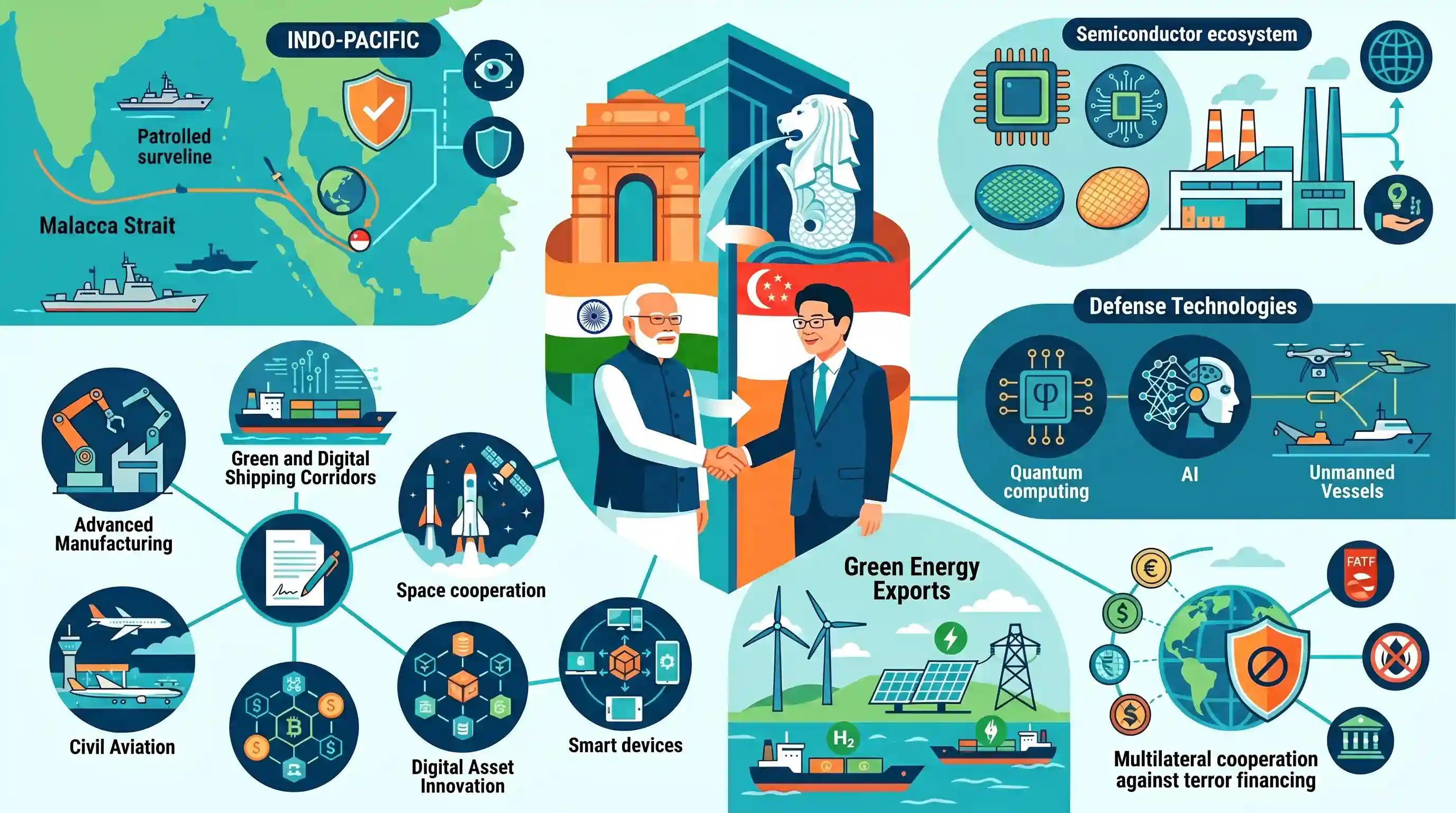
The article outlines the recent strengthening of bilateral ties between India and Singapore following discussions between Prime Ministers Narendra Modi and Lawrence Wong in New Delhi. Both nations have advanced their relations beyond traditional diplomacy by expanding cooperation into maritime security in the Indo-Pacific, with Singapore acknowledging India's strategic intent to patrol the Malacca Strait. The leaders witnessed the signing of five MoUs covering advanced manufacturing, green and digital shipping corridors, space, civil aviation, and digital asset innovation. They also emphasized joint initiatives in semiconductor manufacturing, civil aviation MRO, defense technologies (quantum computing, AI, unmanned vessels), green energy exports, and multilateral cooperation against terror financing via the FATF.
Key Points
- India and Singapore have broadened their Comprehensive Strategic Partnership into advanced manufacturing, green shipping, skilling, civil nuclear energy, and water management.
- Five MoUs were signed focusing on green and digital shipping corridors, space cooperation, civil aviation R&D, digital asset innovation, and an advanced manufacturing skilling centre in Chennai.
- Maritime security cooperation was prioritized, with Singapore acknowledging India's strategic interest in patrolling the Malacca Strait as a contiguous state to the Andaman Sea.
- Defence collaboration is expanding into submarine rescue and advanced technologies including quantum computing, AI, automation, and unmanned vessels.
- Economic engagements emphasized building a semiconductor ecosystem (design and fabrication) in India, advancing civil aviation Maintenance, Repair, and Overhaul (MRO), and facilitating green energy exports.
- Both nations committed to combating cross-border terrorism and terror financing through multilateral frameworks like the Financial Action Task Force (FATF).
Important Terms
Indo-Pacific Oceans Initiative (IPOI)

A non-treaty, voluntary initiative launched by India in 2019 to promote maritime security, ecology, and connectivity through seven thematic pillars, ensuring a free, open, and inclusive Indo-Pacific.
UPSC context
GS Paper II (International Relations); tests India's maritime diplomacy and its 'SAGAR' vision for regional stability and cooperative security.
Malacca Straits Patrol (MSP)
A coordinated security framework by Indonesia, Malaysia, Singapore, and Thailand to secure the Malacca Strait against piracy and terrorism; India recently expressed strategic intent to participate in patrols.
UPSC context
GS Paper II/III (Maritime Security); relevant for strategic chokepoints and India's role as a net security provider in the Indian Ocean.
Financial Action Task Force (FATF)
An inter-governmental body established by the G7 in 1989 to set global standards for combating money laundering and terrorist financing, monitoring country compliance through 'grey' and 'black' lists.
UPSC context
GS Paper II/III (International Groupings/Internal Security); tests knowledge of global financial governance and anti-terror mechanisms.
Bharat Mumbai Container Terminal (BMCT)
Located at the Jawaharlal Nehru Port Authority (JNPA) and operated by Singapore’s PSA International, it is India's largest container terminal; its Phase II expansion represents significant FDI from Singapore.
UPSC context
GS Paper III (Infrastructure/Economy); focuses on port-led development, foreign direct investment, and India-Singapore economic cooperation.
Prelims Trap
India is a formal member state of the Malacca Straits Patrol (MSP).
While Singapore acknowledged India's strategic interest in the region, India is not a member of the Malacca Straits Patrol (comprising Indonesia, Malaysia, Singapore, Thailand).
Static Concepts Connected
Why is the Malacca Strait strategically critical for global trade?
- Geographic Chokepoint: It is a primary maritime chokepoint connecting the Indian Ocean (Andaman Sea) to the Pacific Ocean (South China Sea).
- Energy Artery: It handles a massive percentage of global trade, particularly crucial oil and LNG shipments bound for East Asian economies like China and Japan.
- Strategic Command: India's Andaman and Nicobar Islands grant it a commanding geopolitical position near the strait's western entrance.
What is the Financial Action Task Force (FATF) Mutual Evaluation?
- Global Watchdog: FATF is the global money laundering and terrorist financing watchdog established by the G7 in 1989.
- Mutual Evaluation: A peer-review process assessing how effectively a member country implements FATF's 40 recommendations to combat illicit financing.
- Compliance Lists: Jurisdictions with significant deficiencies are placed on the 'Grey List' or 'Black List', impacting their global financial standing.
Cross-Topic Patterns
Semiconductor geopolitics + Act East Policy
India is leveraging its Act East policy to plug into the ASEAN semiconductor value chain, expanding its focus from traditional software services to hardware fabrication and design.
Green Shipping Corridors + Indo-Pacific Security
The signing of 'Green and Digital Shipping Corridors' alongside Indo-Pacific naval cooperation reflects a modern shift from purely military deterrence to sustainable maritime infrastructure.

India's strategic posturing in the Andaman Sea and intent to patrol the Malacca Strait is highly likely to feature in 2026 prelims mapping.
Linked PYQs · 4
Linked PYQs · 4
- 2016MainsGS2
Evaluate the economic and strategic dimensions of India's Look East Policy in the context of the post Cold War international scenario.
- 2020MainsGS2
What is the significance of Indo-US defence deals over Indo-Russian defence deals? Discuss with reference to stability in the Indo-Pacific region.
- 2025MainsGS3
India aims to become a semiconductor manufacturing hub. What are the challenges faced by the semiconductor industry in India? Mention the salient features of the India Semiconductor Mission.
- 2023MainsGS3
Give out the major sources of terror funding in India and the efforts being made to curtail these sources. In the light of this, also discuss the aim and objective of the 'No Money for Terror (NMFT)' Conference recently held at New Delhi in November 2022.
