India and EAEU Advance Free Trade Agreement Negotiations
Source:The Hindu ↗
Why It Matters
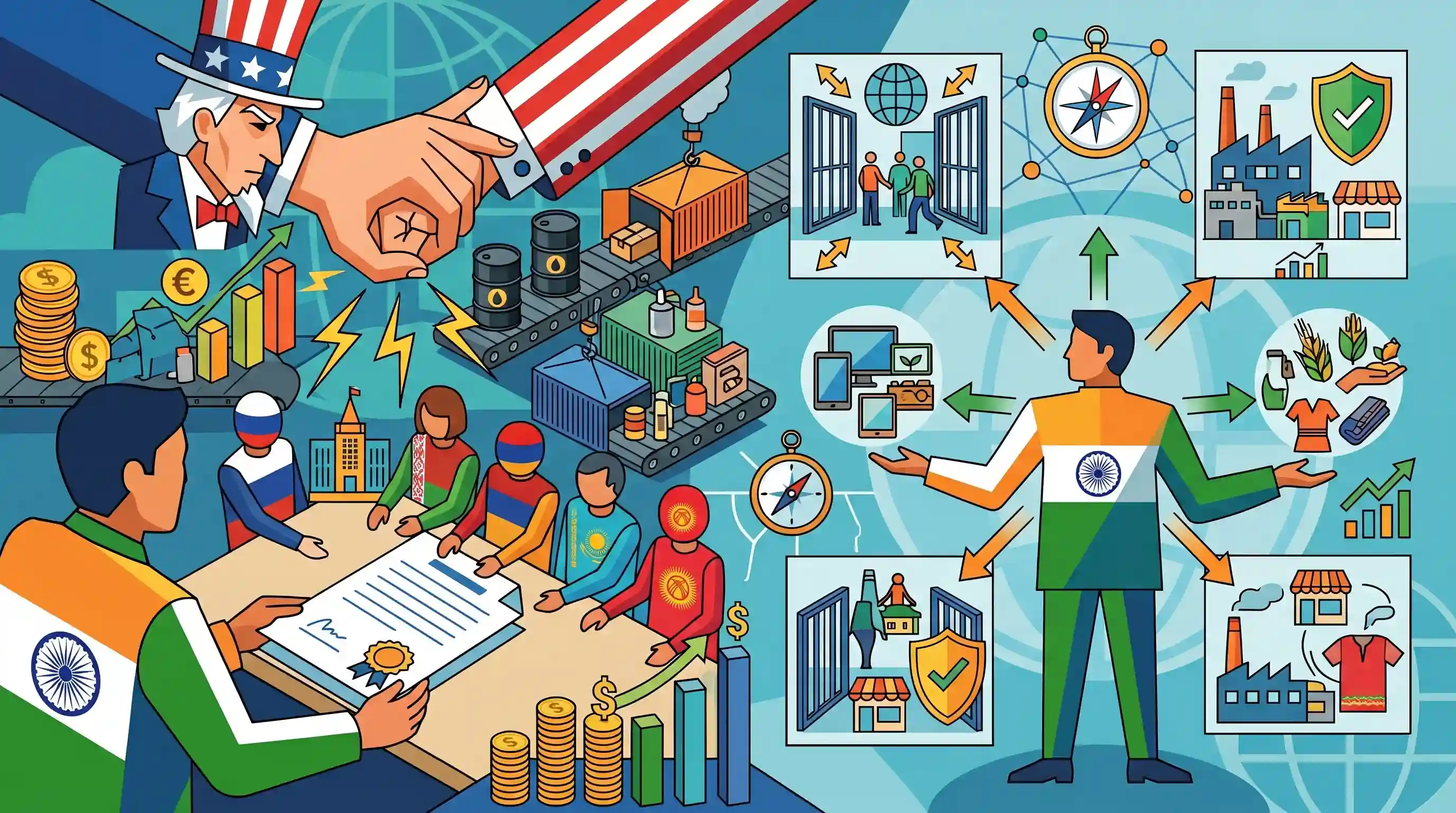
The article is highly relevant for GS2 (International Relations) as it illustrates India's exercise of strategic autonomy in foreign policy. Despite Western pressure to distance itself from Russia, India is advancing an FTA with the Russia-led EAEU. This highlights the complexities of geopolitical maneuvering and the importance of securing energy supplies and expanding export markets.
Summary
India has signed the Terms of Reference (ToR) to initiate negotiations for a Free Trade Agreement (FTA) with the Eurasian Economic Union (EAEU), which includes Russia, Armenia, Belarus, Kazakhstan, and the Kyrgyz Republic. This move towards deeper economic integration comes amid pressure from the United States urging India to reduce its trade ties with Russia, particularly concerning crude oil imports. The bilateral trade between India and the EAEU stood at $69 billion in 2024. The FTA is expected to provide Indian exporters with enhanced market access, diversify trade sectors, and support MSMEs in competing with non-market economies.
Key Points
- India signed Terms of Reference (ToR) to launch Free Trade Agreement (FTA) negotiations with the Eurasian Economic Union (EAEU).
- The EAEU comprises Russia, Armenia, Belarus, Kazakhstan, and the Kyrgyz Republic, with India-EAEU bilateral trade reaching $69 billion in 2024.
- The agreement is progressing despite significant U.S. pressure on India to scale down its economic relations with Russia over the Ukraine conflict.
- The proposed FTA aims to improve market access for Indian exporters across new sectors, enhance competitiveness, and provide a boost to MSMEs.
Important Terms
Eurasian Economic Union (EAEU)

An economic union of five post-Soviet states—Russia, Armenia, Belarus, Kazakhstan, and Kyrgyzstan—ensuring the free movement of goods, services, capital, and labor among members.
UPSC context
GS Paper II: Regional groupings involving India. Critical for studying India's 'Extended Neighborhood' policy and trade diversification.
Free Trade Agreement (FTA)
A formal pact between two or more countries to reduce or eliminate tariffs, quotas, and non-tariff barriers to facilitate cross-border trade in goods and services.
UPSC context
GS Paper II & III: International Relations and Indian Economy. Tests understanding of trade policy and economic integration.
Terms of Reference (ToR)
A foundational document that defines the scope, objectives, and procedural roadmap for negotiations or a project, serving as the mandate for the involved parties.
UPSC context
GS Paper II: International Relations. Represents the formal initiation of diplomatic and economic negotiations.
Non-market Economies
A nation where the government significantly influences prices, production, and currency, making domestic costs an unreliable basis for determining 'fair value' in trade disputes.
UPSC context
GS Paper III: Indian Economy and Trade. Relevant for understanding anti-dumping duties and WTO-related trade remedies.
Federation of Indian Export Organisations (FIEO)
The apex export promotion body in India, established by the Ministry of Commerce in 1965 to represent and support Indian exporters in global markets.
UPSC context
GS Paper III: Indian Economy. Key institution for export-led growth and MSME empowerment.
Prelims Trap
"The Eurasian Economic Union (EAEU) comprises Russia and all five Central Asian republics."
The EAEU only includes two Central Asian republics: Kazakhstan and Kyrgyzstan. Uzbekistan, Tajikistan, and Turkmenistan are NOT members. Aspirants often conflate Central Asia with EAEU/CIS memberships.
Static Concepts Connected
What distinguishes an Economic Union (like EAEU) from a standard Free Trade Area?
- Four Freedoms: Unlike an FTA, an Economic Union ensures the 'four freedoms'—free movement of goods, services, capital, and labor among members.
- Common External Tariff: Members apply a uniform customs tariff to imports from non-member countries, rather than maintaining independent external trade policies.
- Policy Harmonization: It goes beyond reducing trade barriers to actively harmonize and coordinate macroeconomic, agricultural, and industrial policies.
Which strategic transit initiatives enable India to access the EAEU market?
- INSTC: A multi-modal transport network connecting India to Russia via Iran (Bandar Abbas/Chabahar) and the Caspian Sea, bypassing Pakistan.
- Chabahar Port: An India-backed deep-water port in Iran that provides a direct, sea-land gateway to Afghanistan and the broader Central Asian region.
- Ashgabat Agreement: A multimodal transport agreement facilitating transit and transport of goods between Central Asia and the Persian Gulf, integrated with INSTC.
Cross-Topic Patterns
Strategic Autonomy & Crude Oil Imports
India's pursuit of this FTA, despite Western pressure over the Ukraine conflict, showcases its multi-alignment doctrine. It directly ties foreign policy autonomy to domestic inflation management via discounted Russian crude.
Trade Agreements & Physical Connectivity
The commercial viability of an EAEU trade deal is entirely dependent on the International North-South Transport Corridor (INSTC) and Chabahar Port bypassing Pakistan to physically reach Central Asia and Russia.

Expect a 2026 Prelims multi-statement question contrasting EAEU membership (excluding Uzbekistan/Tajikistan) with SCO member states.
Linked PYQs · 4
Linked PYQs · 4
- 2018PrelimsGS1
Consider the following countries: 1. Australia 2. Canada 3. China 4. India 5. Japan 6. USA Which of the above are among the 'free-trade partners' of ASEAN?
- 2016PrelimsGS1
The term 'Regional Comprehensive Economic Partnership' often appears in the news in the context of the affairs of a group of countries known as
- 2024MainsGS2
Critically analyse India's evolving diplomatic, economic and strategic relations with the Central Asian Republics (CARs) highlighting their increasing significance in regional and global geopolitics.
- 2025MainsGS2
"Energy security constitutes the dominant kingpin of India's foreign policy, and is linked with India's overarching influence in Middle Eastern countries.” How would you integrate energy security with India's foreign policy trajectories in the coming years?
