India Japan joint crediting mechanism for low carbon technologies
Source:The Hindu ↗
Why It Matters
Carbon credit mechanisms, Article 6 of the Paris Agreement, and NDCs are core components of the UPSC GS3 environment syllabus. The article provides a practical example of international climate diplomacy and market-based mechanisms, highly relevant for both Prelims (factual knowledge of Article 6/NDCs) and Mains (climate financing and bilateral cooperation).
Summary
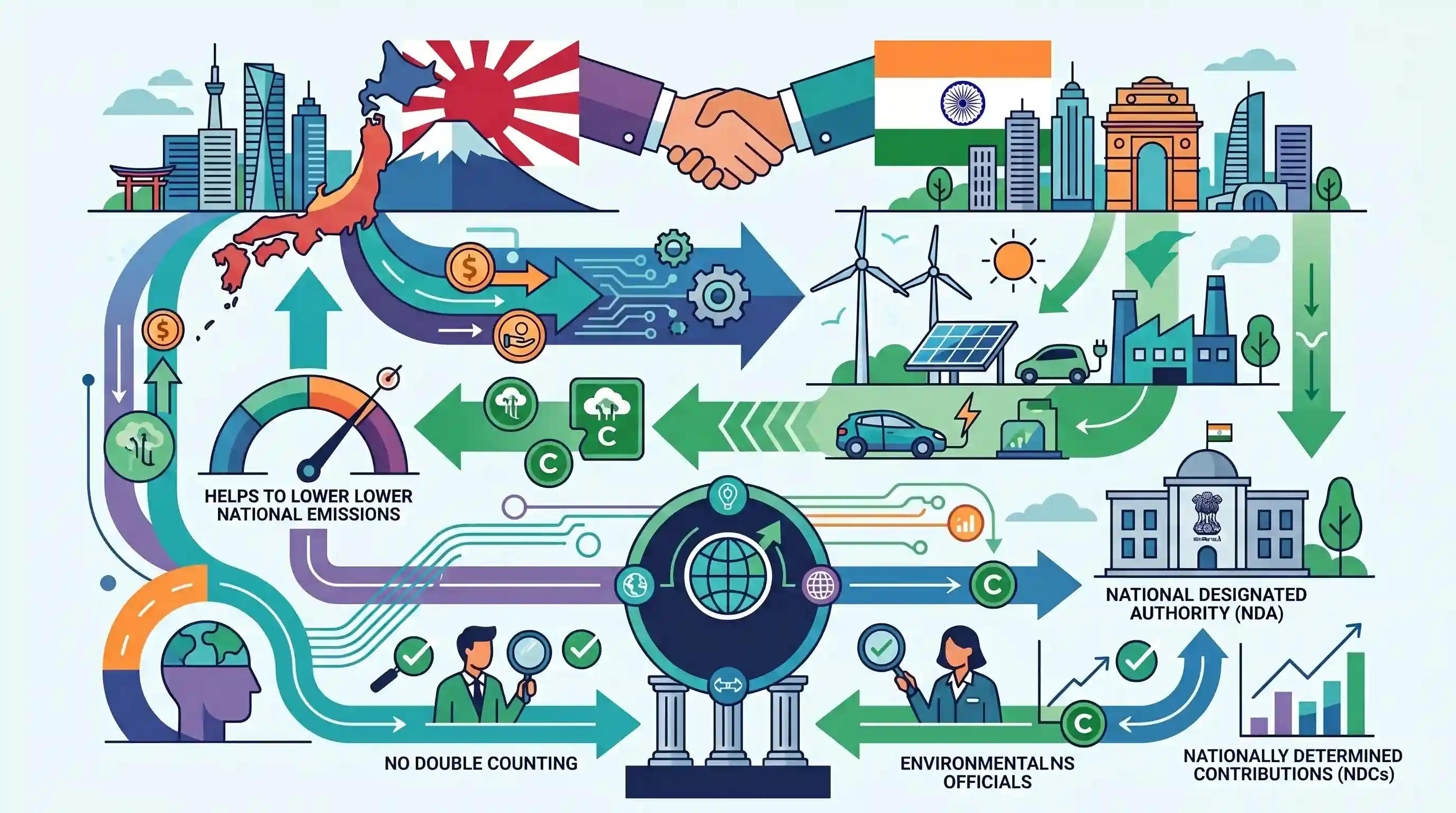
India and Japan have signed a Memorandum of Cooperation on a Joint Crediting Mechanism (JCM) to facilitate Japanese investments in low-carbon technologies within India. Through this mechanism, Japan will acquire carbon credits to meet its national emissions-reduction targets, governed by Article 6.2 of the Paris Agreement to avoid double counting. The Indian Environment Ministry has established a National Designated Authority (NDA) to oversee these projects and ensure they align with India's own Nationally Determined Contributions (NDCs). This bilateral collaboration highlights the growing importance of international carbon markets and technology transfer in global climate change mitigation efforts.
Key Points
- India and Japan signed a Memorandum of Cooperation (MoC) for a Joint Crediting Mechanism (JCM) to promote Japanese investments in low-carbon technologies in India.
- Carbon credits generated from these projects will be used by Japan to meet its national emissions-reduction targets.
- The mechanism functions under Article 6.2 of the Paris Agreement, which allows international trading of carbon credits while preventing double counting.
- India's Environment Ministry has constituted a 'National Designated Authority (NDA)' to approve projects and oversee the Indian carbon market.
- A Joint Committee comprising representatives from both nations will develop guidelines and rules for project registration and carbon credit issuance.
- The MoC ensures that the trading of carbon credits does not adversely affect India's commitments under its own Nationally Determined Contributions (NDCs).
- India's NDCs aim to reduce GDP emission intensity by 45% by 2030 (from 2005 levels), achieve 50% non-fossil electric power capacity by 2030, and create a 2.5-3 billion tonne CO2 equivalent carbon sink.
Important Terms
Joint Crediting Mechanism (JCM)

A bilateral carbon market system where Japan invests in low-carbon technologies in partner countries like India. The resulting emission reduction credits are shared between both nations to meet their respective climate targets.
UPSC context
GS-III (Environment) & GS-II (IR). Tests understanding of bilateral climate cooperation, technology transfer, and international carbon credit frameworks.
Article 6.2 (Paris Agreement)
A provision of the Paris Agreement allowing countries to cooperate through international carbon markets. It enables the bilateral or plurilateral transfer of 'mitigation outcomes' (carbon credits) to achieve national climate goals.
UPSC context
GS-III (Environment). Critical for questions on global climate governance, carbon market transparency, and the transition to the Paris framework.
Nationally Determined Contributions (NDCs)
National climate action plans submitted under the Paris Agreement. They outline a country's voluntary targets for reducing emissions (e.g., India's 45% intensity reduction by 2030) and adapting to climate change.
UPSC context
GS-III (Environment). Essential for tracking India's specific international climate commitments and global compliance progress.
National Designated Authority (NDA)
An inter-ministerial body (headed by the Environment Secretary) that regulates and approves carbon market projects in India. It ensures these projects align with national priorities and international Article 6 rules.
UPSC context
GS-III (Environmental Governance). Tests knowledge of India's institutional framework for managing international carbon trading and regulatory oversight.
Paris Agreement
A 2015 legally binding international treaty aimed at limiting global warming to well below 2°C, preferably 1.5°C. It functions through a five-year cycle of progressively ambitious national climate actions.
UPSC context
GS-III (Environment). The foundational framework for international climate policy, global stocktakes, and environmental diplomacy questions.
Memorandum of Cooperation (MoC)
A non-binding diplomatic document that outlines a framework for bilateral cooperation. In this context, it formalizes the India-Japan partnership for implementing the Joint Crediting Mechanism and technology exchange.
UPSC context
GS-II (International Relations). Relates to the instruments used to formalize strategic partnerships and bilateral environmental cooperation.
Prelims Trap
Credits generated under the India-Japan JCM will simultaneously count towards both India's and Japan's Nationally Determined Contributions (NDCs).
Under Article 6.2, "corresponding adjustments" are mandatory. If Japan buys the credits to meet its targets, India must subtract them from its own NDC ledger to prevent double-counting.
Static Concepts Connected
How do Article 6.2 and 6.4 of the Paris Agreement differ in carbon trading?
- Article 6.2 (Bilateral): Allows countries to directly trade emission reductions (Internationally Transferred Mitigation Outcomes or ITMOs) via bilateral pacts, like the JCM.
- Article 6.4 (Multilateral): Establishes a centralized UN-supervised global carbon market, open to both public and private sectors for trading carbon credits.
- Corresponding Adjustments: Both mechanisms strictly require accounting subtractions (Corresponding Adjustments) to prevent two countries from claiming the same emission reduction.
What are India's updated quantitative Nationally Determined Contributions (NDCs) for 2030?
- Emission Intensity: Reduce the emission intensity of its GDP by 45 percent by 2030, compared to the 2005 baseline levels.
- Non-Fossil Energy: Achieve about 50 percent cumulative electric power installed capacity from non-fossil fuel-based energy resources by 2030.
- Carbon Sink: Create an additional carbon sink of 2.5 to 3 billion tonnes of CO2 equivalent through additional forest and tree cover by 2030.
Cross-Topic Patterns
Carbon Markets & CBAM dynamics
India's expanding domestic carbon market infrastructure and bilateral JCM pacts are strategic buffers to prepare Indian industries for external carbon pricing threats like the EU's Carbon Border Adjustment Mechanism (CBAM).
Clean Energy in India-Japan ties
The JCM broadens the India-Japan Special Strategic Partnership, moving beyond defense and infrastructure into climate finance, supplementing the existing Clean Energy Partnership (CEP) and Quad climate agendas.

Expect a 2026 Prelims question differentiating Paris Agreement's Article 6.2 (bilateral), Article 6.4 (UN-supervised), and ITMO dynamics.
Linked PYQs · 5
Linked PYQs · 5
- 2025PrelimsGS1
Consider the following statements : Statement I: Article 6 of the Paris Agreement on climate change is frequently discussed in global discussions on sustainable development and climate change. Statement II: Article 6 of the Paris Agreement on climate change sets out the principles of carbon markets. Statement III : Article 6 of the Paris Agreement on climate change intends to promote inter-country non-market strategies to reach their climate targets. Which one of the following is correct in respect of the above statements?
- 2016PrelimsGS1
The term 'Intended Nationally Determined Contributions' is sometimes seen in the news in the context of
- 2025MainsGS3
Write a review on India's climate commitments under the Paris Agreement (2015) and mention how these have been further strengthened in COP26 (2021). In this direction, how has the first Nationally Determined Contribution intended by India been updated in 2022?
- 2014MainsGS3
Should the pursuit of carbon credits and clean development mechanisms set up under UNFCCC be maintained even though there has been a massive slide in the value of a carbon credit? Discuss with respect to India's energy needs for economic growth.
- 2019MainsGS2
‘The time has come for India and Japan to build a strong contemporary relationship, one involving global and strategic partnership that will have a great significance for Asia and the world as a whole.’ Comment.
