Human Spaceflight Mission to International Space Station
Source:Indian Express ↗
Why It Matters
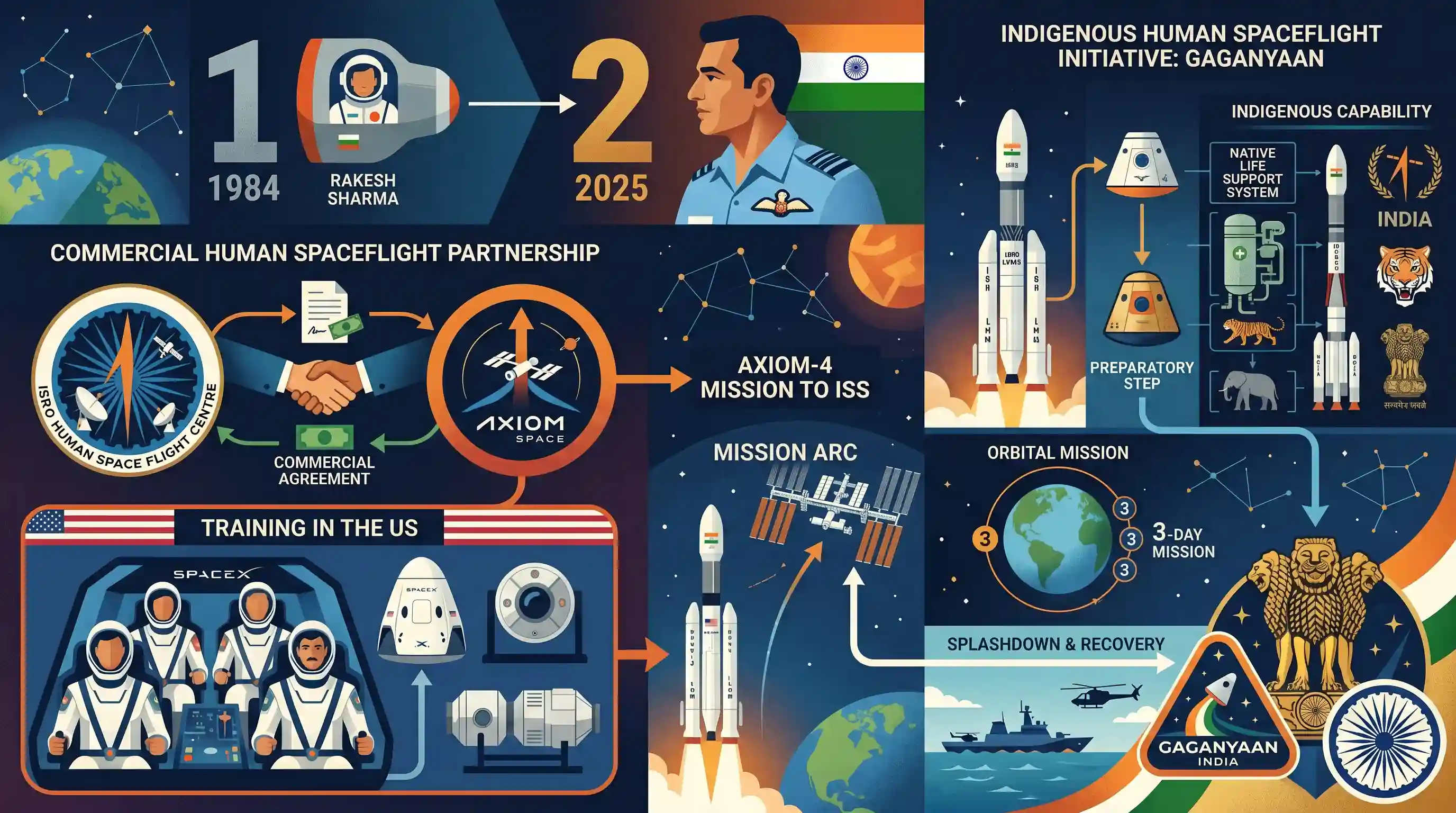
It marks a significant milestone in India's space trajectory, showcasing ISRO's strategic collaborations with private and international space agencies (NASA, Axiom, SpaceX) to acquire crucial human spaceflight experience before launching the domestic Gaganyaan mission.
Summary
Group Captain Shubhanshu Shukla has been chosen to fly to the International Space Station (ISS) in May 2025 as part of the commercial Axiom-4 mission, making him the second Indian citizen to travel to space after Rakesh Sharma. Supported by an agreement between ISRO's Human Space Flight Centre and Axiom Space, this mission serves as a critical preparatory step for India's upcoming indigenous human spaceflight initiative, the Gaganyaan mission. The astronauts are currently undergoing specialized training in the US to familiarize themselves with ISS systems and the SpaceX Crew Dragon spacecraft.
Key Points
- Group Captain Shubhanshu Shukla will pilot the Axiom-4 mission to the ISS in May 2025, becoming the first Indian to travel to space in over 40 years.
- Group Captain Prasanth Balakrishnan Nair has been selected as the backup pilot for the mission.
- The Ax-4 mission is a commercial spaceflight facilitated by Axiom Space and NASA, utilizing a SpaceX Crew Dragon spacecraft.
- Both Indian astronauts are test pilots from the Indian Air Force and are receiving comprehensive training at NASA, SpaceX, and Axiom Space facilities.
- This collaborative mission will involve conducting micro-gravity experiments and is viewed as a crucial capacity-building step ahead of ISRO's indigenous human spaceflight program, Gaganyaan, slated for 2026.
Important Terms
Gaganyaan

India’s maiden indigenous human spaceflight program aiming to send a three-member crew to Low Earth Orbit (LEO) for three days using the LVM3 launch vehicle.
UPSC context
GS-3: Science and Tech. Tests knowledge of indigenous space capabilities and India's objectives for a permanent space presence.
Axiom-4 (Ax-4) mission
A commercial crew mission to the International Space Station (ISS) operated by Axiom Space. It serves as a precursor for Indian astronauts to gain orbital experience before Gaganyaan.
UPSC context
GS-3: Space Technology. Tests understanding of international collaboration (ISRO-NASA-Axiom) and the role of commercial players in space.
Human Space Flight Centre (HSFC)
The nodal agency within ISRO responsible for implementing the human spaceflight program, including mission planning, astronaut training, and the development of life-support systems.
UPSC context
GS-3: Science and Tech. Tests institutional awareness of ISRO’s specialized wings and their roles in national security and innovation.
Space Flight Agreement
A formal legal framework between ISRO and Axiom Space enabling Indian astronauts to fly on commercial spacecraft. It stems from the 2023 India-US joint statement.
UPSC context
GS-2/3: International Relations and Tech. Tests understanding of bilateral technology transfers and diplomatic frameworks for space research.
Axiom Space
A private U.S. aerospace company that provides commercial access to the International Space Station and is building the first private-sector-led space station.
UPSC context
GS-3: Space. Tests awareness of the global trend toward private sector participation and commercialization in the space economy.
Prelims Trap
Shubhanshu Shukla is the first Indian citizen in space, launched under ISRO's Gaganyaan mission.
He is the second Indian citizen (after Rakesh Sharma) and is flying to the ISS on a commercial US mission (Axiom-4), not the indigenous Gaganyaan mission.
Static Concepts Connected
What defines Low Earth Orbit (LEO) and why is it used for human spaceflight?
- Altitude range: Typically orbits between 160 km to 2,000 km above Earth. Both the ISS and the upcoming Gaganyaan mission operate at approximately 400 km.
- Radiation protection: LEO lies largely below the inner Van Allen radiation belt, offering astronauts vital protection from extreme cosmic radiation.
- Accessibility: It requires significantly less energy (fuel) to reach, allowing for higher payload capacities, easier resupply missions, and rapid communication.
What are the key technical components developed for India's Gaganyaan mission?
- Launch Vehicle: The Human Rated LVM3 (HLVM3), which has been modified with enhanced safety features to ensure reliability for crewed flights.
- Orbital Module: Consists of the Crew Module (a pressurized, habitable Earth-like environment) and the Service Module (unpressurized, housing propulsion systems).
- Crew Escape System: An abort system designed to safely and rapidly pull the crew module away from the launch vehicle in case of a launch emergency.
Cross-Topic Patterns
Commercialization of human spaceflight
The Ax-4 mission highlights a shift from state-only space exploration to commercial partnerships, mirroring India's own space sector privatization via IN-SPACe and NSIL.
iCET and Artemis Accords in action
This NASA-facilitated mission directly actualizes joint space commitments made under the India-US initiative on Critical and Emerging Technology (iCET) and India's signing of the Artemis Accords.

Expect a 2026 prelims question contrasting the executing agencies and orbits of Axiom/ISS, Gaganyaan, and the Bharatiya Antariksh Station.
Linked PYQs · 2
Linked PYQs · 2
- 2025PrelimsGS1
Consider the following space missions : I. Axiom-4 II. SpaDeX III. Gaganyaan How many of the space missions given above encourage and support micro-gravity research?
- 2017MainsGS3
India has achieved remarkable successes in unmanned space missions including the Chandrayaan and Mars Orbitter Mission, but has not ventured into manned space missions. What are the main obstacles to launching a manned space mission, both in terms of technology and logistics? Examine critically.
