Finalizing Free Trade Agreements Amidst Global Tariff Pauses
Source:Indian Express ↗
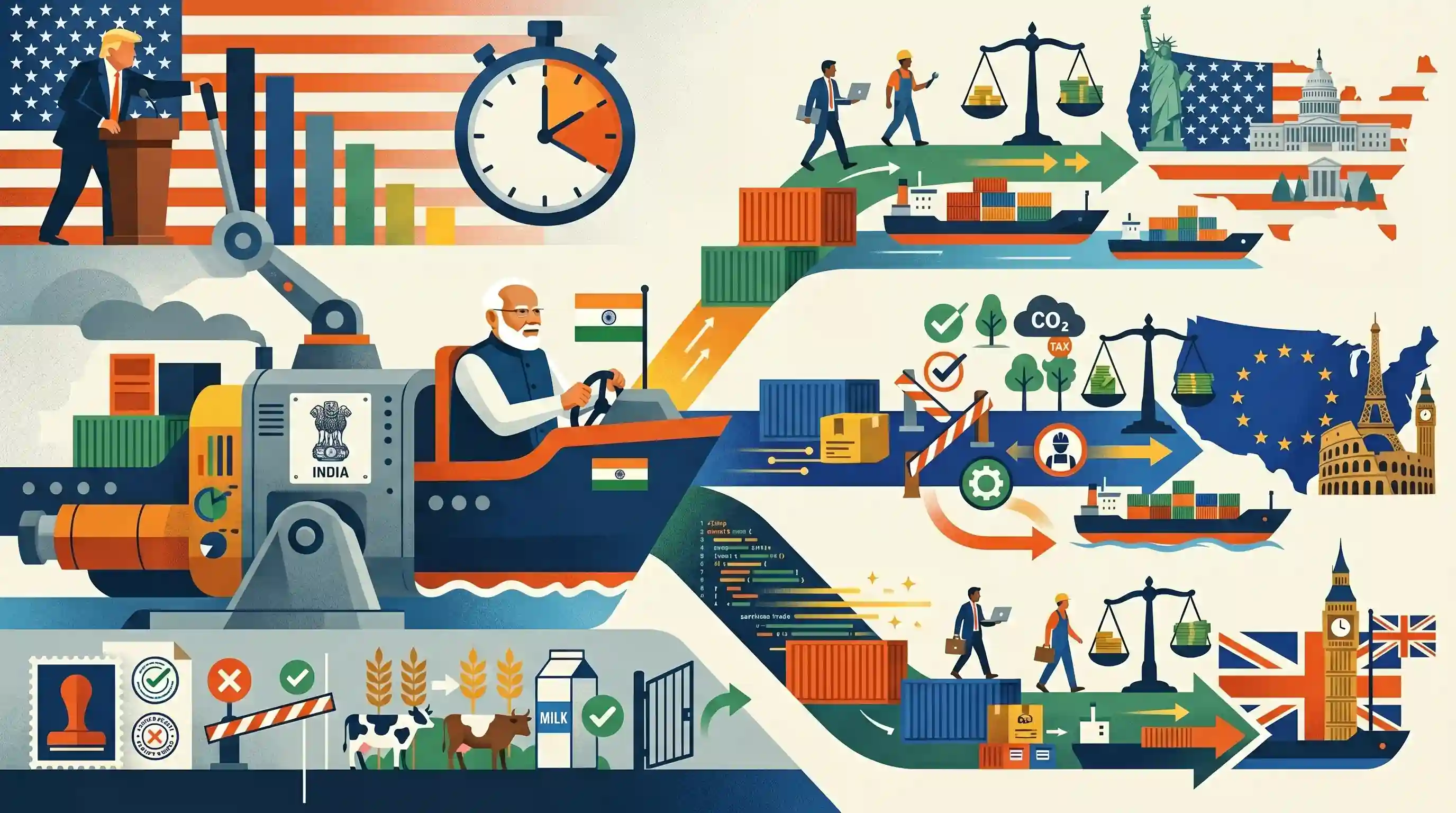
Why It Matters
Evaluates India's trade strategy amidst rising global protectionism, highlighting the urgency of securing Free Trade Agreements with major economies. Essential for GS2 (IR) and GS3 (Economy) focusing on tariffs, trade surplus, and non-tariff barriers like the carbon border tax.
Summary
The article outlines the 90-day window provided by US President Donald Trump’s pause on his 26% reciprocal tariffs, reducing them to 10% on Indian imports. It argues that the Narendra Modi government should seize this opportunity to expedite and finalize bilateral trade agreements with the US, the European Union (EU), and the United Kingdom (UK). These three regions are crucial trading partners, accounting for a significant share of India's exports, with India enjoying a trade surplus in all three relationships. The agreements should comprehensively cover both merchandise and services trade, specifically aiming for improved market access for India’s IT professionals and skilled workers. Furthermore, negotiations must address Non-Tariff Barriers (NTBs)—such as the EU's carbon border tax and strict environmental/labor standards—while India will need to reconsider its own protective measures like Quality Control Orders (QCOs) and restrictions on agricultural/dairy imports.
Key Points
- The US administration has paused the imposition of 26% reciprocal tariffs, temporarily capping them at 10% for 90 days, creating a critical window for trade diplomacy.
- India should leverage this period to expedite and finalize comprehensive bilateral trade agreements with the US, the EU, and the UK.
- These three partners are vital to India's economy, accounting for 38.1% of merchandise exports and 16.5% of imports in 2023-24, with India holding a trade surplus across all three.
- Trade pacts must incorporate the services sector, prioritizing improved market access for Indian IT professionals and skilled workers.
- Resolving Non-Tariff Barriers (NTBs) is essential; India must navigate western environmental/labor standards and the EU's carbon border tax, while evaluating its own Quality Control Orders (QCOs) and agricultural import restrictions.
Important Terms
Reciprocal Tariffs

Trade duties imposed by a country to match the exact tariff rates another country levies on its exports.
UPSC context
GS Paper 2 & 3. Tests understanding of protectionism versus the WTO’s multilateral rule-based trade order.
Carbon Border Adjustment Mechanism (CBAM)
An EU policy imposing a carbon price on imports equivalent to the cost paid by EU producers for their emissions.
UPSC context
GS Paper 3. A key 'Green Protectionism' issue testing India’s export competitiveness and climate-related trade barriers.
Free Trade Agreements (FTAs)
Treaties between countries to reduce or eliminate tariffs and non-tariff barriers on goods and services.
UPSC context
GS Paper 2 & 3. Tests India's strategic shift toward high-standard bilateral trade pacts.
Non-Tariff Barriers (NTBs)
Trade restrictions other than taxes, such as quotas, technical regulations, and sanitary standards that impede market access.
UPSC context
GS Paper 3. Tests the ability to identify 'back-door protectionism' used in global trade.
Quality Control Orders (QCOs)
Mandatory directives requiring products to meet Bureau of Indian Standards (BIS) benchmarks to ensure quality and safety.
UPSC context
GS Paper 3. Tests the balance between setting domestic standards and preventing trade distortions.
Bureau of Indian Standards (BIS)
The national standards body of India responsible for product certification, testing, and ensuring quality assurance across industries.
UPSC context
GS Paper 3. Tests knowledge of regulatory institutions enforcing trade and manufacturing standards.
Prelims Trap
India runs a merchandise trade deficit with its major Western partners like the US, EU, and the UK.
While India has a massive overall global trade deficit (driven by China and oil imports), it consistently maintains a merchandise trade surplus with the US, EU, and UK.
Static Concepts Connected
What are the primary Non-Tariff Barriers (NTBs) under WTO rules?
- Technical Barriers (TBT): Regulations outlining product characteristics or their related processes and production methods (e.g., India's mandatory Quality Control Orders).
- SPS Measures: Measures applied to protect human, animal, or plant life/health from risks arising from additives, contaminants, toxins, or disease-carrying organisms.
- Environmental Taxes: Policies like the EU's CBAM that tax imports based on their carbon footprint, widely debated as legitimate environmental policy versus disguised protectionism.
How are services traded under the WTO's GATS framework?
- Mode 1 (Cross-border): Services supplied from one country to another (e.g., software services, telemedicine).
- Mode 2 (Consumption): Consumers traveling to the supplying country (e.g., tourism, students studying abroad).
- Mode 3 (Commercial Presence): Foreign companies setting up branches or subsidiaries to provide services locally.
- Mode 4 (Natural Persons): Temporary movement of professionals to another country to provide a service (India's core demand in Western FTAs).
Cross-Topic Patterns
Carbon Taxes as Trade Barriers
The EU's Carbon Border Adjustment Mechanism (CBAM) intersects trade with climate action, forcing developing nations like India to challenge unilateral carbon taxes as disguised protectionism at the WTO.
Domestic QCOs vs Free Trade
India's Quality Control Orders (QCOs) by BIS aim to block sub-standard Chinese imports but increasingly act as friction points in Western FTA negotiations, blurring domestic regulation and trade protectionism.

Expect a Prelims match-the-following on GATS Modes (esp Mode 4) or a Mains prompt on how climate policies (CBAM) act as new trade barriers.
Linked PYQs · 3
Linked PYQs · 3
- 2025MainsGS3
What are the challenges before the Indian economy when the world is moving away from free trade and multilateralism to protectionism and bilateralism? How can these challenges be met?
- 2020PrelimsGS1
With reference to the international trade of India at present, which of the following statements is/are correct? 1. India's merchandise exports are less than its merchandise imports. 2. India's imports of iron and steel, chemicals, fertilisers and machinery have decreased in recent years. 3. India's exports of services are more than its imports of services. 4. India suffers from an overall trade/current account deficit. Select the correct answer using the code given below:
- 2018PrelimsGS1
Consider the following countries: 1. Australia 2. Canada 3. China 4. India 5. Japan 6. USA Which of the above are among the 'free-trade partners' of ASEAN?
