India Bangladesh Relations and Diplomatic Shelter for Sheikh Hasina
Source:Indian Express ↗
Why It Matters
The political transition in Bangladesh presents a major diplomatic challenge for India. Understanding how India balances historical alliances with current geopolitical realities is crucial for the UPSC Mains, especially regarding the 'Neighbourhood First' policy and its direct impact on India's internal security and regional influence.
Summary
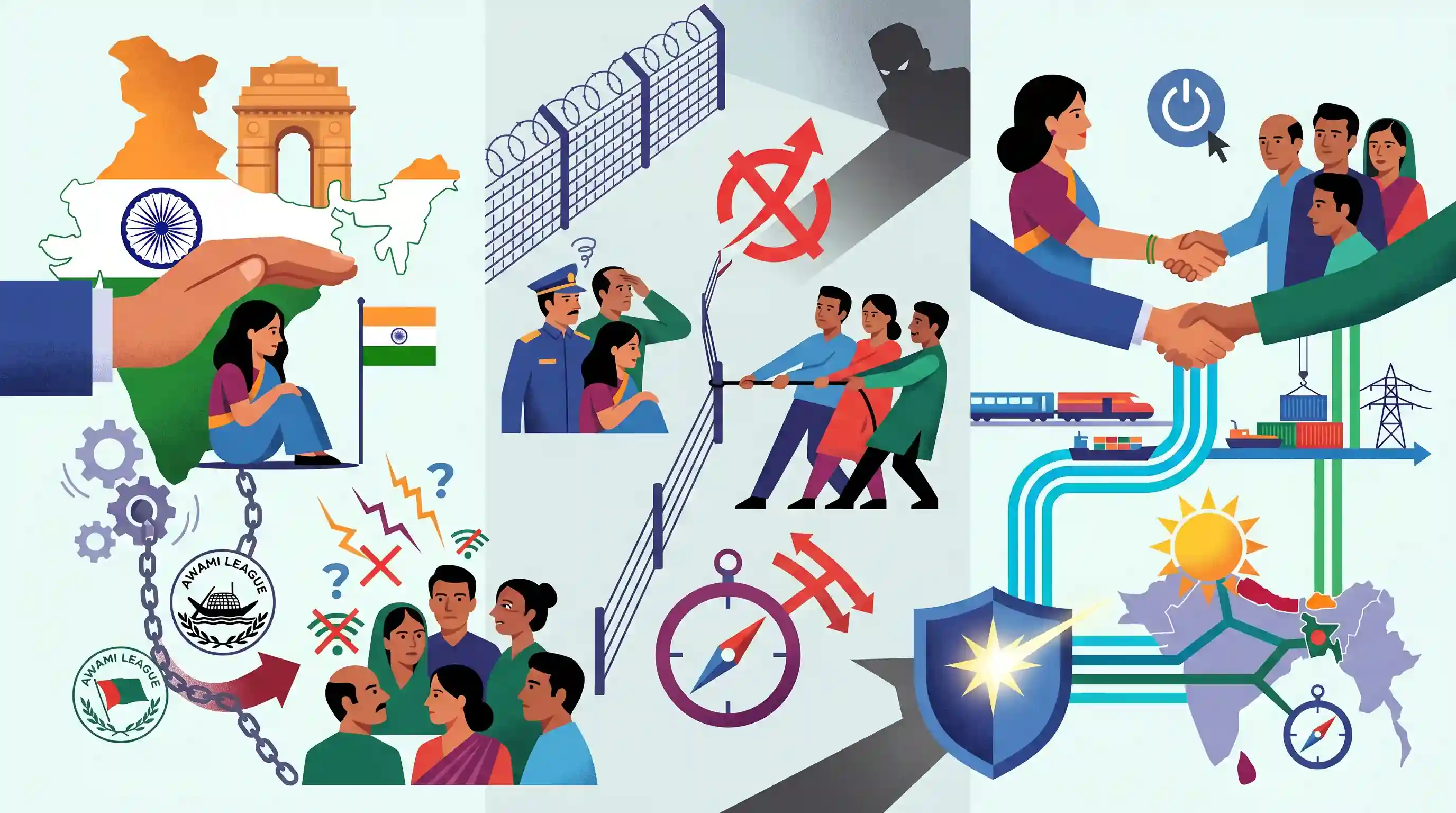
The article critically examines India's decision to provide political shelter to ousted Bangladeshi Prime Minister Sheikh Hasina. It argues that while India has deep historical ties with the Awami League, hosting Hasina has become a diplomatic liability that complicates relations with Bangladesh's interim government. The piece suggests that New Delhi must prioritize its broader strategic, economic, and security interests—such as border management and regional connectivity—over loyalty to an individual leader. To safeguard its 'Neighbourhood First' policy and prevent adversarial influence in Dhaka, India is urged to adopt a more pragmatic diplomatic approach that respects the new political realities in Bangladesh.
Key Points
- India's continued sheltering of ousted Bangladeshi Prime Minister Sheikh Hasina risks alienating the current interim government and the general populace in Bangladesh.
- Prioritizing historical ties with the Awami League over present geopolitical realities may stoke anti-India sentiment and push Bangladesh closer to adversarial powers.
- Broader bilateral interests, including border security, regional connectivity, and trade, are being jeopardized by hosting a politically contentious figure.
- New Delhi needs to pragmatically recalibrate its 'Neighbourhood First' policy to engage with the new political dispensation in Dhaka effectively.
Important Terms
Neighbourhood First Policy

India’s foreign policy priority aimed at fostering proactive, non-reciprocal engagement and multi-modal connectivity with immediate neighbors to ensure regional stability, prosperity, and security.
UPSC context
GS II (International Relations); tests India's regional leadership, neighborhood diplomacy, and strategic positioning in South Asia.
Awami League
A major secular, center-left political party in Bangladesh that led the 1971 liberation; under Sheikh Hasina, it maintained a strong pro-India strategic and security partnership.
UPSC context
GS II (Bilateral Relations); relevant for understanding the historical and political underpinnings of India-Bangladesh ties.
Interim Government (of Bangladesh)
A temporary administration led by Nobel laureate Muhammad Yunus, formed after the 2024 ouster of Sheikh Hasina to restore order and organize new general elections.
UPSC context
GS II (International Relations); concerns bilateral stability and diplomatic continuity during periods of political transition in neighboring states.
India-Bangladesh Extradition Treaty
A bilateral legal framework (2013, amended 2016) for exchanging fugitives; it currently defines the legal obligations and exceptions regarding the potential return of ousted leaders.
UPSC context
GS II (Bilateral Agreements); tests understanding of legal complexities in cross-border justice and hosting foreign political figures.
Land Boundary Agreement (LBA)
A landmark 2015 agreement where India and Bangladesh exchanged enclaves to settle decades-old border disputes, showcasing the success of 'Neighbourhood First' diplomacy.
UPSC context
GS II (Bilateral Relations); a prime example of successful territorial dispute resolution and regional cooperation.
Prelims Trap
India's granting of political asylum is governed by its obligations under the 1951 UN Refugee Convention.
India is NOT a signatory to the 1951 UN Refugee Convention or its 1967 Protocol. Asylum and refugee decisions are handled via executive ad-hoc measures.
Static Concepts Connected
What is the legal framework governing refugees and asylum in India?
- No formal law: India lacks specific national refugee legislation; asylum and political shelter decisions are purely executive and ad-hoc.
- Non-signatory: India is not a party to the 1951 UN Refugee Convention or its 1967 Protocol.
- Foreigners Act 1946: Governs entry, stay, and exit of foreigners, granting the central government absolute powers to deport or detain.
What are the key geographical and transit features of the India-Bangladesh border?
- Longest border: India shares its longest land border (4,096 km) with Bangladesh, touching WB, Assam, Meghalaya, Tripura, and Mizoram.
- Transit necessity: Crucial for India's Act East policy and Northeast connectivity via access to Chattogram and Mongla ports.
- Riverine topography: Highly porous and complex riverine topography makes border management difficult, leading to issues like smuggling and illegal migration.
Cross-Topic Patterns
Regime transitions & Act East
Bangladesh's political shift mirrors past Myanmar crises. UPSC often links internal stability in bordering states directly to the economic viability and internal security of India's Northeast.
Asylum vs. Extradition Treaties
Sheltering ousted leaders invokes the complex interplay between India's executive asylum decisions and binding bilateral Extradition Treaties (India and Bangladesh signed one in 2013).

India's non-signatory status to the 1951 Refugee Convention paired with its extradition treaties is ripe for a 2026 Prelims statement.
Linked PYQs · 3
Linked PYQs · 3
- 2022MainsGS2
India is an age-old friend of Sri Lanka.’ Discuss India's role in the recent crisis in Sri Lanka in the light of the preceding statement.
- 2020MainsGS3
Analyze internal security threats and transborder crimes along Myanmar, Bangladesh and Pakistan borders including Line of Control (LoC). Also discuss the role played by various security forces in this regard.
- 2014MainsGS3
How does illegal transborder migration pose a threat to India's security? Discuss the strategies to curb this, bringing out the factors which give impetus to such migration.
