Product led economy transition requires triple helix framework
Source:The Hindu ↗
Why It Matters
Provides a modern roadmap for India's economic transition towards a product-led economy. It offers concrete examples (like the triple helix model and Karnataka's skill/decentralization policies) that can be directly used in Mains answers regarding MSME growth, employability, R&D commercialization, and digitalization.
Summary
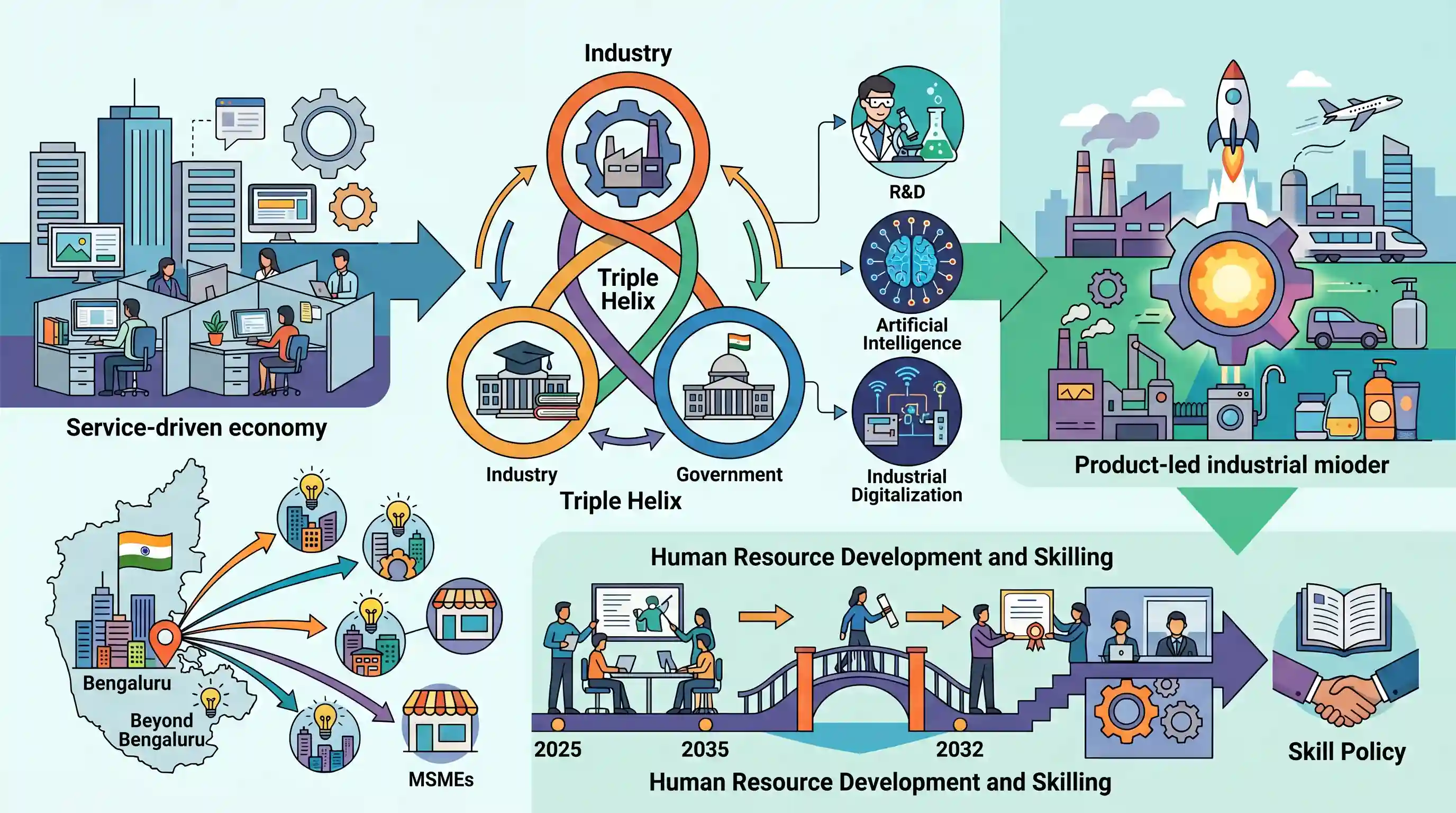
At the CII India INNOVERGE 2025 conclave, experts emphasized the need for India to transition from a service-driven economy to a product-led nation by fostering R&D, artificial intelligence, and industrial digitisation. The consensus highlighted moving from competition to collaboration via a 'triple helix' framework involving industry, academia, and government. The event showcased Karnataka's strategic initiatives, including the upcoming Skill Policy 2025-2032—which links education with employment—and the 'Beyond Bengaluru' effort to decentralize innovation hubs to Tier-2 cities, aiming to bolster MSMEs and broader economic resilience.
Key Points
- India must transition from a service-centric model to a 'product-first nation' by increasing investments in R&D, AI, and industrial digitisation.
- A 'triple helix' model of structured collaboration between academia, government, and industry is required to commercialize research and build trust.
- The upcoming Karnataka Skill Policy 2025-2032 aims to bridge the gap between education, skill development, and employment to create an industry-ready workforce.
- The 'Beyond Bengaluru' initiative is decentralizing the state's innovation and manufacturing ecosystem to Tier-2 cities like Hubballi, Mysuru, and Belagavi, particularly benefiting MSMEs.
Important Terms
Triple Helix Model

A framework for innovation involving interaction between Academia (universities), Industry, and Government. It shifts universities from simple knowledge providers to active economic participants via R&D and commercialization.
UPSC context
GS Paper 3 (Science & Technology/Economy); tests innovation ecosystems and Industry-Academia linkages for a product-led economy.
MSMEs
Enterprises classified by investment and turnover (revised 2020) that form the 'backbone' of the Indian economy, contributing ~30% to GDP and 45% to manufacturing.
UPSC context
GS Paper 3 (Economy); core topic regarding employment, industrial policy, and inclusive growth.
Confederation of Indian Industry (CII)
A non-governmental, industry-led, not-for-profit organization founded in 1895. It acts as a policy advocate and bridge between the government and private sector to enhance industrial competitiveness.
UPSC context
GS Paper 2 & 3 (Governance/Economy); tests the role of non-state actors in policymaking and industrial reform.
Karnataka Skill Policy 2025-2032
A seven-year blueprint (₹4,432 crore outlay) aiming to train 3 million youth. It integrates vocational training with formal education and targets 33% women enrolment in ITIs.
UPSC context
GS Paper 3 (HRD/Economy); focuses on bridging the skill gap and achieving a 'skilling to employment' pipeline.
Beyond Bengaluru initiative
A mission to decentralize the digital economy into Tier-2/3 clusters (e.g., Mysuru, Mangaluru), aiming for $10 billion in regional IT exports by 2030 to reduce Bengaluru's urban stress.
UPSC context
GS Paper 3 (Economy/Urban Development); relates to regional parity, decentralization of innovation, and infrastructure management.
Prelims Trap
"In India, the private sector contributes the majority share of the gross domestic expenditure on R&D (GERD)."
Unlike developed nations where private enterprises drive 65-75% of R&D, in India, the government and public institutions account for the vast majority (>50%) of GERD.
Static Concepts Connected
What is the 'Triple Helix' model of innovation often cited in R&D policies?
- Academia: Acts as the primary source of fundamental research, new knowledge creation, and skilled human capital.
- Industry: Commercializes academic research by transforming theoretical knowledge and prototypes into viable, market-ready products and services.
- Government: Provides the crucial regulatory framework, funding incentives, intellectual property protection, and overall policy stability.
What are the structural bottlenecks preventing the realization of India's demographic dividend?
- Formal skill deficit: A very low percentage of the Indian workforce undergoes formal skill training compared to peers like South Korea or Germany.
- Education-industry gap: Curricula heavily emphasize theoretical knowledge over practical, industry-aligned skills like AI or industrial digitization, leading to graduate unemployment.
- Informal sector dominance: The vast majority of employment remains locked in low-productivity, low-wage informal jobs, hindering the transition to high-value product manufacturing.
Cross-Topic Patterns
Industrial decentralization & Urbanization
Decentralization efforts like 'Beyond Bengaluru' directly connect GS3 industrial policy with GS1 urbanization, offering a model to counter hyper-urbanization and infrastructure collapse in megacities.
PLI Schemes + R&D deficit
The push for a 'product-first' nation naturally ties into PLI scheme objectives. UPSC often contrasts PLI manufacturing goals with the structural lack of domestic deep-tech R&D capabilities.

Expect a GS3 mains question contrasting India's service-led growth with the urgent need for a 'product-led' R&D ecosystem via Triple Helix.
Linked PYQs · 5
Linked PYQs · 5
- 2023MainsGS3
What is the status of digitalization in the Indian economy? Examine the problems faced in this regard and suggest improvements.
- 2023MainsGS3
Faster economic growth requires increased share of the manufacturing sector in GDP, particularly of MSMEs. Comment on the present policies of the Government in this regard.
- 2019MainsGS2
The need for cooperation among various service sectors has been an inherent component of development discourse. Partnership bridges the gap among the sectors. It also sets in motion a culture of 'collaboration' and 'team spirit'. In the light of statements above examine India's development process.
- 2023MainsGS2
Skill development programmes have succeeded in increasing human resources supply to various sectors. In the context of the statement analyse the linkages between education, skill and employment.
- 2014MainsGS3
While we flaunt India's demographic dividend, we ignore the dropping rates of employability. What are we missing while doing so? Where will the jobs that India desperately needs come from? Explain.
