India Role in Global South Diplomacy Amid West Asia Energy Crisis
Source:The Hindu ↗
Why It Matters
This article directly addresses India's strategic vulnerabilities and diplomatic responsibilities in West Asia. It ties together crucial UPSC themes such as energy security, the economic importance of the Indian diaspora (remittances), supply chain stability, and India's emerging leadership role in the Global South.
Summary
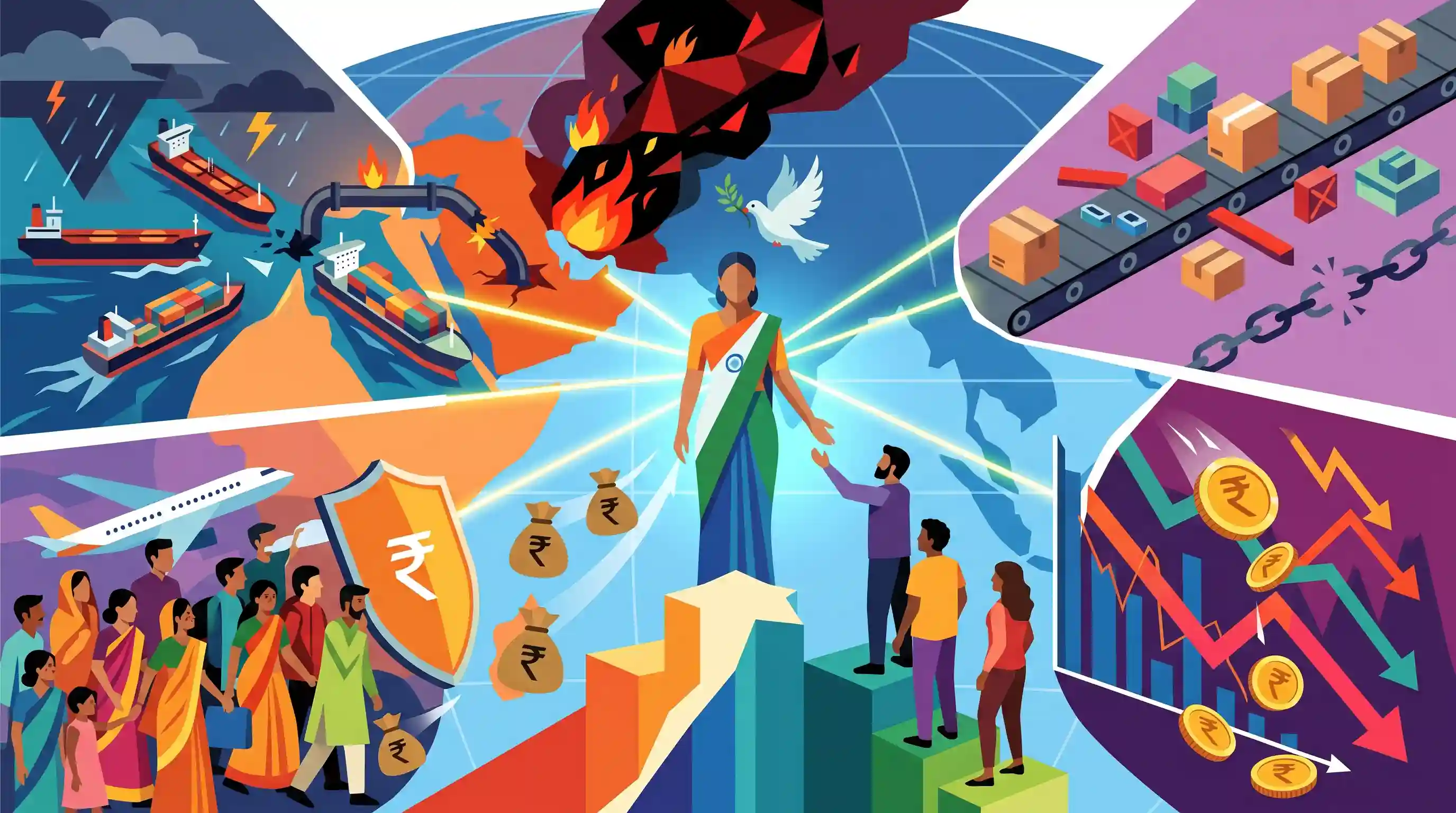
A senior Congress leader has emphasized that India should leverage its position to lead the Global South in de-escalating the crisis in West Asia. The escalating conflict poses a severe threat to India's energy security—given its dependence on crude oil and natural gas routed through the Strait of Hormuz—and risks disrupting supply chains. Furthermore, the crisis jeopardizes the safety of around 10 million Indian diaspora members in the region, whose remittances constitute nearly 60% of India's foreign exchange inflows. The situation risks triggering global market volatility and a sharp depreciation of the Indian rupee, underlining the need for proactive diplomatic engagement.
Key Points
- Senior Congress leader Anand Sharma has urged India to take a leadership role among the Global South to help de-escalate the ongoing crisis in West Asia.
- He highlighted the vulnerability of countries dependent on West Asia for crude oil, LPG, and natural gas, especially concerning shipments through the strategic Strait of Hormuz.
- The conflict threatens the safety and interests of nearly 10 million Indians living in the region, whose remittances account for roughly 60% of India's foreign exchange inflows.
- Escalation of hostilities could lead to severe economic consequences for India, including supply chain disruptions, global market volatility, and a sharp depreciation of the rupee.
- Sharma also appreciated the government's diplomatic handling of the situation and the convening of an all-party meeting to brief political leaders.
Important Terms
Global South

A geopolitical term for developing and less-developed nations in Asia, Africa, and Latin America, often sharing a history of colonialism and economic marginalization.
UPSC context
GS Paper II (International Relations); tests India's leadership role in multipolar diplomacy and the 'Voice of Global South' initiative.
Strait of Hormuz
A critical maritime chokepoint between Iran and Oman, connecting the Persian Gulf to the open ocean; it handles approximately 20-25% of global seaborne oil.
UPSC context
GS Paper I (Geography) & II (IR); vital for India's energy security as nearly 50% of its crude imports pass through it.
Indian Diaspora
The over 35 million people of Indian origin (NRIs and OCIs) living abroad, including nearly 10 million in the West Asia region alone.
UPSC context
GS Paper II (International Relations); focuses on soft power, safety of expatriates, and their role in India's foreign policy.
Remittances
Funds transferred by migrants to their home country. India is the world's top recipient, receiving roughly $138 billion in FY 2025-26.
UPSC context
GS Paper III (Economy); crucial for current account stability, foreign exchange reserves, and balancing the merchandise trade deficit.
Energy Security
The uninterrupted availability of energy sources at an affordable price, a major concern for India given its ~88% dependence on crude oil imports.
UPSC context
GS Paper III (Infrastructure/Resources); evaluates India's vulnerability to global supply shocks and the need for strategic petroleum reserves.
West Asia Crisis
Ongoing geopolitical instability in the Middle East affecting global energy markets, trade routes like the Red Sea, and regional stability.
UPSC context
GS Paper II (Effect of global policies); impacts India’s ‘Link West’ policy, energy pricing, and strategic corridors like IMEC.
Prelims Trap
"The Strait of Hormuz connects the Persian Gulf to the Red Sea, facilitating India's energy imports."
Aspirants often confuse West Asian maritime chokepoints. Hormuz connects the Persian Gulf to the Gulf of Oman. Bab el-Mandeb connects the Red Sea to the Gulf of Aden.
Static Concepts Connected
What are the key maritime chokepoints in West Asia impacting global trade?
- Strait of Hormuz: Connects the Persian Gulf to the Gulf of Oman and Arabian Sea; a vital transit point for a major share of global crude oil.
- Bab el-Mandeb: Connects the Red Sea to the Gulf of Aden; a critical bottleneck for maritime traffic heading toward the Suez Canal.
- Suez Canal: An artificial waterway in Egypt connecting the Red Sea to the Mediterranean Sea, bypassing the Cape of Good Hope.
How do global crude oil price shocks directly impact India's macroeconomic stability?
- Imported Inflation: Higher fuel prices cascade into elevated transportation and manufacturing costs, leading to cost-push inflation in the domestic economy.
- CAD Expansion: An inflated import bill for oil widens the trade deficit, thereby expanding the CAD and pressuring foreign exchange reserves.
- Currency Depreciation: Increased demand for US Dollars to pay for expensive oil imports weakens the Indian Rupee against the greenback.
Cross-Topic Patterns
Gulf crises & RBI's inflation targeting
Geopolitical shocks in West Asia cause supply-side 'imported inflation' via oil prices, frequently forcing the RBI to maintain hawkish interest rates to protect the Rupee despite domestic growth needs.
Multi-alignment via Global South leadership
India balances its strategic autonomy in volatile regions by acting as the primary voice of the Global South, bridging the gap between Western blocs and developing nations without formal alliances.

Expect a 2026 Prelims question mapping West Asian maritime chokepoints (Hormuz, Bab el-Mandeb) to their connecting seas and trade routes.
Linked PYQs · 3
Linked PYQs · 3
- 2025MainsGS2
"Energy security constitutes the dominant kingpin of India's foreign policy, and is linked with India's overarching influence in Middle Eastern countries.” How would you integrate energy security with India's foreign policy trajectories in the coming years?
- 2017MainsGS2
The question of India's Energy Security constitutes the most important part of India's economic progress. Analyze India's energy policy cooperation with West Asian countries.
- 2023MainsGS2
Indian diaspora has scaled new heights in the West. Describe its economic and political benefits for India.
