India needs consistent domestic framework for international crimes
Source:The Hindu ↗
ఇది ఎందుకు ముఖ్యం
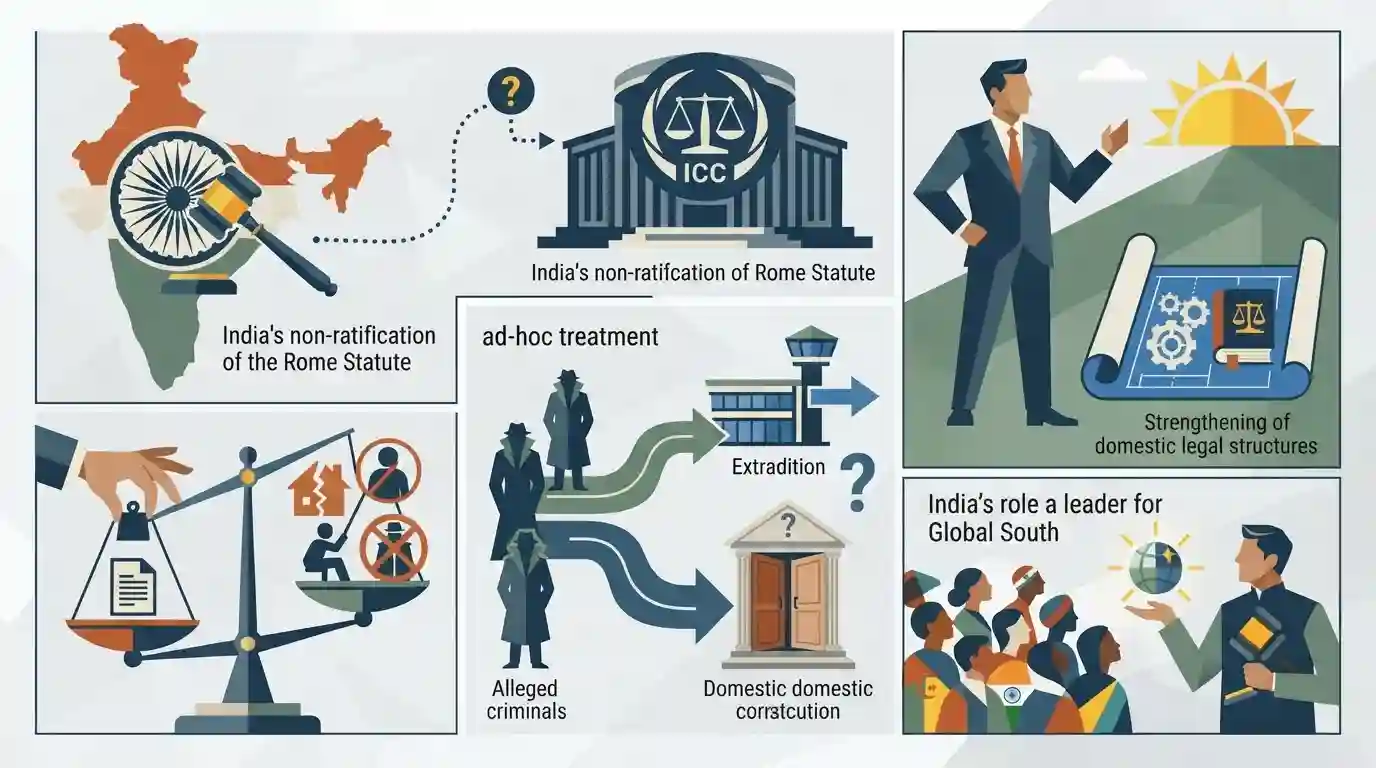
India's stance on international humanitarian law and the prosecution of war crimes is a critical component of its foreign policy, especially as it seeks a permanent seat on the UN Security Council and positions itself as a principled leader of the Global South.
సారాంశం
The article critically examines India's inconsistent approach towards the prosecution and extradition of international criminals and perpetrators of war crimes. It argues that while India has legitimate historical reservations about joining the Rome Statute of the International Criminal Court (ICC), its ad-hoc treatment of war criminals undermines its international standing. To solidify its position as a responsible global power and a moral leader for the Global South, India must strengthen its domestic legal mechanisms to align with international humanitarian law and ensure it does not become a safe haven for human rights violators.
ముఖ్య అంశాలు
- India is not a signatory to the Rome Statute and has traditionally held reservations about the International Criminal Court (ICC) over sovereignty concerns.
- The article highlights India's inconsistent or differential treatment of individuals accused of international crimes, often influenced by geopolitical alignments.
- There is a pressing need to update India's domestic legal framework (like the Geneva Conventions Act) to explicitly prosecute or extradite perpetrators of genocide and war crimes.
- Adopting a firm, consistent stance on prosecuting war criminals would enhance India's moral authority and credibility as a responsible global power.
ముఖ్యమైన పదాలు
Rome Statute

The 1998 founding treaty establishing the International Criminal Court (ICC) to prosecute individuals for war crimes, genocide, and crimes against humanity. India is not a party due to sovereignty concerns.
UPSC context
GS Paper II (International Relations): Tests understanding of multilateral treaties, global justice mechanisms, and India's sovereignty-centric foreign policy.
Geneva Conventions
Four international treaties (1949) codifying humanitarian standards in war to protect non-combatants and prisoners. India is a party, implemented domestically through the Geneva Conventions Act, 1960.
UPSC context
GS Paper II (International Relations): Tests knowledge of International Humanitarian Law, domestic legislative frameworks, and human rights in conflict zones.
International Criminal Court (ICC)
A permanent international tribunal headquartered in The Hague, established under the Rome Statute to prosecute individuals for severe international crimes. India is not a member.
UPSC context
GS Paper II (Important International Institutions): Tests grasp of international tribunals, global judicial accountability, and India's diplomatic reservations.
United Nations Security Council (UNSC)
A principal UN organ charged with maintaining global peace and security. It has fifteen members, including five permanent veto-wielding powers. India actively seeks permanent membership.
UPSC context
GS Paper II (Bilateral, Regional & Global Groupings): Tests knowledge of global security governance, institutional reform debates, and India's strategic ambitions.
ప్రిలిమ్స్ ఉచ్చు
India has neither signed nor ratified the 1948 UN Genocide Convention.
India signed and ratified the Genocide Convention by 1959. The actual issue is its failure to enact domestic legislation criminalizing genocide, relying instead on generic penal provisions.
అనుసంధానమైన స్థిర భావనలు
How does the International Criminal Court (ICC) differ from the ICJ?
- Different Mandates: The ICC prosecutes individuals for war crimes and genocide, whereas the ICJ resolves legal disputes submitted by member states.
- Institutional Origin: The ICJ is a principal organ of the United Nations. The ICC is an independent body established by the 1998 Rome Statute.
- India's Membership: India is a member of the ICJ but has consistently refused to sign the Rome Statute, citing sovereignty and UNSC interference concerns.
What is 'Universal Jurisdiction' and how does India apply it?
- Definition: A legal principle allowing states to claim criminal jurisdiction over an accused person regardless of where the crime occurred or their nationality, usually for severe international crimes.
- Indian Legal Framework: India recognizes universal jurisdiction only under specific frameworks: piracy (Maritime Anti-Piracy Act, 2022) and war crimes (Geneva Conventions Act, 1960).
అంతర-అంశ నమూనాలు
Article 51 & Treaty Enforcement
The lack of a domestic Genocide law highlights the gap between Article 51 (Directive Principle to respect treaties) and Article 253 (Parliament's exclusive power to legislate for treaty implementation).
Geopolitics of Asylum and Extradition
India's ad-hoc treatment of war criminals parallels its lack of a formal national refugee law, making extradition and deportation highly dependent on geopolitical alignments rather than statutory mandates.

Expect a multi-statement question contrasting ICC vs ICJ mandates, combined with India's specific objections to the Rome Statute.
అనుసంధాన PYQలు · 1
అనుసంధాన PYQలు · 1
- 2024MainsGS2
‘Terrorism has become a significant threat to global peace and security.’ Evaluate the effectiveness of the United Nations Security Council's Counter Terrorism Committee (CTC) and its associated bodies in addressing and mitigating this threat at the international level.
