India Vision to Become Global Artificial Intelligence Superpower
Source:The Hindu ↗
Why It Matters
It provides a comprehensive overview of India's strategic roadmap for Artificial Intelligence, covering technological innovation, digital public infrastructure, ethical regulation, and the socioeconomic impact on employment. It is highly relevant for GS3 S&T and Economy, as well as GS2 E-governance topics.
Summary
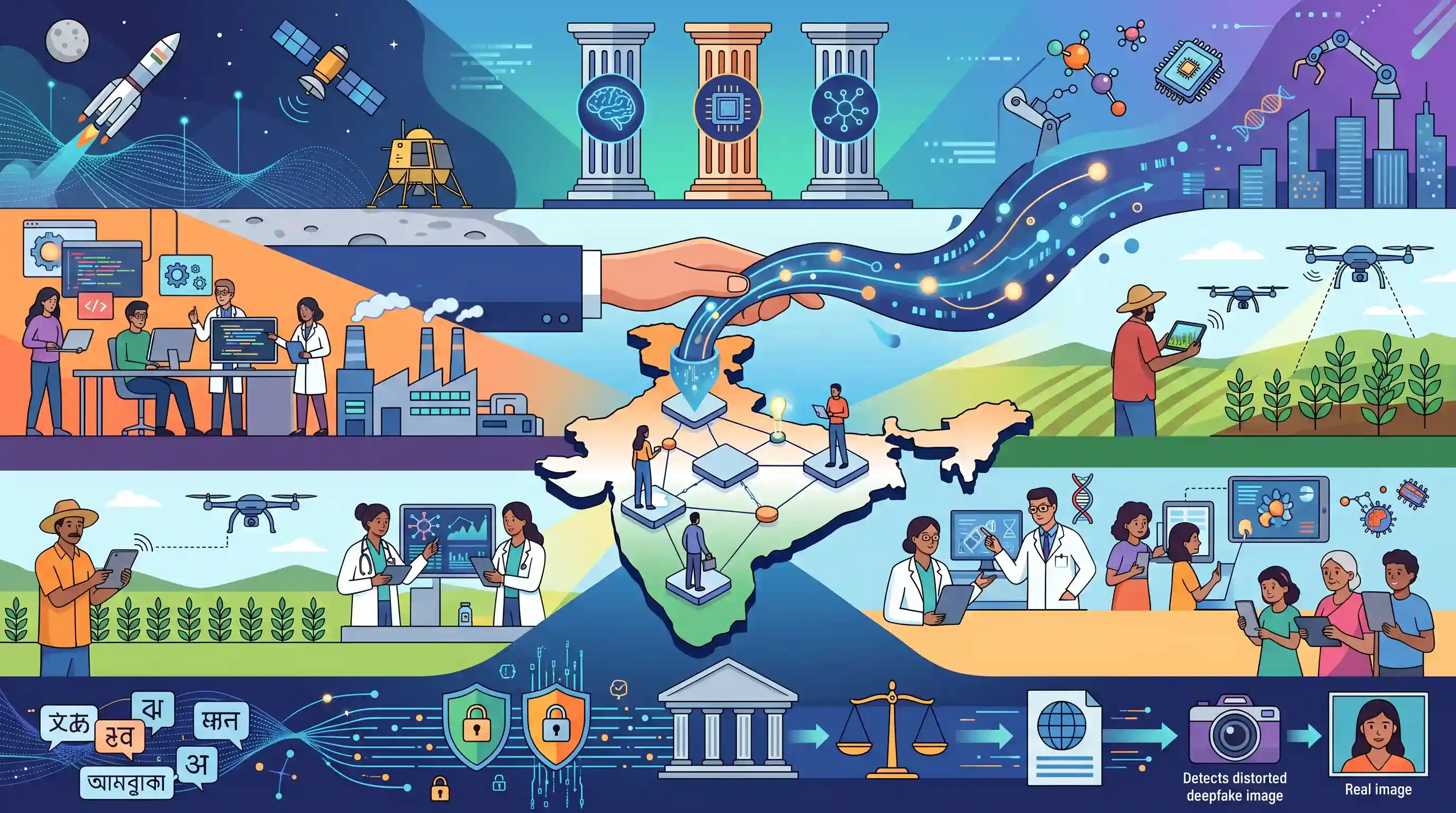
The article details Prime Minister Narendra Modi's vision at the AI Impact Summit 2026 to position India among the top three global Artificial Intelligence superpowers. Emphasizing a shift from consuming to creating AI technologies, the strategy is built on sovereignty, inclusivity, and innovation. The government plans to integrate AI with India's established Digital Public Infrastructure (DPI) to enhance governance, healthcare, and agriculture while addressing AI biases through diverse, regional-language datasets. Additionally, robust regulatory frameworks like the IndiaAI Safety Institute and the DPDP Act are being established to counter deepfakes and ensure human-centric AI. The initiative also focuses on massive upskilling to harness the demographic dividend amidst technological disruption.
Key Points
- India is hosting the AI Impact Summit 2026, marking the first time a Global South country has hosted such an event, with the motto \'Sarvajan Hitay, Sarvajan Sukhaye\' (Welfare for all).
- The Prime Minister outlined three pillars for AI under Aatmanirbhar Bharat: sovereignty, inclusivity, and innovation, aiming to make India a creator of homegrown AI models and rank among the top three AI superpowers globally.
- AI is actively being leveraged for inclusive development in healthcare (disease detection), education (personalized learning in regional languages), agriculture (Bharat Vistaar), and dairy farming (Amul).
- The integration of Artificial Intelligence with Digital Public Infrastructure (DPI) like Aadhaar and UPI is identified as the next frontier for responsive, transparent e-governance.
- To combat AI bias, deepfakes, and ensure safety, India launched the IndiaAI Safety Institute in 2025, mandated watermarking for synthetic media, and implemented the Digital Personal Data Protection Act.
- Addressing automation fears, the government is establishing National Centres of Excellence for Skilling, arguing that AI will transform rather than replace the IT sector and jobs.
Important Terms
IndiaAI Mission

A comprehensive national initiative with an outlay of ₹10,372 crore to build a robust AI ecosystem through high-end compute capacity (GPUs), dataset platforms, and indigenous foundational models.
UPSC context
GS Paper III (Science & Tech); crucial for topics on technological sovereignty and the Fourth Industrial Revolution.
Bharat Vistaar
A multilingual, AI-powered conversational advisory system launched to provide farmers with real-time, location-specific agricultural guidance by integrating AgriStack, weather data, and government schemes.
UPSC context
GS Paper III (Agriculture); relevant for e-technology in the aid of farmers and doubling farmer income.
IndiaAI Safety Institute
An agency established under the IndiaAI Mission to manage AI-related risks, develop indigenous safety standards, and conduct research on deepfake detection and algorithmic bias mitigation.
UPSC context
GS Paper III (IT & Cyber Security); tests understanding of regulatory frameworks for emerging technologies.
Digital Personal Data Protection Act, 2023
India's first comprehensive legal framework for digital privacy, defining rights of individuals (Data Principals) and obligations of entities (Data Fiduciaries) while establishing the Data Protection Board.
UPSC context
GS Paper II (Governance/Polity); key for fundamental rights (Article 21) and data sovereignty discussions.
2023 GPAI New Delhi Declaration
A multilateral agreement adopted by 29 members to prioritize ethical AI, risk mitigation, and international collaboration, specifically targeting applications in healthcare and agriculture.
UPSC context
GS Paper II (International Relations); reflects India’s leadership in global tech governance and the Global South.
Digital Public Infrastructure (DPI)
A shared digital foundation (comprising Aadhaar, UPI, etc.) that enables the delivery of public and private services at population scale through open standards and interoperability.
UPSC context
GS Paper III (Economic Development/IT); central to India's strategy for inclusive growth and e-governance.
Prelims Trap
The IndiaAI Safety Institute is a statutory body established directly under the Digital Personal Data Protection Act.
The Institute coordinates AI safety and synthetic media watermarking. While the DPDP Act supports data privacy, it did not statutorily establish this AI-specific institute.
Static Concepts Connected
What are the core components of Digital Public Infrastructure (DPI)?
- Digital Identity: Verifiable foundational IDs (e.g., Aadhaar) serving as the primary trust layer for citizen authentication.
- Digital Payments: Interoperable, fast payment gateways (e.g., UPI) enabling frictionless financial inclusion and service delivery.
- Data Exchange: Consent-based data sharing frameworks like DEPA (Data Empowerment and Protection Architecture) ensuring secure information flow.
What are the existing legal mechanisms addressing deepfakes in India?
- IT Rules: Intermediaries must remove reported deepfake or morphed content within 24 hours under the IT Rules, 2021.
- BNS Provisions: The Bharatiya Nyaya Sanhita (BNS) tackles the malicious use of deepfakes through provisions on defamation, forgery, and identity theft.
- DPDP Act: Restricts the unauthorized scraping and usage of citizens' personal data to train the AI models that generate synthetic media.
Cross-Topic Patterns
AI layered on foundational DPI
Integrating generative AI (like regional voice assistants) with existing DPIs (Aadhaar/UPI) shifts e-governance from static back-end portals to predictive, responsive front-end citizen delivery.
Sovereign AI vs. Data Colonization
Developing indigenous compute models using localized, vernacular datasets counters Western AI bias and protects India's digital borders from algorithmic data colonization.

Expect a GS3 Mains question evaluating how generative AI layered on India's DPI (Bharat VISTAAR) can bridge the rural-urban governance divide.
Linked PYQs · 5
Linked PYQs · 5
- 2023MainsGS3
Introduce the concept of Artificial Intelligence (AI). How does Al help clinical diagnosis? Do you perceive any threat to privacy of the individual in the use of Al in healthcare?
- 2023MainsGS3
What is the status of digitalization in the Indian economy? Examine the problems faced in this regard and suggest improvements.
- 2020MainsGS2
The emergence of Fourth Industrial Revolution (Digital Revolution) has initiated e-Governance as an integral part of government". Discuss.
- 2025MainsGS2
e-governance projects have a built-in bias towards technology and back-end integration than user-centric designs. Examine.
- 2014MainsGS3
While we flaunt India's demographic dividend, we ignore the dropping rates of employability. What are we missing while doing so? Where will the jobs that India desperately needs come from? Explain.
