India to Ease Quality Control Orders for Trade Partners
Source:Indian Express ↗
Why It Matters
This issue perfectly illustrates the tightrope walk between protecting domestic industries (import substitution via QCOs) and maintaining healthy global trade relations. It is highly relevant for GS-III (Economy - Industrial Policy, Liberalization, Protectionism) and GS-II (IR - Bilateral trade frictions, WTO disputes). It underscores how domestic regulatory frameworks can inadvertently act as Non-Tariff Barriers (NTBs) and disrupt local manufacturing supply chains if implemented rigidly.
Summary
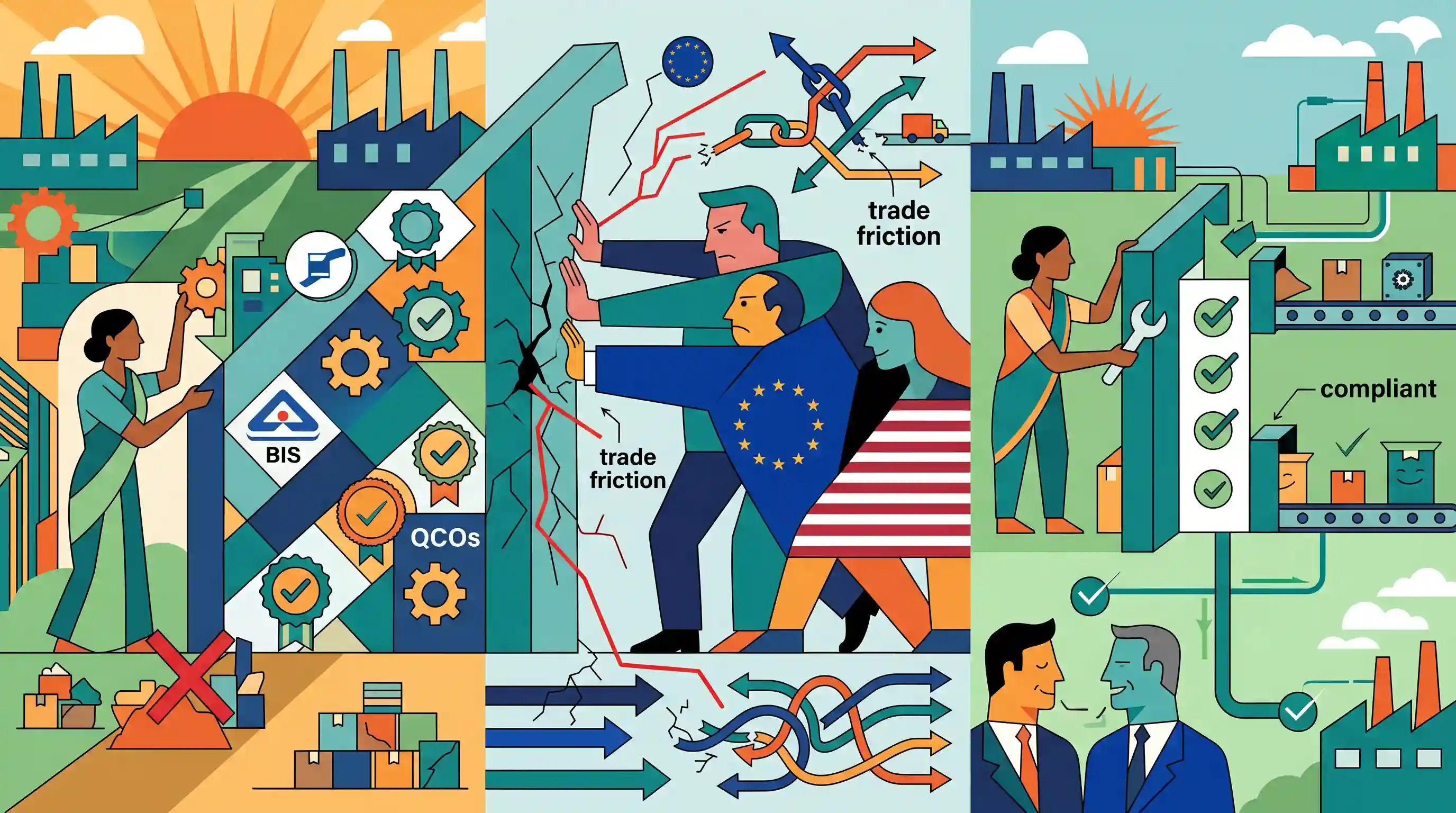
India is preparing to ease mandatory Quality Control Orders (QCOs) in response to pressure from major trading partners, including the US and the EU. While these Bureau of Indian Standards (BIS) norms were designed to curb cheap imports and boost domestic manufacturing, foreign partners argued they act as restrictive Non-Tariff Barriers (NTBs) that disrupt global supply chains. To safeguard domestic industries reliant on specialized imported components and to ease frictions in international trade relations, the government plans to expedite relief measures such as exemptions and simplified compliance processes.
Key Points
- India is expediting measures to provide relief on mandatory Quality Control Orders (QCOs) enforced by the Bureau of Indian Standards (BIS), responding to concerns from key trading partners like the US and the EU.
- Initially implemented to curb sub-standard imports and protect domestic industries under the Make in India initiative, these QCOs have been criticized as Non-Tariff Barriers (NTBs) and Technical Barriers to Trade (TBT).
- Trading partners have raised issues at the WTO regarding delayed factory inspections, sudden compliance deadlines, and a lack of regulatory transparency, which have disrupted global supply chains.
- To prevent domestic manufacturing from suffering due to a lack of critical imported inputs for which local substitutes are unavailable, the government is considering exemptions, deadline extensions, and simplified certification for trusted sources.
- This recalibration represents a pragmatic balancing act between domestic import substitution goals and the necessity of maintaining smooth international trade relations and supply chain integration.
Important Terms
Quality Control Orders (QCOs)

Mandatory standards issued by the Indian government under the BIS Act, 2016. They ensure product safety and quality, often used to curb substandard imports and support domestic manufacturing.
UPSC context
GS Paper 3 (Economy); relevant for industrial policy, import substitution, and trade relations with major partners like China and the USA.
Non-Tariff Barriers (NTBs)
Trade restrictions other than customs duties—such as quotas, licensing, and technical regulations. They can serve legitimate public health goals or act as disguised protectionism.
UPSC context
GS Paper 3 (International Trade); tests understanding of protectionist tools and their impact on global supply chains and export competitiveness.
Technical Barriers to Trade (TBT) Agreement
A World Trade Organization treaty ensuring that technical regulations, standards, and certification procedures do not create unnecessary trade obstacles. It promotes international harmonization of standards.
UPSC context
GS Paper 3 (International Trade); essential for understanding WTO compliance and disputes regarding India's domestic quality standards.
Bureau of Indian Standards (BIS)
The national standards body of India established under the BIS Act, 2016. It formulates standards, operates certification schemes (ISI mark), and enforces Quality Control Orders.
UPSC context
GS Paper 3 (Economy/Industrial Growth); key institution for ensuring product quality, consumer protection, and facilitating international trade competitiveness.
Make in India
A flagship 2014 initiative aiming to transform India into a global manufacturing hub by boosting infrastructure, improving ease of doing business, and attracting foreign investment.
UPSC context
GS Paper 3 (Economic Development/Industrial Policy); fundamental for analyzing shifts in India's trade strategy and domestic manufacturing ambitions.
World Trade Organization (WTO)
The only global international organization dealing with rules of trade between nations. It provides a forum for negotiations and a mechanism for settling trade-related disputes.
UPSC context
GS Paper 2 (International Institutions); critical for studying multilateral trade agreements and India's role in global trade governance.
Prelims Trap
"WTO rules completely prohibit member nations from imposing mandatory quality standards on imports."
The WTO's TBT Agreement allows countries to adopt product standards for safety and quality, provided they don't create discriminatory or unnecessary trade obstacles.
Static Concepts Connected
How do WTO's TBT and SPS agreements differ?
- TBT Agreement: Covers technical regulations, product standards, and packaging rules for all goods (e.g., BIS marks on electronics).
- SPS Agreement: Applies specifically to food safety, animal, and plant health standards (e.g., restricting agricultural imports due to pests).
What constitutes a Non-Tariff Barrier (NTB)?
- Definition: Any structural trade restriction or hurdle that is not a direct tax or tariff (customs duty) on imports.
- Examples: Import quotas, complex licensing regimes, unreasonable quality control orders, embargoes, and artificially delayed customs inspections.
- WTO Stance: WTO discourages NTBs when used as disguised protectionism, mandating that domestic regulations be transparent and non-discriminatory toward foreign goods.
Cross-Topic Patterns
QCOs vs. Global Value Chains (GVCs)
Strict import substitution policies often clash with GVC integration, as domestic 'Make in India' manufacturers rely heavily on specialized foreign intermediate goods to produce competitive exports.
China-targeting collateral damage
While QCOs were primarily designed to check cheap Chinese dumping, their blanket application unintentionally triggered WTO trade frictions with strategic Western partners like the US and EU.

Expect a 2026 Prelims statement question distinguishing WTO's TBT vs SPS agreements, explicitly linked to India's Quality Control Orders.
Linked PYQs · 3
Linked PYQs · 3
- 2025MainsGS3
What are the challenges before the Indian economy when the world is moving away from free trade and multilateralism to protectionism and bilateralism? How can these challenges be met?
- 2018MainsGS3
How would the recent phenomena of protectionism and currency manipulations in world trade affect macroeconomic stability of India?
- 2023PrelimsGS1
Consider the following statements: Statement-I: Recently, the United States of America (USA) and the European Union (EU) have launched the 'Trade and Technology Council'. Statement-II: The USA and the EU claim that through this they are trying to bring technological progress and physical productivity under their control. Which one of the following is correct in respect of the above statements?
