India Poised to Become World Third Largest Economy Says Minister
Source:The Hindu ↗
Why It Matters
The article provides valuable current data (such as R&D spending, patent filings, and budget allocations for AI and semiconductors) that candidates can use to substantiate answers on India's economic growth, technological self-reliance, and improvements in the higher education sector across GS2 and GS3.
Summary
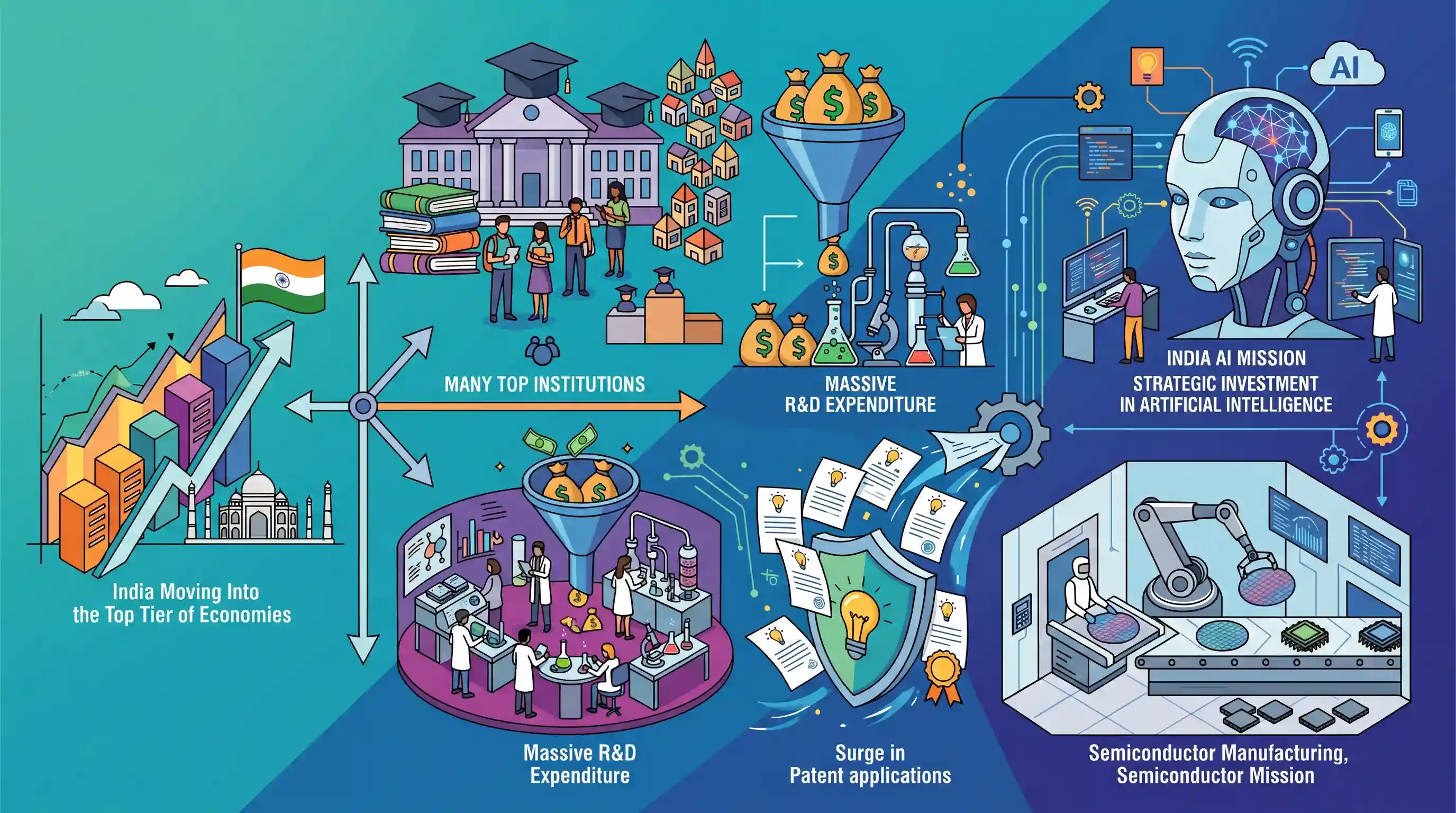
Union Minister Pralhad Joshi has stated that India is on track to emerge as the world’s third-largest economy, driven by significant strides in education, research, and emerging technologies. He highlighted that 54 Indian institutions are now part of the QS World University Rankings 2026. Emphasizing the government's push for innovation, he cited an R&D expenditure of ₹1.27 lakh crore and a surge in patent applications to 92,000. Furthermore, India ranks third globally in Science and Engineering PhDs. The government is also making massive strategic investments, including ₹10,300 crore for the India AI Mission and a ₹40,000 crore allocation for the India Semiconductor Mission 2.0 in the recent budget.
Key Points
- India is poised to become the third-largest economy globally, supported by robust economic and technological advancements.
- 54 Indian institutions have been featured in the QS World University Rankings 2026, indicating progress in higher education.
- India's R&D expenditure stands at ₹1.27 lakh crore, accompanied by an increase in annual patent applications to 92,000.
- According to the US NSF's Science and Engineering Indicators 2022, India ranks third globally in Science and Engineering PhDs.
- The Union Government is investing heavily in future technologies, with over ₹10,300 crore allocated to the India AI Mission and ₹40,000 crore to the India Semiconductor Mission (ISM) 2.0 in the 2026-27 Budget.
Important Terms
India AI Mission

A ₹10,372 crore national initiative to build India's AI ecosystem through compute infrastructure (10,000+ GPUs), startup financing, and a Datasets Platform to drive digital economic growth.
UPSC context
GS Paper 3: Science and Technology. Crucial for questions on digital sovereignty, AI governance, and industrial growth.
India Semiconductor Mission (ISM) 2.0
The second phase of India’s chip-manufacturing program (announced in Budget 2026-27 with ₹40,000 crore outlay) focusing on indigenous design, advanced nodes (3nm/2nm), and semiconductor equipment manufacturing.
UPSC context
GS Paper 3: Infrastructure and Economic Development. Key for 'Atmanirbhar Bharat' and global supply chain resilience.
US National Science Foundation (NSF)
An independent US federal agency whose 'Science and Engineering Indicators' report ranks India 3rd globally in scientific publications and PhDs, serving as a benchmark for India’s research standing.
UPSC context
GS Paper 3: Science and Technology. Used as an authoritative data source for India's global research and development metrics.
QS World University Rankings
A global ranking of universities. In the 2026 edition, a record 54 Indian institutions were featured, reflecting the impact of the National Education Policy (NEP) 2020 on academic visibility.
UPSC context
GS Paper 2: Issues relating to Education. Relevant for discussions on higher education quality and international benchmarking.
Intellectual Property Rights (IPR)
Legal rights for intellectual creations. India's surge to 92,000 patent applications highlights a shift toward a knowledge economy and the strengthening of the innovation ecosystem.
UPSC context
GS Paper 3: Issues relating to Intellectual Property Rights. Essential for topics on innovation, trade, and economic incentives.
Prelims Trap
India's R&D expenditure as a percentage of GDP has consistently increased to cross the global average.
Despite high absolute numbers (₹1.27 lakh crore), India's R&D expenditure hovers around 0.65% of GDP, which remains far below the global average.
Static Concepts Connected
What governs Intellectual Property Rights (IPR) administration in India?
- Nodal Agency: The Department for Promotion of Industry and Internal Trade (DPIIT) under the Ministry of Commerce and Industry oversees IPR administration.
- Key Acts: The Patents Act 1970, Trademarks Act 1999, and GI Act 1999 form the statutory foundation.
- TRIPS Alignment: India amended its patent laws in 2005 to fully comply with the WTO's TRIPS agreement, introducing product patents.
What is the India Semiconductor Mission (ISM) framework?
- Nodal Body: It is established within the Digital India Corporation under the Ministry of Electronics and IT (MeitY).
- Financial Support: Offers up to 50% of the project cost on pari-passu basis for setting up Semiconductor and Display Fabs in India.
- Design Focus: Includes a Design Linked Incentive (DLI) scheme to financially support domestic fabless startups developing semiconductor designs.
Cross-Topic Patterns
STEM Output vs. Employability Gap
India's high rank in STEM PhDs contrasts with skill gap reports highlighting low technical employability, directly feeding Demographic Dividend debates in GS3.
Tech Sovereignty & Quad Alignment
The ₹40,000 crore ISM 2.0 allocation supports Quad's critical technology supply chain resilience initiatives, aiming to decouple from Chinese electronics manufacturing.

Expect a multi-statement 2026 Prelims question mixing India Semiconductor Mission's nodal agency with R&D-to-GDP ratio and patent trends.
Linked PYQs · 3
Linked PYQs · 3
- 2025MainsGS3
India aims to become a semiconductor manufacturing hub. What are the challenges faced by the semiconductor industry in India? Mention the salient features of the India Semiconductor Mission.
- 2024MainsGS3
What is the present world scenario of intellectual property rights with respect to life materials? Although, India is second in the world to file patents, still only a few have been commercialized. Explain the reasons behind this less commercialization.
- 2015MainsGS2
The quality of higher education in India requires major improvements to make it internationally competitive. Do you think that the entry of foreign educational institutions would help improve the quality of higher and technical education in the country? Discuss.
