India shapes strategic roadmap for semiconductor and AI chips
Source:Indian Express ↗
हे का महत्त्वाचे आहे
It directly addresses India's high-stakes ambition to become a global semiconductor and AI hub, balancing capital-intensive fabrication goals with high-value design and supply chain resilience.
सारांश
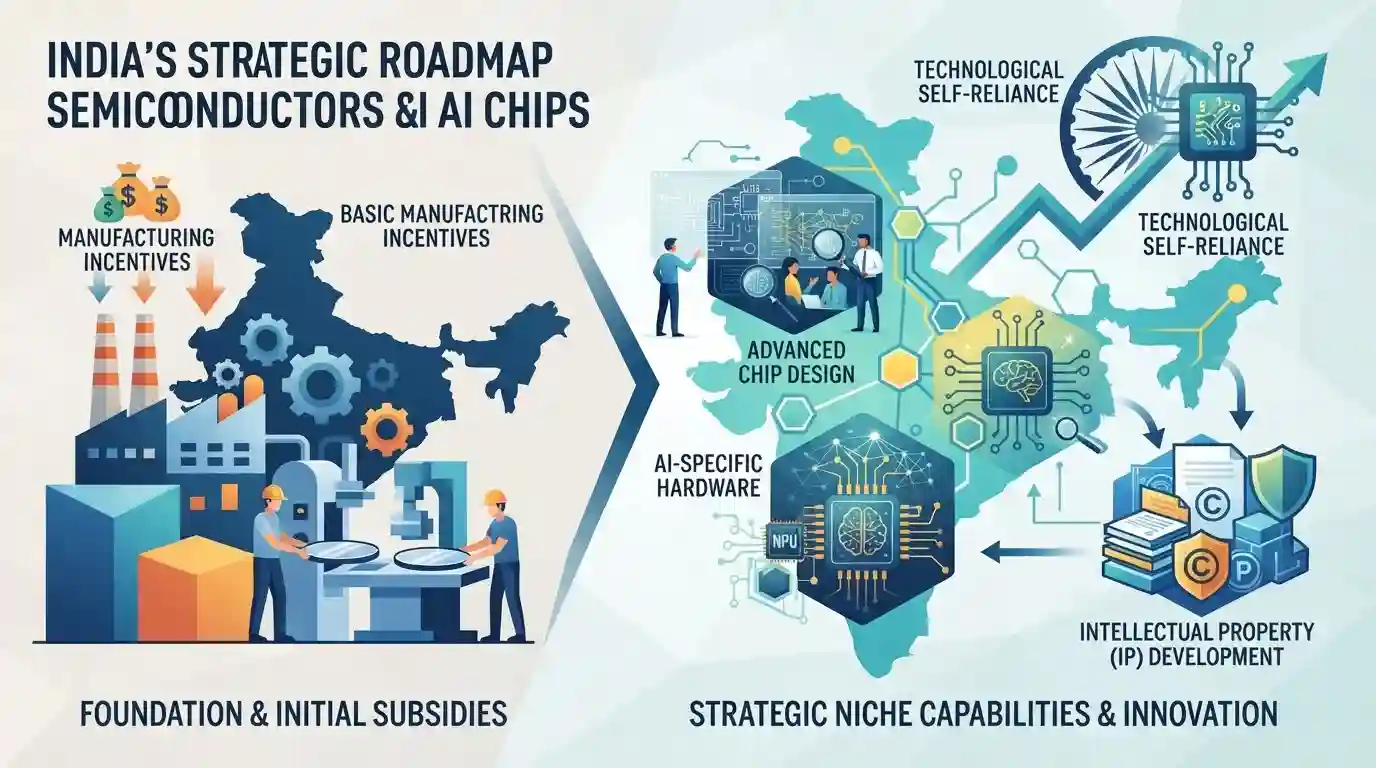
The article evaluates India's strategic roadmap for semiconductors and AI chips, emphasizing the necessity of moving beyond basic manufacturing subsidies to focus on niche capabilities like chip design, AI-specific hardware, and intellectual property development to secure technological self-reliance.
मुख्य मुद्दे
- India's strategy for semiconductor and AI chips requires shifting focus beyond traditional silicon fabs toward specialized AI hardware, design, and advanced packaging.
- The global semiconductor supply chain is intensely competitive and geoeconomically sensitive, making strategic autonomy a key priority for India.
- Success in the AI era depends on moving up the value chain from pure assembly and testing (OSAT) to custom chip design, intellectual property (IP), and sovereign compute capabilities.
- Policy interventions need to address skill deficits, R&D funding gaps, and foster a robust fabless ecosystem to complement fabrication investments.
महत्त्वाच्या संज्ञा
Production Linked Incentive (PLI) scheme

A flagship financial incentive program launched by the Indian government to boost domestic manufacturing, attract large-scale investments, and enhance industrial competitiveness across key sectors including electronics and semiconductors.
UPSC context
GS Paper III: Government policies, industrial growth, and indigenization of technology. Tests understanding of fiscal incentives for manufacturing.
India Semiconductor Mission (ISM)
A specialized nodal agency under the Ministry of Electronics and Information Technology (MeitY) tasked with driving India's semiconductor and display ecosystem strategy and managing financial support programs.
UPSC context
GS Paper III: IT & Computers, technology missions, and strategic self-reliance in critical hardware.
पूर्वपरीक्षा सापळा
India's semiconductor strategy under the India Semiconductor Mission is restricted exclusively to setting up silicon fabrication plants.
Aspirants often confuse the India Semiconductor Mission (ISM) as only supporting physical manufacturing (fabs), ignoring that it also covers compound semiconductors, ATMP/OSAT, and fabless design through separate incentives.
संबंधित स्थिर संकल्पना
What is the structural difference between Fab-based and Fabless semiconductor business models?
- Fabrication Fabs: Pure-play foundries (Fabs) handle physical manufacturing, requiring astronomical capital expenditure, advanced cleanrooms, and extreme precision lithography equipment.
- Fabless Model: Fabless companies focus entirely on research, architecture, custom chip design, and software, outsourcing physical manufacturing to foundry giants like TSMC.
- Backend OSAT: ATMP/OSAT facilities handle Assembly, Testing, Marking, and Packaging, representing the labor-intensive backend of the semiconductor value chain.
आंतर-विषय नमुने
Semiconductors + Critical Minerals Supply Chains
India's semiconductor push requires massive capital and specialized minerals like gallium and germanium, linking industrial policy directly with critical mineral diplomacy and supply chain security initiatives like the MSP.
AI Sovereignty + Defense Technology Autonomy
Developing sovereign AI compute and custom chip design ties advanced technological indigenization to national security frameworks and defense modernization under Atmanirbhar Bharat.

Expect a multi-statement prelims question distinguishing the fiscal coverage and objective differences between PLI for Fabs and the DLI scheme.
संबंधित PYQ · 2
संबंधित PYQ · 2
- 2025MainsGS3
India aims to become a semiconductor manufacturing hub. What are the challenges faced by the semiconductor industry in India? Mention the salient features of the India Semiconductor Mission.
- 2025MainsGS3
Discuss the rationale of the Production Linked Incentive (PLI) scheme. What are its achievements? In what way can the functioning and outcomes of the scheme be improved?
