India Semiconductor and AI Chip Manufacturing Strategy
Source:Indian Express ↗
কেন এটি গুরুত্বপূর্ণ
Directly addresses India's evolving tech policy, semiconductor strategy, and AI ambitions, which are central to GS3 Science & Technology and Economic Development syllabus.
সারসংক্ষেপ
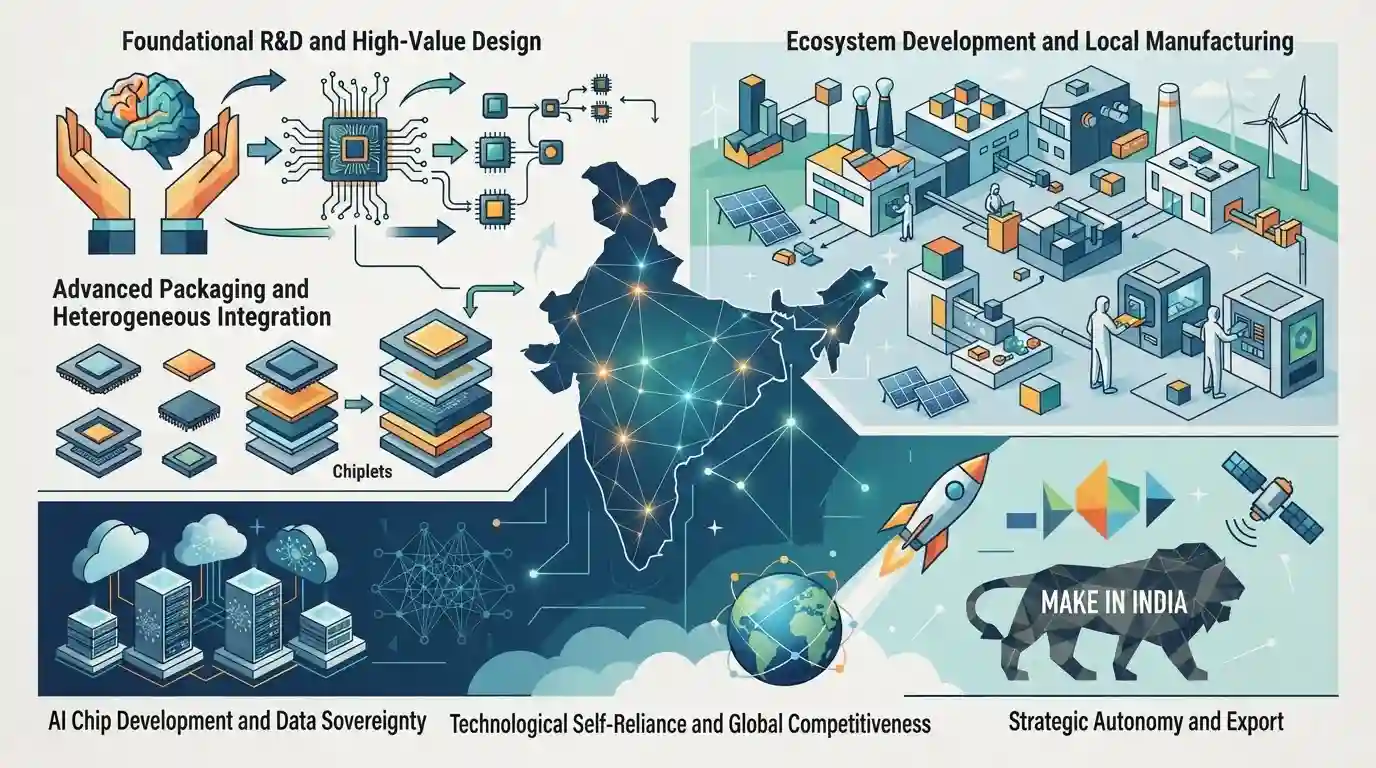
The article discusses India's strategic roadmap for semiconductor and artificial intelligence (AI) chips, emphasizing the need to focus on high-value design, advanced packaging, and ecosystem development rather than just low-end assembly, aligning with broader technological self-reliance goals.
মূল বিষয়
- India's strategy for semiconductors and AI chips requires moving beyond assembly and testing towards advanced chip design, architecture, and specialized AI workloads.
- The semiconductor global value chain is deeply fragmented and resource-intensive, requiring robust ecosystem support, talent development, and intellectual property creation.
- Integrating AI chip development with domestic industrial demand can position India as a critical player in futuristic technological governance and manufacturing.
গুরুত্বপূর্ণ শব্দ
India Semiconductor Mission

A dedicated nodal agency under the Ministry of Electronics and Information Technology (MeitY) tasked with driving India's semiconductor and display ecosystem development and financial incentive programs.
UPSC context
GS Paper III (Technology, Industrial Policy). Tests India's strategic roadmap for tech self-reliance, manufacturing, and critical supply chains.
Production Linked Incentive Scheme
A flagship fiscal incentive scheme by the Government of India designed to boost domestic manufacturing, attract large-scale investments, and integrate Indian industries into global supply chains across key sectors.
UPSC context
GS Paper III (Indian Economy, Manufacturing Sector). Tests government industrial policy instruments for export promotion and import substitution.
PLI scheme
Abbreviation for Production Linked Incentive scheme, a financial incentive framework supporting high-tech manufacturing, including semiconductors, electronics, and specialized components in India.
UPSC context
GS Paper III (Economic Development). Tests implementation and impact of fiscal policy levers on domestic manufacturing growth.
সংযুক্ত স্থির ধারণা
What are the key components of the semiconductor value chain and India's policy instruments?
- Upstream Focus: Upstream value chain involves silicon mining, polysilicon refining, wafer fabrication, and high-value Electronic Design Automation (EDA) software.
- Downstream Focus: Midstream & downstream covers OSAT (Outsourced Semiconductor Assembly and Test), advanced packaging, and testing facilities.
- Policy Support: ISM & DLI Schemes feature the India Semiconductor Mission offering financial support for fabs/displays, alongside the Design Linked Incentive for startups and IP creation.
আন্তঃবিষয় প্যাটার্ন
Semiconductors + Industrial Water Security
Semiconductor manufacturing requires ultra-pure water and reliable power, directly linking high-tech industrial policy to climate goals, water security, and state-level infrastructure disputes.
AI Chips + Critical Mineral Supply Chains
The global race for AI chips mirrors critical mineral scarcity, tying high-end manufacturing policy to diplomatic supply chain pacts like the Mineral Security Partnership (MSP).

Expect statement-based questions combining ISM, DLI scheme, and the distinction between OSAT assembly and advanced semiconductor fabrication.
সংযুক্ত PYQ · 2
সংযুক্ত PYQ · 2
- 2025MainsGS3
India aims to become a semiconductor manufacturing hub. What are the challenges faced by the semiconductor industry in India? Mention the salient features of the India Semiconductor Mission.
- 2025MainsGS3
Discuss the rationale of the Production Linked Incentive (PLI) scheme. What are its achievements? In what way can the functioning and outcomes of the scheme be improved?
