Atmanirbharta Essential for National Security and Global Order
Source:Indian Express ↗
Why It Matters
The concept of Atmanirbhar Bharat is a cornerstone of India's current economic and foreign policy. Understanding the nuances of self-reliance in the context of retreating globalization is critical for answering questions on Indian economy, industrial policy (GS3), and India's evolving role in the global order (GS2).
Summary
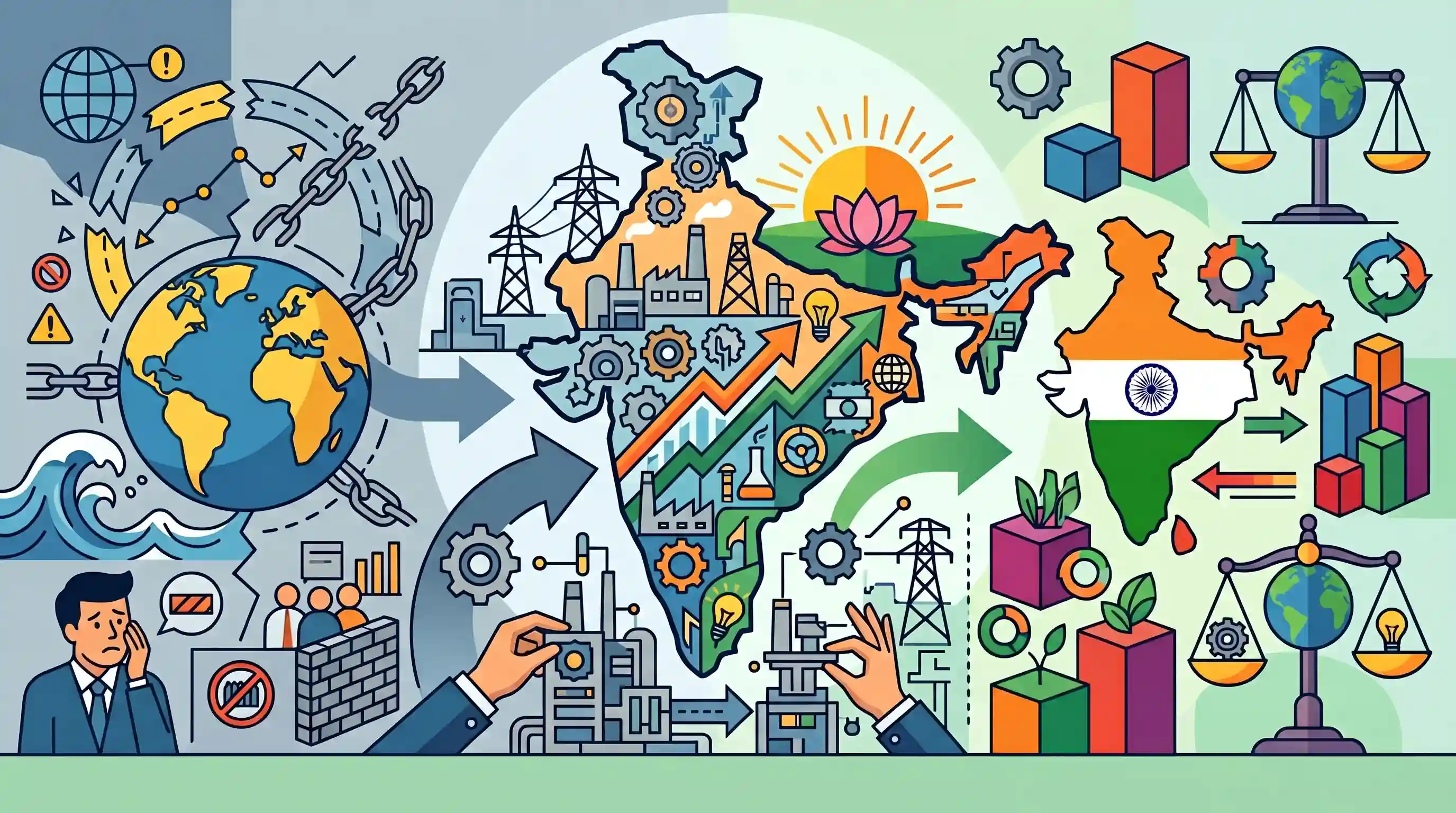
The article underscores the strategic necessity for India to pursue self-reliance (Atmanirbharta) to secure its national future and contribute to global stability. As the world transitions away from unrestrained globalization and free trade towards protectionism and bilateralism, India's over-reliance on external supply chains poses significant risks. By bolstering domestic manufacturing and technological capacities, India can insulate itself from global shocks while simultaneously enhancing its leverage in international relations. The piece reflects the leadership's vision that a robust, self-reliant India is a prerequisite for a stable, multipolar global order.
Key Points
- India's focus on self-reliance (Atmanirbharta) is essential for securing its national future and acting as a stabilizing force in the emerging global order.
- With the global economic landscape shifting away from free trade and multilateralism towards protectionism, India must reduce its vulnerabilities by strengthening domestic supply chains and manufacturing capabilities.
- Self-reliance does not imply isolationism; rather, it is about building strategic national capacities to engage with the world from a position of strength and resilience.
- The vision aligns domestic economic policies with foreign policy objectives, aiming to establish India as a crucial player in a multipolar world architecture.
Important Terms
Atmanirbhar Bharat Abhiyan

A comprehensive government initiative launched in 2020 to make India self-reliant. It focuses on five pillars: Economy, Infrastructure, Technology-driven Systems, Vibrant Demography, and Demand, aiming to reduce import dependency.
UPSC context
GS Paper 3 (Economy); crucial for questions on industrial policy, self-sufficiency, and economic resilience during global shocks.
Make in India
A flagship initiative launched in 2014 to transform India into a global manufacturing hub. It encourages domestic and foreign companies to manufacture products in India, targeting growth in 27 industrial sectors.
UPSC context
GS Paper 3 (Changes in industrial policy); tests knowledge of FDI, ease of doing business, and manufacturing-led growth.
Multipolar Global Order
An international system where power is distributed among multiple states or regional blocs (e.g., US, China, India, EU) rather than being dominated by one or two superpowers.
UPSC context
GS Paper 2 (International Relations); central to India's foreign policy strategy of 'strategic autonomy' and 'multi-alignment'.
Protectionism
Government policies that restrict international trade through tariffs, quotas, and subsidies to protect domestic industries from foreign competition, often as a reaction against unrestrained globalization.
UPSC context
GS Paper 3 (Effects of liberalization); tests understanding of global trade trends, WTO challenges, and domestic industrial shielding.
Global Supply Chains
The integrated network of individuals, organizations, and resources involved in moving a product from supplier to customer across multiple countries, now increasingly targeted for 'de-risking'.
UPSC context
GS Paper 3 (Infrastructure/Economy); tests knowledge of logistics, dependency on imports (like China), and supply chain resilience.
Rashtriya Swayamsevak Sangh (RSS)
A Hindu nationalist volunteer organization founded in 1925. It emphasizes national strength, discipline, and cultural self-reliance, significantly influencing the ideological framework of India's current leadership.
UPSC context
GS Paper 1 (Social Empowerment/History); relevant for understanding the ideological roots of contemporary Indian political and economic thought.
Prelims Trap
Atmanirbhar Bharat aims to completely eliminate imports and return India to an isolationist import-substitution regime.
Atmanirbharta focuses on building domestic capacity to integrate competitively into Global Value Chains (GVCs), not a return to autarky, isolationism, or blanket import bans.
Static Concepts Connected
What is the Supply Chain Resilience Initiative (SCRI)?
- Origin: A trilateral initiative formally launched by India, Japan, and Australia in 2021.
- Core Objective: To reduce dependency on a single nation (China) and build sustainable, robust supply chain networks in the Indo-Pacific region.
- Mechanism: Involves sharing best practices, promoting foreign direct investment, and matching buyers with sellers across trusted partner nations.
How does the PLI scheme mark a shift in India's Industrial Policy?
- Output-linked incentives: Subsidies are tied to incremental sales and output rather than providing upfront capital investment or tax exemptions.
- Champion building: Aims to create 'national champions' in 14 strategic sectors, including semiconductors, telecom, and pharmaceutical APIs, reducing import reliance.
- GVC Integration: Designed to achieve economies of scale and make domestic manufacturing globally competitive, facilitating deeper integration into GVCs.
Cross-Topic Patterns
Self-reliance balancing new FTAs
India's recent push for bilateral FTAs (UAE, Australia) runs parallel to Atmanirbharta, aiming to secure export markets for PLI-backed manufacturing while protecting domestic industries from unfair dumping.
Geopolitics of Critical Minerals
Self-reliance in electronics and semiconductors requires securing rare earths, directly linking GS3 industrial policy with GS2 Quad initiatives, the Minerals Security Partnership, and diplomacy in Africa.

Expect a Mains GS3 question contrasting Atmanirbhar Bharat with pre-1991 import substitution, focusing on PLI's role in GVC integration.
Linked PYQs · 3
Linked PYQs · 3
- 2025MainsGS3
What are the challenges before the Indian economy when the world is moving away from free trade and multilateralism to protectionism and bilateralism? How can these challenges be met?
- 2019MainsGS2
‘The long-sustained image of India as a leader of the oppressed and marginalised nations has disappeared on account of its new found role in the emerging global order.’ Elaborate.
- 2025MainsGS3
India aims to become a semiconductor manufacturing hub. What are the challenges faced by the semiconductor industry in India? Mention the salient features of the India Semiconductor Mission.
