School Education Enrolment Trends and NITI Aayog Insights
Source:Indian Express ↗
ఇది ఎందుకు ముఖ్యం
Understanding school education trends, particularly the dynamics between government and private school enrolments, is crucial for evaluating human capital development, policy efficacy (like NEP 2020 and RTE Act), and social equity under GS Paper 2.
సారాంశం
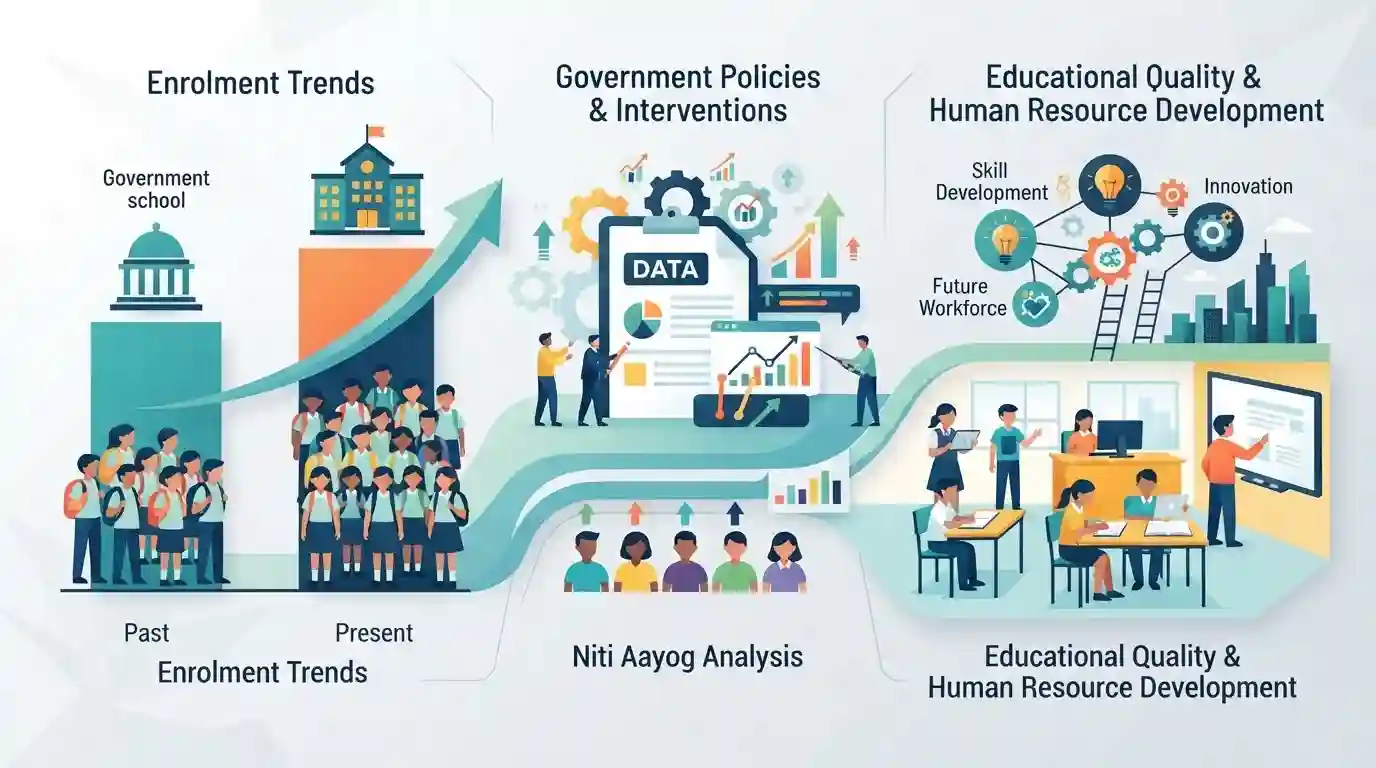
The article discusses trends in school education in India, focusing on enrolment patterns between government and private institutions as analyzed through reports such as those from Niti Aayog, touching upon broader themes of educational equity, quality, and human resource development.
ముఖ్య అంశాలు
- Analysis of school education trends in India highlights shifting patterns in enrolment between government and private schools.
- Niti Aayog's insights reflect critical aspects of human capital formation, schooling access, and educational quality.
- Shifts in enrolment patterns have implications for public policy, resource allocation, and equitable access to foundational learning.
ముఖ్యమైన పదాలు
Right of Children to Free and Compulsory Education Act 2009

A landmark legislation enacted in 2009 that makes elementary education a fundamental right for children aged 6 to 14, mandating free education, neighborhood schools, and infrastructure standards.
UPSC context
UPSC Mains GS Paper II: Social Sector, Education policies, and implementation challenges regarding fundamental rights and elementary schooling.
National Education Policy 2020
India’s comprehensive education framework introduced in 2020 to replace the 1986 policy, aiming to overhaul school and higher education through a 5+3+3+4 structure, foundational literacy, and critical thinking.
UPSC context
UPSC Mains GS Paper II: Human Resource Development, educational reforms, equity, and quality enhancement in schooling.
Niti Aayog
The premier policy think tank of the Government of India that provides strategic input, monitors development metrics, and publishes systemic analyses on sectors like education.
UPSC context
UPSC Mains GS Paper II: Governance, institutional bodies, cooperative federalism, and policy formulation in human resource sectors.
ప్రిలిమ్స్ ఉచ్చు
Government school enrolment share in India has consistently risen above 60% over the last decade due to robust public infrastructure investments.
Aspirants often assume government school enrolment has been rising due to flagship schemes like Samagra Shiksha, whereas data shows it has slipped below 50% as private enrolment grows.
అనుసంధానమైన స్థిర భావనలు
What are the key constitutional and statutory provisions governing education in India?
- Constitutional Basis: Article 21A guarantees free and compulsory education to all children aged 6-14 years as a Fundamental Right.
- RTE Mandate: The RTE Act 2009 mandates 25% reservation for children from disadvantaged and weaker sections in private unaided schools.
- Concurrent List: Education was shifted from the State List to the Concurrent List (Entry 25) via the 42nd Constitutional Amendment Act in 1976.
అంతర-అంశ నమూనాలు
School Enrolment Trends and Fiscal Federalism
The structural shift toward private schooling directly impacts fiscal federalism, as states grapple with declining student numbers in public institutions alongside rising infrastructure and salary overheads.
Demographic Dividend vs Foundational Learning Quality
The declining child population and changing enrolment ratios feed directly into India's demographic dividend discourse, shifting the policy focus from mere school access to foundational learning quality.

Expect a statement-based Q linking NITI Aayog's school enrolment findings to GER targets, school rationalization, and NEP 2020.
అనుసంధాన PYQలు · 5
అనుసంధాన PYQలు · 5
- 2023MainsGS2
Skill development programmes have succeeded in increasing human resources supply to various sectors. In the context of the statement analyse the linkages between education, skill and employment.
- 2022MainsGS2
The Right of Children to Free and Compulsory Education Act, 2009 remains inadequate in promoting incentive-based system for children's education without generating awareness about the importance of schooling. Analyse.
- 2020MainsGS2
National Education Policy 2020 is in conformity with the Sustainable Development Goal-4 (2030). It intends to restructure and reorient education system in India. Critically examine the statement.
- 2024MainsGS2
Poverty and malnutrition create a vicious cycle, adversely affecting human capital formation. What steps can be taken to break the cycle ?
- 2023MainsGS2
The crucial aspect of development process has been the inadequate attention paid to Human Resource Development in India. Suggest measures that can address this inadequacy.
