Global Supply Chain Weaponisation and Indian Economic Resilience
Source:Indian Express ↗
Why It Matters
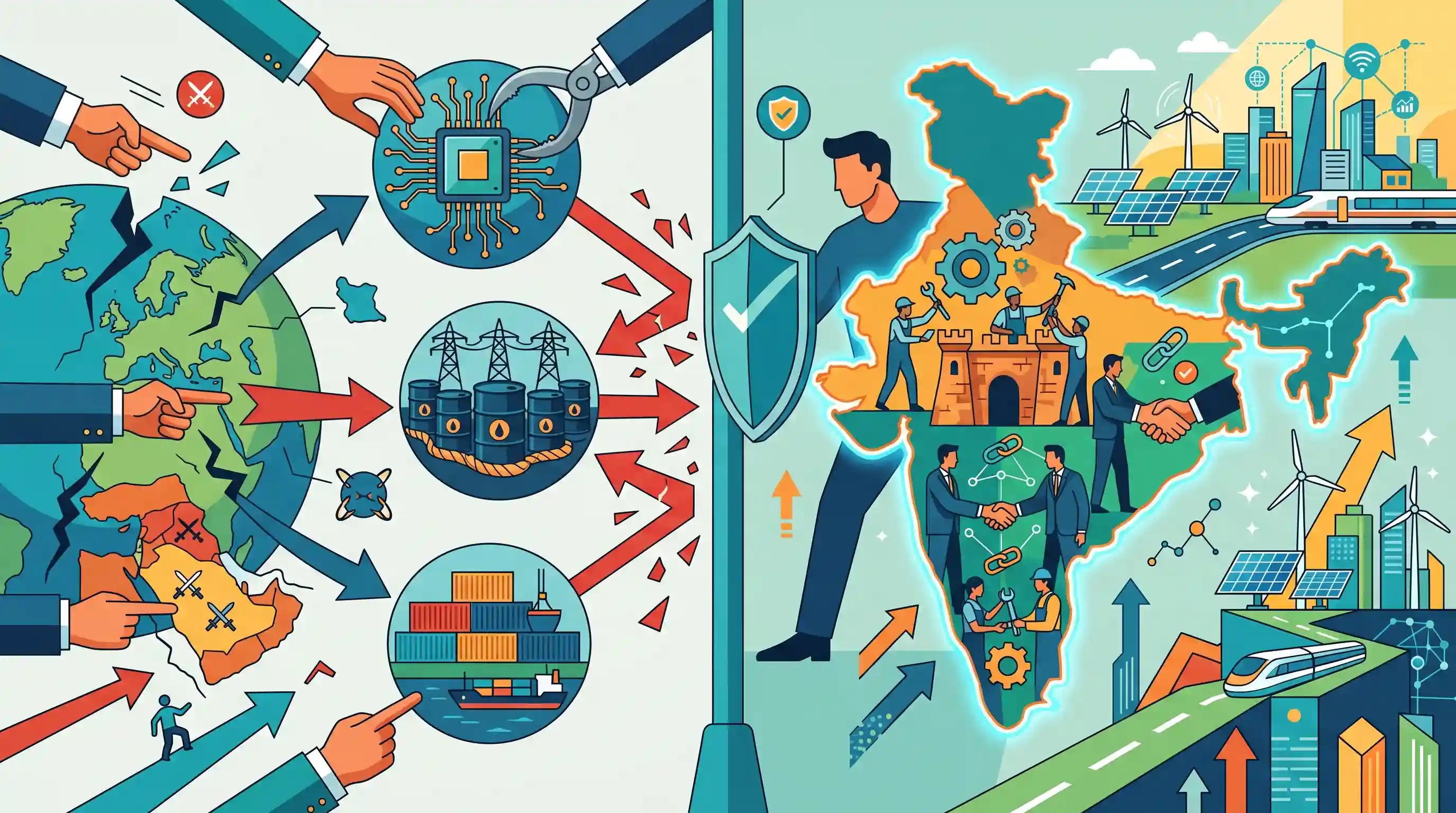
It provides a critical foreign policy perspective on how India intends to navigate an increasingly fragmented global order where trade, technology, and energy are 'weaponised'. Understanding India's strategy of 'de-risking', strategic autonomy, and domestic resilience is crucial for GS-2 (IR) and GS-3 (Economy/Security).
Summary
External Affairs Minister S Jaishankar, speaking at the IIM Raipur convocation, warned that structural shifts in the global order have led to the 'weaponisation' of critical domains such as technology, energy, and supply chains. He emphasized that heightened global competition and the current conflict in West Asia demand a focus on building national capabilities, self-reliance, and trusted global partnerships to de-risk India's strategic interests. He also praised India's resilience amid global shocks, noting the nation's success in managing domestic and external challenges while advancing toward the goal of a 'Viksit Bharat' (Developed India).
Key Points
- External Affairs Minister S Jaishankar highlighted that basic domains like technology, energy, connectivity, and military capabilities are being increasingly 'weaponised' amid structural shifts in the global order.
- India is mitigating geopolitical risks by building robust self-reliance, developing international leverage, cultivating trusted partnerships, and diversifying its supply chains.
- Despite overlapping global shocks—including conflicts in West Asia (such as the Iran-Israel tensions)—India has demonstrated strong economic resilience and remains one of the top five global economies.
- India's path to becoming a developed nation (Viksit Bharat) involves leveraging its digital revolution, demographic advantages, and inclusive growth while navigating heightened global competition and strategic risk-taking.
Important Terms
Viksit Bharat

The Government of India's vision to transform the nation into a developed country by 2047, targeting a $30-40 trillion economy and high human development standards.
UPSC context
GS Paper III: Indian Economy and development; GS Paper II: Government policies and interventions for development.
Weaponisation of everything
The strategic use of trade, technology, energy, and supply chains as tools of coercion or political leverage in international relations, rather than for purely economic exchange.
UPSC context
GS Paper II: Effect of policies and politics of developed and developing countries on India's interests.
De-risking
A strategy to reduce economic vulnerability by diversifying supply chains and reducing over-dependence on a single nation (e.g., China), without completely severing trade ties.
UPSC context
GS Paper II: Bilateral and global groupings; GS Paper III: Effects of liberalization on the economy.
Atmanirbhar Bharat
A policy framework launched in 2020 aiming to make India self-reliant through domestic manufacturing, import substitution, and integration into global supply chains without adopting an isolationist stance.
UPSC context
GS Paper III: Indian Economy, Industrial Policy, and growth. Tests understanding of self-reliance versus protectionism.
West Asia Conflict
Current regional instability involving conflicts between Israel, Hamas, and regional powers like Iran, impacting India's energy security, maritime trade (Strait of Hormuz), and diaspora safety.
UPSC context
GS Paper II: Regional and global groupings and agreements involving India and/or affecting India's interests.
Global Supply Chain Resilience
The ability of international trade networks to withstand and recover from disruptions, achieved through diversification, 'friend-shoring,' and reduced reliance on volatile geopolitical actors.
UPSC context
GS Paper III: Infrastructure, Energy, and Economy; GS Paper II: International Relations.
Prelims Trap
"To counter global shocks, India's official foreign policy advocates 'de-coupling' its economy and returning to import substitution."
India officially pursues "de-risking" (diversifying supply chains, China-plus-one), not "de-coupling" (total economic separation). Atmanirbhar Bharat promotes global resilience and integration, not isolationist autarky.
Static Concepts Connected
What is the 'Weaponization of Interdependence' in IR?
- Asymmetric control: The exploitation of global network hubs (e.g., SWIFT, semiconductor supply chains) by states that have disproportionate control over them.
- Panopticon effect: Using central nodes in global networks to gather intelligence or extract data on adversaries and allies alike.
- Chokepoint effect: Cutting off an adversary's access to critical global networks (e.g., technology export bans, financial sanctions) as a coercive foreign policy tool.
How does 'De-risking' differ from 'De-coupling'?
- De-coupling: A broad, systemic severing of economic and trade ties between two countries to eliminate overall dependence (e.g., total US-China economic separation).
- De-risking: A targeted reduction of vulnerabilities in critical, strategic sectors (like AI, energy, semiconductors) while maintaining general, non-sensitive trade relations.
Cross-Topic Patterns
SWIFT and Currency Weaponization
The exclusion of Russian banks from SWIFT showcased financial weaponization, accelerating India's drive for Rupee internationalization, Vostro accounts, and the global export of its DPI (UPI/RuPay).
Critical Minerals and the Quad
The weaponization of green tech and semiconductors directly links to the Quad's Supply Chain Resilience Initiative (SCRI) and India's entry into the US-led Minerals Security Partnership (MSP).

Expect a 2026 GS-2 question linking 'weaponization of interdependence' (tech/SWIFT) to India's DPI and supply chain resilience strategies.
Linked PYQs · 3
Linked PYQs · 3
- 2024MainsGS2
‘The West is fostering India as an alternative to reduce dependence on China's supply chain and as a strategic ally to counter China's political and economic dominance.’ Explain this statement with examples.
- 2025MainsGS2
"Energy security constitutes the dominant kingpin of India's foreign policy, and is linked with India's overarching influence in Middle Eastern countries.” How would you integrate energy security with India's foreign policy trajectories in the coming years?
- 2025MainsGS3
What are the challenges before the Indian economy when the world is moving away from free trade and multilateralism to protectionism and bilateralism? How can these challenges be met?
