Strategic autonomy and proactive diplomacy in geopolitical conflicts
Source:Indian Express ↗
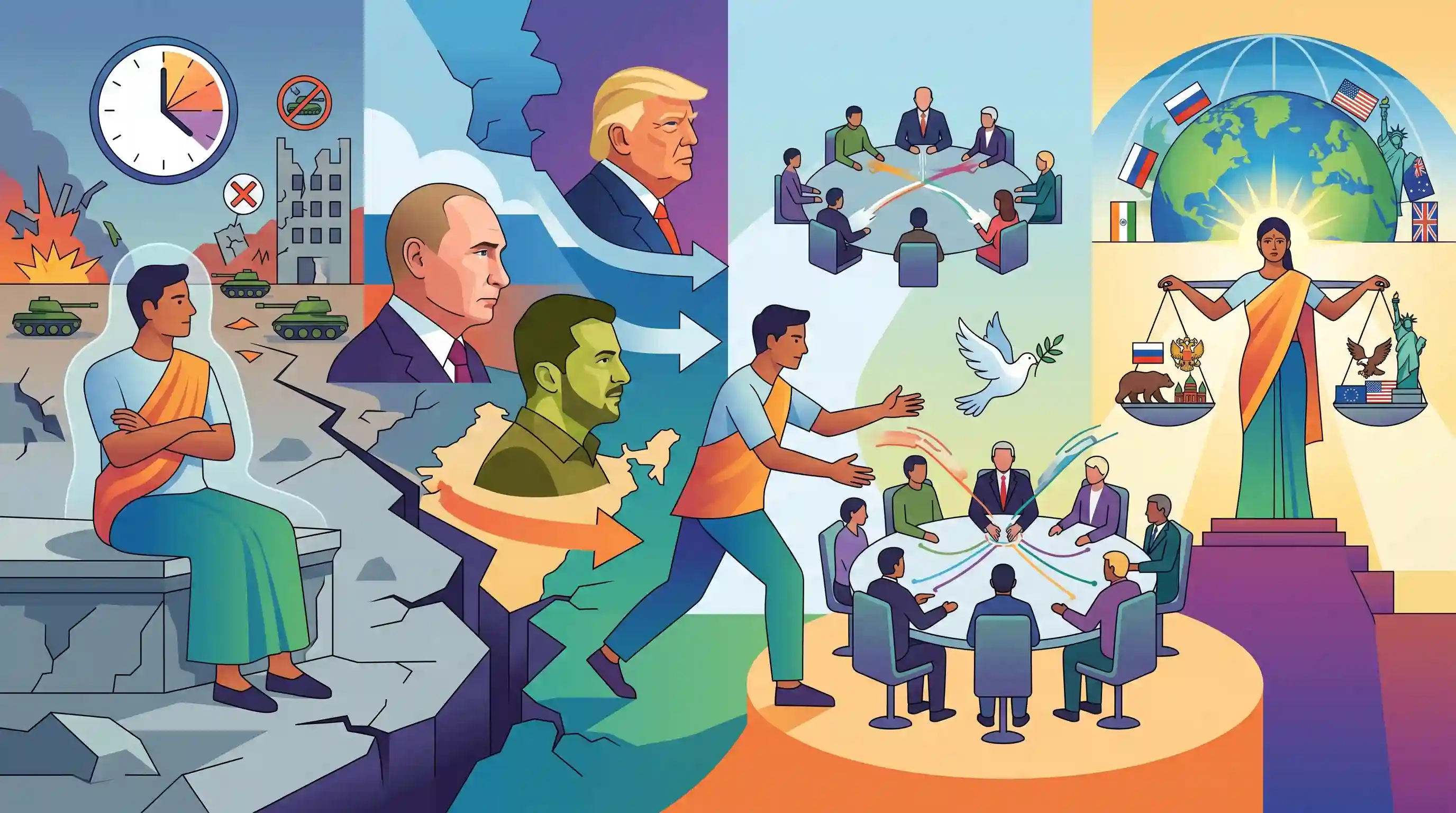
Why It Matters
This is highly relevant for GS2 (International Relations) as it tackles the core debate over India's strategic neutrality versus active diplomacy, evaluating how India manages its balancing act between historical allies and modern strategic partners amidst major global conflicts.
Summary
The article critiques India's passive 'hands-off' approach to the Russia-Ukraine war, arguing that four years into the conflict, this strategy is no longer viable. Amid evolving global geopolitics involving leaders like Vladimir Putin, Volodymyr Zelenskyy, and Donald Trump, the piece suggests India should transition to a more proactive diplomatic role. By actively participating in peacemaking and mediation efforts, India can better protect its strategic interests, balance its relations with both Russia and the West, and elevate its influence in shaping the future global order.
Key Points
- Four years into the Russia-Ukraine conflict, India's traditional 'hands-off' or neutral diplomatic strategy is increasingly seen as inadequate.
- Shifting global dynamics, influenced by political figures like Donald Trump, Vladimir Putin, and Volodymyr Zelenskyy, necessitate a reassessment of India's stance.
- India must balance its historical strategic dependence on Russia with its growing partnerships with Western nations and its outreach to Kyiv.
- A more proactive role in peacemaking and conflict resolution could significantly enhance India's global stature and strategic autonomy.
Prelims Trap
"India's policy of Strategic Autonomy mandates strict neutrality and non-interference in all international bilateral conflicts."
Strategic Autonomy does not mean passive isolation or strict neutrality; it involves issue-based alignment and proactive mediation to secure national interests.
Static Concepts Connected
What are key examples of India's early Cold War mediation efforts?
- Korean War: India chaired the Neutral Nations Repatriation Commission (1953) to resolve the prisoner-of-war issue during the Korean War.
- Indochina crises: India chaired the International Control Commission (1954) established by the Geneva Accords to oversee the ceasefire in Vietnam, Laos, and Cambodia.
- Austria (1955): India played a vital backstage diplomatic role communicating between Western powers and the USSR to help finalize the Austrian State Treaty.
Which key geographic regions form the epicenter of the Russia-Ukraine conflict?
- Donbas Region: Comprises the Donetsk and Luhansk oblasts in eastern Ukraine, historically known as a heavy industrial and coal mining hub.
- Crimean Peninsula: Annexed by Russia in 2014, it is strategically located on the northern coast of the Black Sea.
- Zaporizhzhia: Located in southeastern Ukraine along the Dnieper River, it houses Europe's largest nuclear power plant, a focal point of nuclear safety concerns.
Cross-Topic Patterns
SCO stagnation vs Quad minilateral agility
The 'virus of conflict' paralyzes consensus-driven bodies like the SCO and UN, accelerating India's pivot towards agile, issue-based minilaterals like Quad and I2U2 for strategic hedging.
From Non-Alignment to 'Vishwa Bandhu'
India is rebranding its diplomatic posture from Cold War-era Non-Alignment (NAM) to 'Vishwa Bandhu', actively attempting to mediate disputes rather than maintaining a distance from Great Power conflicts.

Expect a Mains GS2 question evaluating India's shift from 'Non-Alignment' to 'Vishwa Bandhu' in the context of global conflict mediation.
Linked PYQs · 4
Linked PYQs · 4
- 2023MainsGS2
‘Virus of Conflict is affecting the functioning of the SCO’ In the light of the above statement point out the role of India in mitigating the problems.
- 2023PrelimsGS1
Consider the following countries: 1. Bulgaria 2. Czech Republic 3. Hungary 4. Latvia 5. Lithuania 6. Romania How many of the above-mentioned countries share a land border with Ukraine?
- 2023PrelimsGS1
Consider the following pairs: Regions often mentioned in news Reason for being in news 1. North Kivu and Ituri : War between Armenia and Azerbaijan 2. Nagorno-Karabakh : Insurgency in Mozambique 3. Kherson and Zaporizhzhia : Dispute between Israel and Lebanon How many of the above pairs are correctly matched?
- 2023PrelimsGS1
Consider the following pairs: Area of conflict mentioned in news Country where it is located 1. Donbas : Syria 2. Kachin : Ethiopia 3. Tigray : North Yemen How many of the above pairs are correctly matched?
