India Diplomatic Peace Proposals and Black Sea Ceasefire
Source:Indian Express ↗
Why It Matters
Crucial for understanding India's strategic foreign policy shift towards active mediation in major geopolitical conflicts, reinforcing its status as a global player and voice of the Global South.
Summary
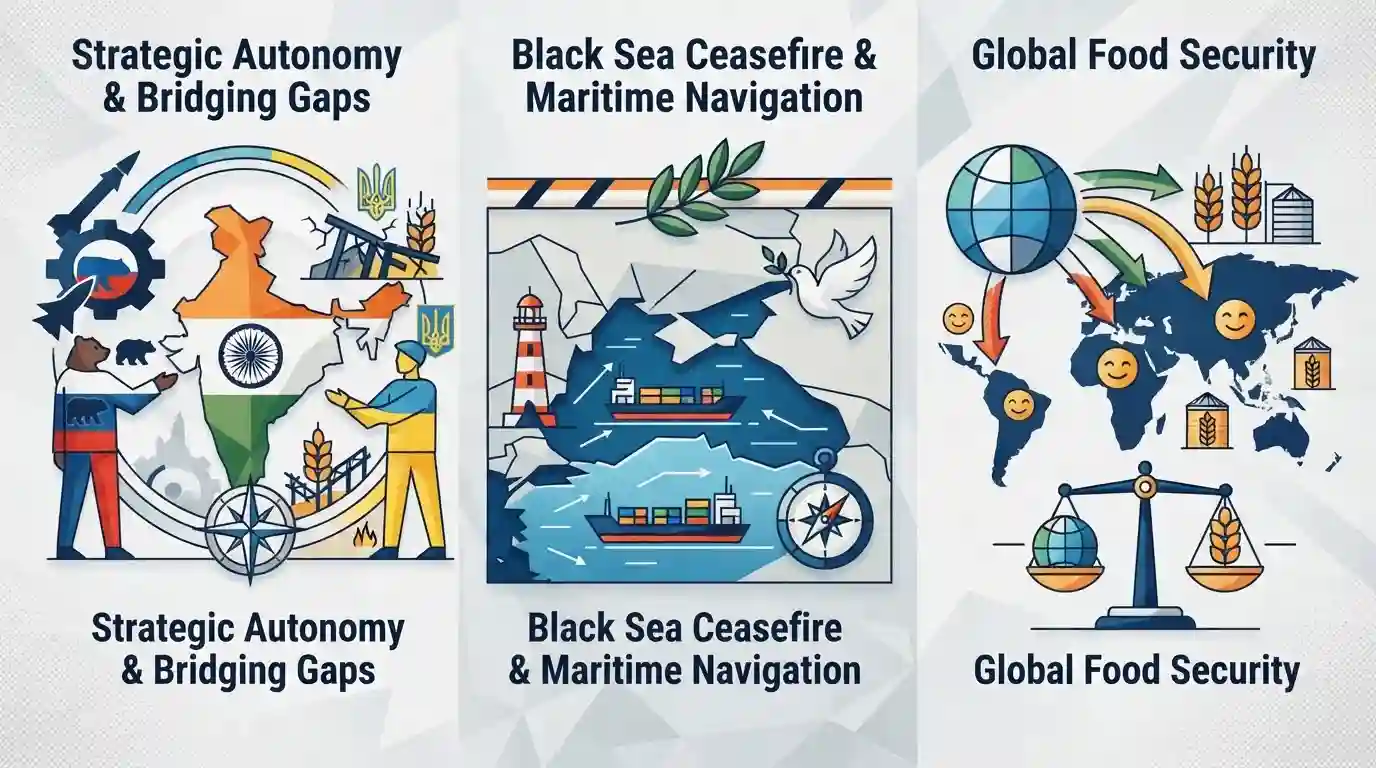
The article discusses India's evolving diplomatic role and peace proposals concerning the Russia-Ukraine war, focusing particularly on proposals around a Black Sea ceasefire, maritime navigation, and global food security. It highlights India's adherence to strategic autonomy while attempting to bridge gaps between warring nations as a mediator.
Key Points
- India's diplomatic stance on the Russia-Ukraine conflict has evolved from passive neutrality to active engagement and peace proposal facilitation.
- The proposed Black Sea ceasefire initiative aims to ensure maritime security, food security, and safe grain exports disrupted by the conflict.
- India maintains a delicate balancing act, preserving its historic defence and energy ties with Russia while advocating for dialogue and territorial integrity of Ukraine.
- India's mediation efforts highlight its rising stature as a voice of the Global South and a proponent of reformed multilateralism and strategic autonomy.
Important Terms
Strategic Autonomy

India's cornerstone foreign policy principle of maintaining independent decision-making and diplomatic relations with all major powers based strictly on national interest, without joining formal military alliances or blocs.
UPSC context
Mains GS Paper II (International Relations): Tests understanding of India’s foreign policy evolution, non-alignment, multi-alignment, and independent stance in great power conflicts.
Black Sea Ceasefire Proposal
A comprehensive three-part truce initiative proposed by India focused on halting energy facility attacks, protecting commercial merchant shipping, and ensuring the uninterrupted flow of grain and energy through maritime corridors.
UPSC context
Mains GS Paper II (International Relations): Tests India’s proactive diplomatic role, mediation efforts, and global food/energy security initiatives in the Russia-Ukraine war.
Prelims Trap
India's active peace proposals indicate a departure from its traditional non-aligned stance toward a formal military alliance with NATO partners.
Aspirants often assume India has formally joined Western-led sanctions or abandoned its traditional defence supplies from Russia, which contradicts its strategic autonomy.
Static Concepts Connected
What are the core pillars and evolution of India's Strategic Autonomy in foreign policy?
- Historical Roots: Historical Roots: Rooted in the Non-Aligned Movement (NAM), emphasizing independent judgment on global issues rather than joining power blocs.
- Multi-Alignment: Multi-Alignment: Contemporary practice of engaging simultaneously with opposing global powers (e.g., US, Russia, EU) to maximize national interest.
- Strategic Partnership: Strategic Partnership: Maintaining long-standing defence and energy ties with Russia while deepening security architectures like the Quad.
Cross-Topic Patterns
Eurasian Diplomacy + Indo-Pacific Maritime Security
India's diplomatic balancing act in Eurasia intersects with maritime security frameworks in the Indo-Pacific, linking sea-lane protection across different theaters.
Global South Advocacy + Food Security Diplomacy
India's advocacy for grain security and supply chains connects bilateral mediation with multilateral food diplomacy platforms like the G20.

Expect a statement-based question testing India's shift from non-alignment to multi-alignment and strategic autonomy in the Ukraine crisis.
Linked PYQs · 2
Linked PYQs · 2
- 2025MainsGS2
"Energy security constitutes the dominant kingpin of India's foreign policy, and is linked with India's overarching influence in Middle Eastern countries.” How would you integrate energy security with India's foreign policy trajectories in the coming years?
- 2023MainsGS2
‘Virus of Conflict is affecting the functioning of the SCO’ In the light of the above statement point out the role of India in mitigating the problems.
