High Level Diplomatic Engagements Intensify with Moscow and Beijing
Source:The Hindu ↗
Why It Matters
The developments highlight India's strategic autonomy and complex balancing act in a multipolar world. They are highly relevant for GS Paper 2 (International Relations) regarding bilateral, regional, and global groupings, and the effect of policies and politics of developed and developing countries on India's interests.
Summary
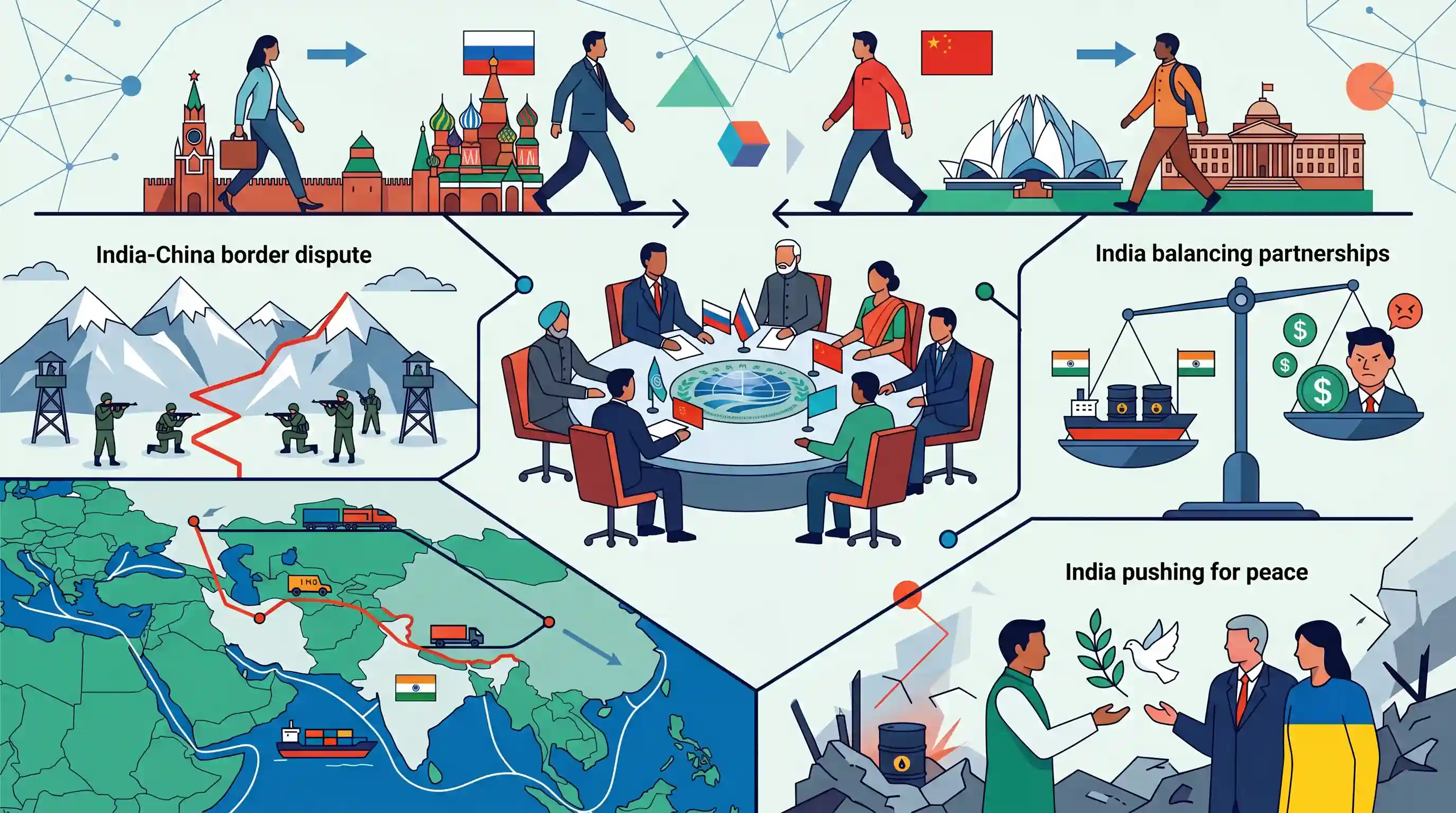
External Affairs Minister S. Jaishankar and Chinese Foreign Minister Wang Yi have scheduled crucial diplomatic visits to Moscow and New Delhi, respectively, to prepare for broader bilateral summits. These high-level interactions come as India seeks to balance its global partnerships amid trade tensions with the US regarding Russian oil imports. The engagements also aim to address the India-China border dispute, prepare for the upcoming SCO summit, and advance regional connectivity projects like the INSTC, while maintaining India's diplomatic push for a peaceful settlement to the Russia-Ukraine conflict.
Key Points
- External Affairs Minister S. Jaishankar is set to visit Moscow to prepare for the annual Russia-India summit between PM Modi and President Putin, focusing on trade and bilateral ties.
- Chinese Foreign Minister Wang Yi will visit New Delhi for high-level discussions with NSA Ajit Doval on the lingering border issue ahead of PM Modi's expected visit to the SCO summit in Tianjin.
- India is intensifying its diplomatic engagements with both Russia and China in response to trade uncertainties triggered by the US imposing tariffs on India over its purchase of Russian oil.
- India maintains a proactive diplomatic stance on multiple fronts, including PM Modi advocating for a peaceful resolution to the Russia-Ukraine conflict and pushing for regional connectivity via the International North-South Transport Corridor (INSTC).
Important Terms
International North-South Transport Corridor (INSTC)

A 7,200-km multimodal trade network linking India to Russia and Europe via Iran and Azerbaijan. It reduces transit time and costs significantly compared to the Suez Canal route.
UPSC context
GS Paper 2/3: Tests regional connectivity, bypassing Pakistan, and India's strategic alternative to China's Belt and Road Initiative (BRI).
Shanghai Cooperation Organisation (SCO)
A Eurasian political, economic, and security alliance founded in 2001. It focuses on regional stability, counter-terrorism (through RATS), and economic cooperation among its 10 member states.
UPSC context
GS Paper 2: Evaluates India's engagement with Central Asia and its ability to navigate complex ties with China and Pakistan.
Line of Actual Control (LAC)
The 3,488-km de facto border between India and China. It is divided into the Western (Ladakh), Middle (Himachal/Uttarakhand), and Eastern (Arunachal Pradesh) sectors.
UPSC context
GS Paper 2/3: Essential for border management, national security, and understanding historical territorial disputes with neighboring countries.
Strategic Autonomy
India's foreign policy doctrine of maintaining independent decision-making in global affairs, avoiding formal military alliances while engaging with multiple power blocs to serve national interests.
UPSC context
GS Paper 2: A core theme in Indian diplomacy, testing the "multi-alignment" approach amidst US-Russia-China competition.
Special and Privileged Strategic Partnership
The formal diplomatic framework established between India and Russia to elevate bilateral ties, emphasizing deep cooperation in defense, civil nuclear energy, and space.
UPSC context
GS Paper 2: Focuses on the unique depth of India-Russia relations and their resilience during global geopolitical shifts.
Special Representatives' (SR) Dialogue
A high-level institutional mechanism between India and China, led by National Security Advisers, specifically tasked with finding a fair and mutually acceptable border settlement.
UPSC context
GS Paper 2: Key for understanding the formal negotiation process used to address the boundary question and maintain peace.
Prelims Trap
INSTC was established by India, Russia, and Central Asian Republics to counter China's BRI.
INSTC was founded in 2000 by India, Iran, and Russia, years before BRI existed. It was not originally designed as an anti-BRI counter-initiative.
Static Concepts Connected
What are the key routing and membership features of the INSTC?
- Founding members: India, Iran, and Russia established the corridor in 2000.
- Multi-modal route: Integrates ship, rail, and road networks to link the Indian Ocean/Persian Gulf to the Caspian Sea and Russia via Iran.
- Strategic value: Completely bypasses the Suez Canal, drastically reducing freight transit time and shipping costs between India and Eurasia.
What is the core membership structure of the SCO?
- Central Asian presence: Kazakhstan, Kyrgyzstan, Tajikistan, and Uzbekistan are members. Turkmenistan is notably excluded due to its UN-recognized permanent neutrality.
- Recent expansion: India and Pakistan joined as full members in 2017. Iran (2023) and Belarus (2024) are the most recent additions.
Cross-Topic Patterns
Strategic Autonomy vs. US Sanctions
India's continued Russian oil purchases despite US tariff threats link domestic energy security imperatives to international trade mechanisms and secondary sanction frameworks like CAATSA.
SCO as a bilateral conflict mediator
Bilateral deadlocks like the India-China border issue are increasingly negotiated on the margins of Eurasian multilateral forums like the SCO and BRICS rather than standalone state visits.

Expect a 2026 Prelims map question linking INSTC nodes, Chabahar port, and the latest SCO members like Iran and Belarus.
Linked PYQs · 5
Linked PYQs · 5
- 2020MainsGS2
What is the significance of Indo-US defence deals over Indo-Russian defence deals? Discuss with reference to stability in the Indo-Pacific region.
- 2014MainsGS2
With respect to the South China sea, maritime territorial disputes and rising tension affirm the need for safeguarding maritime security to ensure freedom of navigation and over flight throughout the region. In this context, discuss the bilateral issues between India and China.
- 2025PrelimsGS1
India is one of the founding members of the International North-South Transport Corridor (INSTC), a multimodal transportation corridor, which will connect
- 2021MainsGS2
Critically examine the aims and objectives of SCO. What importance does it hold for India?
- 2023MainsGS2
‘Virus of Conflict is affecting the functioning of the SCO’ In the light of the above statement point out the role of India in mitigating the problems.
