India Russia Ties and Strategic Credibility in US Trade Negotiations
Source:Indian Express ↗
Why It Matters
India's strategic autonomy and its ability to balance relations between major world powers (US and Russia) is a central pillar of its foreign policy and a recurring theme in UPSC Mains. Understanding how diplomatic decisions and alliances (e.g., ties with Russia amidst Western sanctions) spill over into economic domains (e.g., trade deals with the US) provides crucial analytical depth for International Relations answers.
Summary
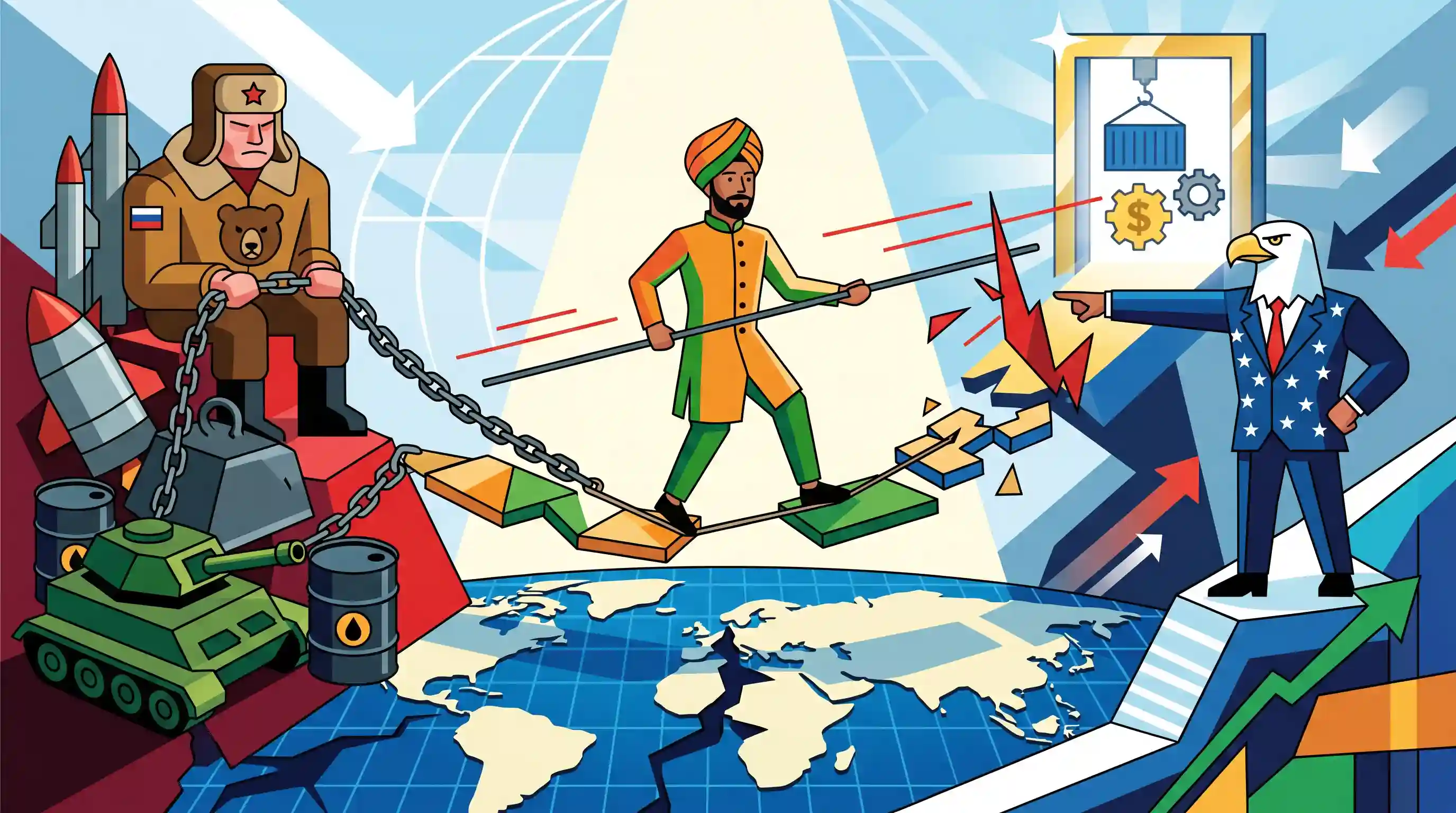
The article analyzes the geopolitical triangulation involving India, Russia, and the United States, arguing that India's sustained ties with Moscow carry a 'cost of credibility' in Washington. This trust deficit could negatively impact India's leverage when negotiating a comprehensive bilateral trade deal with the US. It highlights the modern challenges India faces in practicing strategic autonomy—specifically, the difficulty of balancing its historical reliance on Russian defense and energy resources with its deepening strategic and economic partnerships with the US in an increasingly polarized global order.
Key Points
- India is engaging in a delicate balancing act, maintaining historical ties with Russia while simultaneously deepening its strategic partnership with the United States.
- Sustained Indo-Russian cooperation (such as discounted oil purchases and legacy defense ties) creates a perception of unreliability in Washington, described as the 'cost of credibility.'
- This credibility gap and trust deficit could be utilized by the US as negotiating leverage, potentially complicating or delaying efforts to secure a favorable comprehensive US-India trade deal.
- The dynamic underscores the inherent difficulties of maintaining 'strategic autonomy' as bilateral economic ties become increasingly intertwined with geopolitical alignments.
Important Terms
India-US Bilateral Trade Agreement (BTA)

The formal framework for negotiating trade barriers, market access, and tariffs between India and the United States, recently progressing toward an Interim Agreement to reduce reciprocal duties.
UPSC context
GS Paper II (International Relations). Tests knowledge of bilateral trade mechanisms and economic diplomacy with major powers.
Strategic Autonomy
India's foreign policy doctrine of making independent decisions based on national interest, balancing relationships with competing powers (like the US and Russia) without joining formal military alliances.
UPSC context
GS Paper II (International Relations). Fundamental concept for understanding India's global positioning and response to geopolitical polarization.
CAATSA
A 2017 US federal law that mandates sanctions against countries engaging in significant transactions with Russian, Iranian, or North Korean defense or intelligence sectors.
UPSC context
GS Paper II (IR) and GS Paper III (Security). Key friction point in India-US relations regarding Russian defense imports like the S-400.
Trade Policy Forum (TPF)
The premier ministerial-level institutional mechanism between India and the US for resolving trade disputes, enhancing market access, and addressing non-tariff barriers.
UPSC context
GS Paper II (International Relations). Crucial for understanding the institutional architecture of Indo-US economic engagement.
Generalised System of Preferences (GSP)
A US trade program providing non-reciprocal, duty-free entry for products from designated developing countries; India's status was suspended in 2019 and remains a major negotiation point.
UPSC context
GS Paper III (Economy). Tests understanding of trade incentives and their use as leverage in international negotiations.
Multi-alignment
The contemporary evolution of Non-Alignment, where India engages multiple global powers simultaneously on an issue-basis to maximize its strategic and economic interests.
UPSC context
GS Paper II (International Relations). Describes the shift from Cold War neutrality to active, diverse strategic partnerships.
Prelims Trap
Under CAATSA, the US automatically imposes sanctions on countries importing crude oil from Russia.
CAATSA specifically targets significant transactions with Russia's defense and intelligence sectors (e.g., S-400). It does not mandate sanctions on crude oil imports, though the US uses other trade tariffs for retaliation.
Static Concepts Connected
How does Strategic Autonomy differ from traditional Non-Alignment?
- Traditional Non-Alignment: Passive distancing from Cold War power blocs and a strict ideological refusal to join formal military alliances.
- Strategic Autonomy: Active, issue-based engagement with multiple global poles simultaneously to maximize national interest (e.g., joining both Quad and SCO).
What is CAATSA and how does it affect India's defense imports?
- Core Objective: A US domestic law designed to impose sanctions on countries engaging in significant transactions with the defense sectors of Iran, North Korea, or Russia.
- Defense Vulnerability: India's procurement of major Russian military hardware, like the S-400 missile system, technically triggers CAATSA provisions, requiring a special US presidential waiver to avoid sanctions.
Cross-Topic Patterns
Energy security and Rupee internationalization
India's reliance on discounted Russian oil despite Western pressure accelerates RBI's push for Rupee-Ruble settlement mechanisms, linking energy security directly to currency internationalization.
Defense indigenization as diplomatic shield
Reducing import dependence through Atmanirbhar Bharat in defense isn't just an economic goal; it removes a major friction point in India-US relations, boosting strategic autonomy.

Expect a GS-2 mains question in 2026 analyzing the tension between India's immediate energy security needs and its long-term US alignment.
Linked PYQs · 3
Linked PYQs · 3
- 2020MainsGS2
What is the significance of Indo-US defence deals over Indo-Russian defence deals? Discuss with reference to stability in the Indo-Pacific region.
- 2023MainsGS2
‘The expansion and strengthening of NATO and a stronger US-Europe strategic partnership works well for India.’ What is your opinion about this statement ? Give reasons and examples to support your answer.
- 2018MainsGS2
In what ways would the ongoing US-Iran Nuclear Pact Controversy affect the national interest of India? How should India respond to this situation?
