Consumer Price Index Inflation Trends and RBI Monetary Policy
Source:Indian Express ↗
Why It Matters
Inflation dynamics are a core component of the UPSC GS3 syllabus. Aspirants must understand the distinction between headline, food, and core inflation, and how these indices influence the RBI's monetary policy and interest rate decisions. The interplay between agricultural performance (monsoons) and macroeconomic stability is also a frequent theme in both Prelims and Mains.
Summary
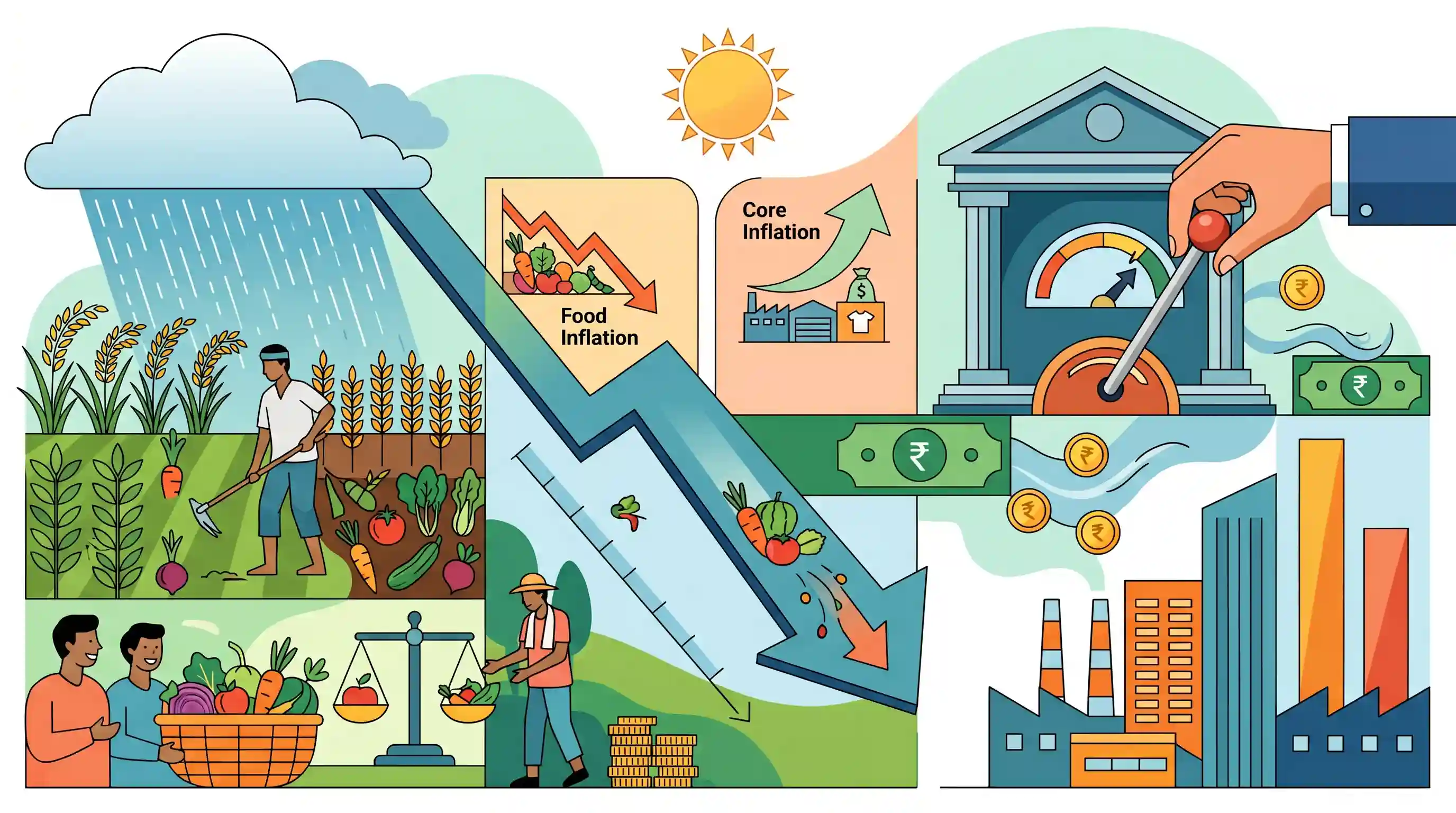
India's retail inflation based on the Consumer Price Index (CPI) eased to a 61-month low of 3.34% in March, primarily driven by a sharp drop in food inflation (2.69%) and a contraction in vegetable prices. While core inflation slightly increased to 4.1%, the overall cooling inflation trend reinforces expectations of further monetary easing. The Reserve Bank of India (RBI) recently reduced its key policy rate and projected a lower GDP growth rate of 6.5%. The positive macroeconomic outlook is further supported by expectations of an above-average monsoon, which is critical for maintaining stable agricultural output and price stability.
Key Points
- India's retail inflation (CPI) dropped to a more-than-five-year low of 3.34% in March, falling below the RBI's 4% target.
- The significant decline was driven largely by cooling food prices, with food inflation easing to 2.69% due to a contraction in vegetable prices.
- Core inflation, which excludes volatile food and energy prices, edged up slightly to 4.1%.
- The Reserve Bank of India (RBI) recently lowered its key policy rate for a second consecutive time, indicating a potential cycle of rate cuts amidst cooling inflation and a lowered GDP growth estimate of 6.5%.
- Forecasts of an above-average monsoon in the upcoming year are expected to further stabilize agricultural supply chains and keep food inflation in check.
Important Terms
Consumer Price Index (CPI)

A metric measuring price changes in a fixed basket of goods and services consumed by households. It reflects retail inflation and is the RBI's primary indicator for monetary policy.
UPSC context
GS III (Economy); Essential for understanding inflation targeting, retail price trends, and the RBI’s policy framework.
Headline Inflation
The raw, total inflation figure reported through CPI, including volatile categories like food and energy. It represents the overall price rise experienced by consumers.
UPSC context
GS III (Economy); Crucial for distinguishing between temporary supply shocks and broader economic price stability.
Core Inflation
A measure of inflation that excludes volatile items like food and energy to reflect the long-term, underlying price trend in the economy.
UPSC context
GS III (Economy); Used to assess demand-side pressures and long-term price trends without the noise of seasonal fluctuations.
Reserve Bank of India (RBI)
India’s central bank and apex monetary authority, established under the RBI Act, 1934. It regulates the banking system, manages foreign exchange, and ensures price stability.
UPSC context
GS III (Economy/Statutory Bodies); Core institution responsible for monetary stability, currency management, and banking regulation.
Monetary Policy Committee (MPC)
A six-member statutory body chaired by the RBI Governor that determines the policy interest rate (Repo Rate) to maintain the inflation target of 4% (±2%).
UPSC context
GS III (Monetary Policy); Key decision-making framework for interest rates; tests knowledge of composition, mandate, and inflation targeting.
Food Inflation
Inflation specific to the food and beverages category. It carries a high weightage (~46%) in India's CPI and is heavily influenced by agricultural supply and monsoons.
UPSC context
GS III (Agriculture/Economy); Highlights the link between agricultural output and macroeconomic stability due to food's large CPI weight.
Prelims Trap
"The RBI targets a 4% Core CPI, and both headline and core inflation have fallen to a 5-year low."
The RBI's statutory mandate is to target Headline CPI (CPI-Combined), not Core CPI. Furthermore, core inflation actually edged up to 4.1% while headline fell.
Static Concepts Connected
What are the key differences between Core and Headline CPI in India?
- Headline CPI: Includes all goods and services in the basket. It is the official anchor for the RBI's Flexible Inflation Targeting (FIT) framework (4% +/- 2%).
- Core CPI: Excludes volatile food and fuel components. It reflects underlying, structural demand-side price pressures in the economy.
How does the weightage of food differ between CPI and WPI?
- CPI Weight: Food and Beverages constitute the highest weight at approximately 45.9%, making retail inflation highly vulnerable to monsoon and agricultural supply shocks.
- WPI Weight: Primary food articles have a much lower weight in WPI. The WPI basket is heavily dominated by manufactured products (approx. 64%).
- Services Inclusion: CPI includes services (e.g., housing, education, health), which are largely sticky in price, whereas WPI tracks only the wholesale prices of physical goods.
Cross-Topic Patterns
ENSO cycle + RBI Rate Stance
Because food dictates nearly half of CPI, IMD's monsoon forecasts (La Niña/El Niño) heavily influence the MPC's policy space for counter-cyclical monetary easing to boost growth.
Growth-Inflation Trade-off dynamics
The RBI's dual challenge of managing lower GDP growth (6.5%) while tracking divergent core and headline inflation tests classic growth-inflation trade-off frameworks.

Expect a 2026 Prelims statement testing the divergence between Core and Headline CPI, as Core actually rose while Headline fell.
Linked PYQs · 5
Linked PYQs · 5
- 2024MainsGS3
What are the causes of persistent high food inflation in India? Comment on the effectiveness of the monetary policy of the RBI to control this type of inflation.
- 2020PrelimsGS1
Consider the following statements: 1. The weightage of food in Consumer Price Index (CPI) is higher than that in Wholesale Price Index (WPI). 2. The WPI does not capture changes in the prices of services, which CPI does. 3. Reserve Bank of India has now adopted WPI as its key measure of inflation and to decide on changing the key policy rates. Which of the statements given above is/are correct?
- 2022PrelimsGS1
In India, which one of the following is responsible for maintaining price stability by controlling inflation?
- 2017PrelimsGS1
Which of the following statements is/are correct regarding the Monetary Policy Committee (MPC)? 1. It decides the RBI's benchmark interest rates. 2. It is a 12-member body including the Governor of RBI and is reconstituted every year. 3. It functions under the chairmanship of the Union Finance Minister. Select the correct answer using the code given below:
- 2022PrelimsGS1
With reference to the Indian economy, consider the following statements: 1. If the inflation is too high, Reserve Bank of India (RBI) is likely to buy government securities. 2. If the rupee is rapidly depreciating, RBI is likely to sell dollars in the market. 3. If interest rates in the USA or European Union were to fall, that is likely to induce RBI to buy dollars. Which of the statements given above are correct?
