Consumer Price Index Inflation Eases in April
Source:The Hindu ↗
Why It Matters
Understanding the dynamics of inflation, including the base effect, the divergence between food and core inflation, and how these indices inform the Reserve Bank of India's monetary policy decisions, is foundational for the UPSC Economy syllabus. Candidates must be able to evaluate the effectiveness of RBI's tools in tackling different types of inflation (as asked in recent Mains).
Summary
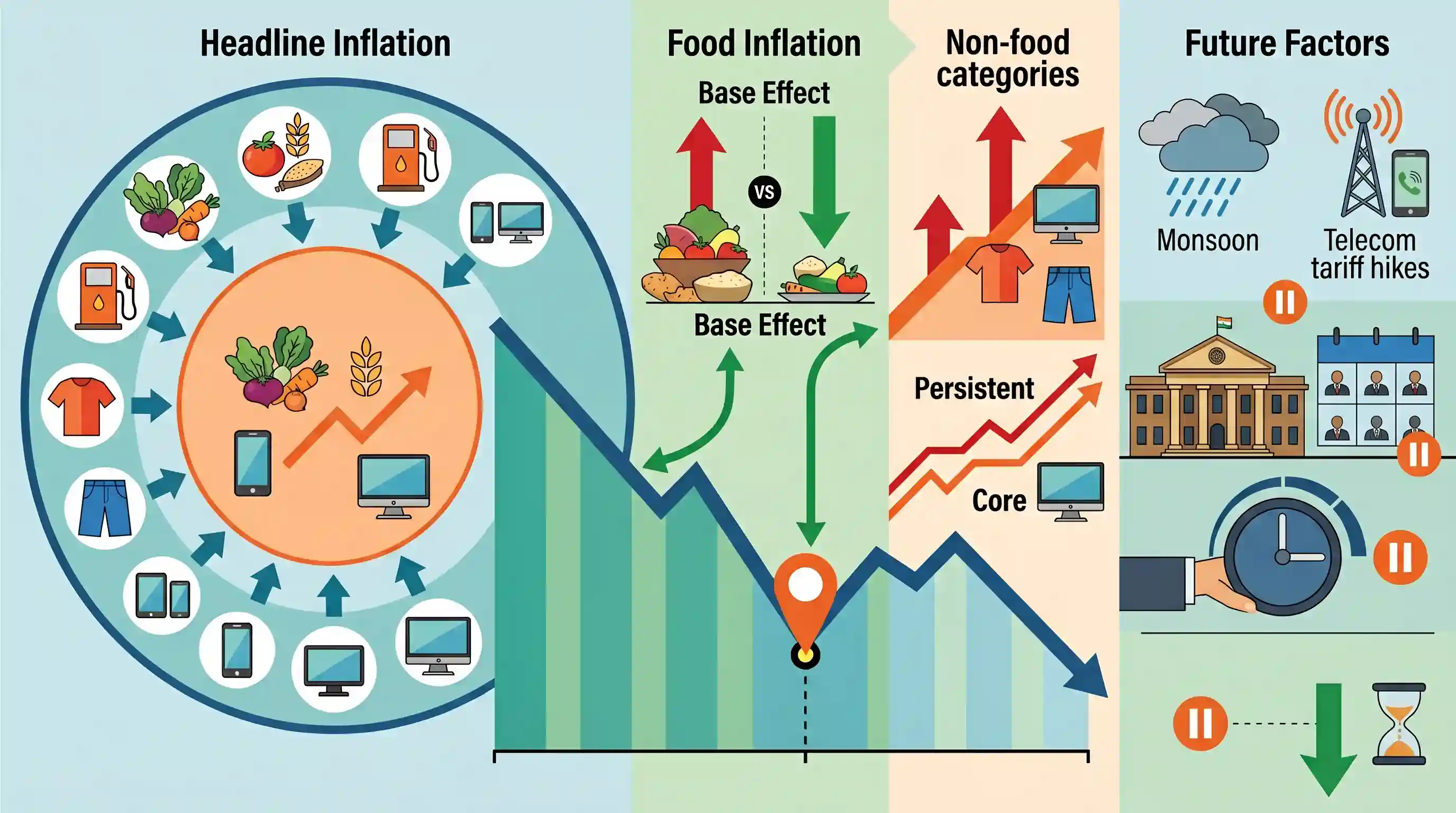
India's retail inflation, as measured by the Consumer Price Index (CPI), dropped to a 69-month low of 3.16% in April 2025. This decline was primarily fueled by a sharp reduction in food inflation, aided by a favorable base effect from the previous year. However, data from the Ministry of Statistics and Programme Implementation showed that inflation increased in non-food categories such as fuel, clothing, and miscellaneous services. Given the persistence of core inflation pressures and upcoming variables like the monsoon season and potential telecom tariff hikes, economists expect the Reserve Bank of India's Monetary Policy Committee to maintain current interest rates in its June meeting, potentially delaying any rate cuts until August.
Key Points
- India's retail inflation (CPI) slowed to 3.16% in April 2025, reaching its lowest level in 69 months.
- The drop in inflation was largely driven by a high base effect and significant moderation in food prices, especially vegetables, pulses, and meat.
- Despite the decline in headline inflation, economists predict the RBI's Monetary Policy Committee will likely hold interest rates in June, awaiting clarity on the monsoon and potential tariff hikes before considering a cut in August.
- Inflation ticked upward in several non-food categories, including fuel and light, clothing and footwear, and miscellaneous items like health and education.
Important Terms
Reserve Bank of India (RBI)

India's central bank (est. 1935) responsible for regulating the monetary system, issuing currency, and maintaining financial stability. It acts as the banker to the government and 'lender of last resort' to commercial banks.
UPSC context
GS Paper III: Core institutional body for monetary policy, banking regulation, and macroeconomic stability.
Monetary Policy Committee (MPC)
A statutory six-member body (3 RBI officials, 3 government nominees) that determines the benchmark interest rate (repo rate) to maintain price stability while supporting economic growth.
UPSC context
GS Paper III: Central to 'Monetary Policy' and 'Inflation Targeting' topics.
Consumer Price Index (CPI)
A measure of retail inflation that tracks changes in the price of a fixed basket of goods and services consumed by households. It is the primary inflation anchor for India's monetary policy.
UPSC context
GS Paper III: Essential for understanding 'Inflation' measurement and policy impacts.
Headline Inflation
The total inflation in an economy, including volatile components like food and fuel. It reflects the overall cost of living and is the headline figure reported through the CPI.
UPSC context
GS Paper III: Critical for comparing transitory shocks vs. structural price trends.
Core Inflation
A measure of inflation that excludes volatile items like food and energy to reveal the underlying long-term trend in the price level and demand-side pressures.
UPSC context
GS Paper III: Vital for analyzing 'Monetary Policy' effectiveness and persistence.
Base Effect
The distortion in a current inflation or growth figure caused by abnormally high or low levels of the same indicator in the previous year's reference period.
UPSC context
GS Paper III: Frequently tested concept in Prelims regarding statistical interpretation.
Ministry of Statistics and Programme Implementation (MoSPI)
The nodal agency of the Government of India responsible for statistical standards, national data collection (including GDP and CPI), and monitoring the implementation of major government projects.
UPSC context
GS Paper III: Key agency for 'Economic Development' and data-driven governance.
Prelims Trap
A continuous decline in the retail inflation rate indicates a fall in general price levels.
Falling inflation (disinflation) means prices are still rising, just at a slower rate. It does NOT mean the general price level is dropping (deflation).
Static Concepts Connected
How does CPI differ from WPI in India's inflation measurement?
- Publishing Authority: The National Statistical Office (MoSPI) releases CPI, whereas the Office of Economic Adviser (Ministry of Commerce and Industry) publishes WPI.
- Coverage: CPI tracks the retail prices of both goods and services, while WPI accounts only for wholesale goods (excluding services entirely).
- Food Weightage: Food and beverages command a significantly higher weight in CPI (approx 45.8%) compared to WPI (approx 24.4%), making CPI more sensitive to food shocks.
What differentiates Headline Inflation from Core Inflation?
- Headline Inflation: The total inflation rate tracking a comprehensive basket of goods and services. The RBI’s statutory inflation target of 4% (+/- 2%) is anchored to Headline CPI.
- Core Inflation: Excludes highly volatile food and fuel components to capture underlying, sticky, long-term macroeconomic price trends. This indicates structural demand rather than supply-side weather shocks.
Cross-Topic Patterns
Climate risks dictating Monetary Policy
Frequent extreme weather events impact agricultural yields, spiking food inflation. Because food drives Indian CPI, the RBI's interest rate trajectory is increasingly hostage to monsoon distribution and climate anomalies.
The 'Base Effect' in Macroeconomic Data
A sharp dip in year-on-year economic metrics often reflects statistical distortions from the previous year's high prices rather than current-year performance. UPSC frequently tests this 'Base Effect' logic.

Expect a 2026 Prelims statement testing whether the RBI targets Core or Headline CPI, paired with a practical definition of 'Base Effect'.
Linked PYQs · 4
Linked PYQs · 4
- 2020PrelimsGS1
Consider the following statements: 1. The weightage of food in Consumer Price Index (CPI) is higher than that in Wholesale Price Index (WPI). 2. The WPI does not capture changes in the prices of services, which CPI does. 3. Reserve Bank of India has now adopted WPI as its key measure of inflation and to decide on changing the key policy rates. Which of the statements given above is/are correct?
- 2022PrelimsGS1
In India, which one of the following is responsible for maintaining price stability by controlling inflation?
- 2017PrelimsGS1
Which of the following statements is/are correct regarding the Monetary Policy Committee (MPC)? 1. It decides the RBI's benchmark interest rates. 2. It is a 12-member body including the Governor of RBI and is reconstituted every year. 3. It functions under the chairmanship of the Union Finance Minister. Select the correct answer using the code given below:
- 2024MainsGS3
What are the causes of persistent high food inflation in India? Comment on the effectiveness of the monetary policy of the RBI to control this type of inflation.
