Consumer Price Index Trends and Food Inflation Dynamics in India
Source:The Hindu ↗
Why It Matters
Inflation dynamics—specifically the distinction between core and headline inflation, the impact of base effects, and the RBI's inflation-targeting mandate—are fundamental concepts in the UPSC syllabus. This article perfectly illustrates how the MPC weighs volatile food prices against sticky core inflation when deciding on benchmark interest rates, a recurring theme in GS3 and Prelims economy questions.
Summary
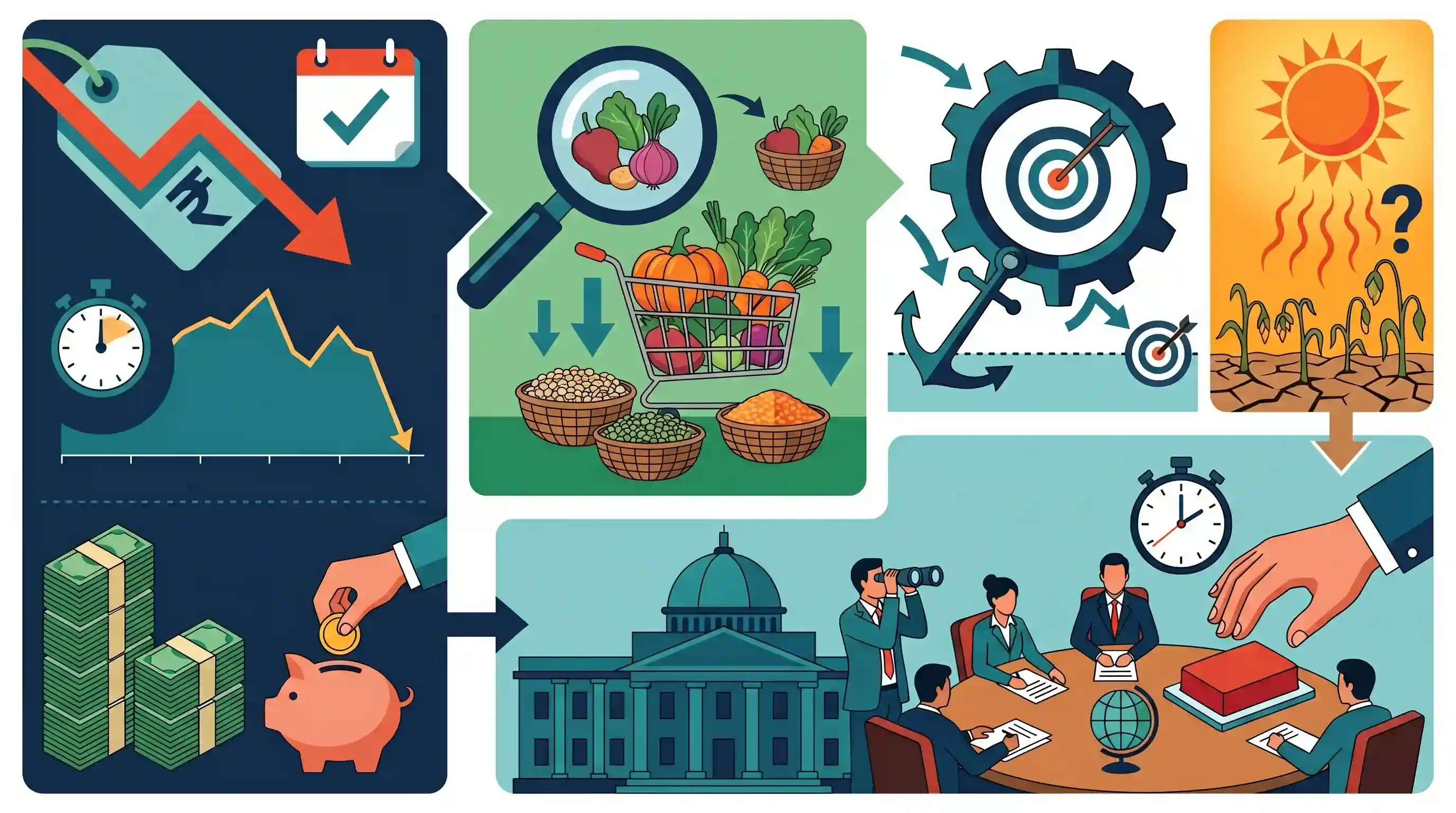
India's retail inflation, measured by the Consumer Price Index (CPI), eased to a 69-month low of 3.16% in April 2025. This significant moderation was largely attributed to falling food prices—particularly vegetables and pulses—which benefited from a high base effect compared to the previous year. While headline inflation has dropped below the Reserve Bank of India's (RBI) medium-term target of 4%, economists point out that core inflation remains stickier at around 4.1%. Given the volatility inherent in food prices and potential disruptions from summer heatwaves, the RBI's Monetary Policy Committee (MPC) may defer immediate interest rate cuts, maintaining a wait-and-watch approach on price stability.
Key Points
- India's retail inflation (CPI) slowed significantly to 3.16% in April 2025, marking its lowest level in 69 months.
- The moderation was primarily driven by a sharp drop in food and beverage inflation, which fell to 2.14%, assisted by a strong base effect from the previous year.
- Vegetable prices actually recorded deflation (-2.15%), contrasting heavily with the near 28% inflation seen in the same month last year.
- Core inflation, which excludes volatile components like food and fuel, was estimated at approximately 4.1%, indicating persistent underlying price pressures.
- Despite headline inflation falling below the RBI's 4% target, the Monetary Policy Committee (MPC) is expected to remain cautious regarding rate cuts due to underlying core inflation and the vulnerability of food prices to impending summer heatwaves.
Important Terms
Monetary Policy Committee (MPC)

A statutory body under the RBI Act, 1934, consisting of six members who determine India's benchmark interest rate (repo rate) to achieve specific inflation targets while supporting economic growth.
UPSC context
GS-III: Indian Economy. Crucial for understanding monetary policy transmission, inflation targeting (4% +/- 2%), and central bank independence.
Consumer Price Index (CPI)
A statistical measure that tracks changes in the retail prices of a representative basket of goods and services consumed by households, used as the primary indicator for retail inflation in India.
UPSC context
GS-III: Inflation. Key for measuring cost of living and indexation of wages/pensions; the RBI's main anchor for monetary policy.
Headline Inflation
The total inflation figure in an economy, representing the overall price change in the entire CPI basket, including volatile components like food and fuel.
UPSC context
GS-III: Indian Economy. Tests ability to distinguish between volatile short-term shocks and long-term price trends.
Core Inflation
A measure of inflation that excludes volatile items like food and energy (fuel), focusing on underlying, persistent price trends and demand-side pressures in the economy.
UPSC context
GS-III: Indian Economy. Vital for analyzing structural inflation and the necessity of policy intervention beyond supply-side management.
Base Effect
The distortion in current inflation figures caused by exceptionally high or low price levels in the previous year's corresponding month, which serves as the comparison base.
UPSC context
GS-III: Economic Growth and Inflation. Tests mathematical literacy in interpreting "real" vs. "statistical" fluctuations in data.
Ministry of Statistics and Programme Implementation (MoSPI)
The nodal central ministry responsible for the planned development of the statistical system in India, releasing key data like CPI, GDP, and IIP through the National Statistical Office (NSO).
UPSC context
GS-II/III: Governance and Economy. Important for identifying the correct institutional source of official Indian macroeconomic statistics.
Reserve Bank of India (RBI)
India's central bank and regulatory body, responsible for managing the money supply, supervising the banking sector, and ensuring price stability as the secretariat for the MPC.
UPSC context
GS-III: Banking and Monetary Policy. Core institution for questions on currency management, forex, and economic stabilization.
Prelims Trap
"The RBI is legally mandated to target Core CPI inflation."
The RBI's legal mandate under the amended RBI Act (1934) is to target Headline CPI inflation (4% +/- 2%), not Core inflation, even though core inflation is less volatile.
Static Concepts Connected
How does the composition of CPI differ from WPI?
- Food weightage: CPI assigns a much higher weight to food and beverages (approx. 45.8%) compared to WPI (approx. 24.3%), making retail inflation highly sensitive to food prices.
- Inclusion of services: CPI tracks the price movement of both goods and services (e.g., education, health, transport), whereas WPI only tracks the wholesale prices of goods.
- Publishing authority: CPI data is released by the NSO under MoSPI, while WPI is published by the Office of Economic Adviser under the Ministry of Commerce and Industry.
Why is monetary policy limited in tackling food-driven inflation?
- Supply-side nature: Monetary tools like repo rate hikes primarily compress aggregate demand but cannot fix structural supply-side bottlenecks or agricultural deficits caused by climate shocks.
- Sticky core constraints: When food prices swing wildly, headline inflation drops, but if core inflation (demand-driven) stays sticky, the RBI cannot safely ease rates without risking broader price instability.
Cross-Topic Patterns
Climate risks to monetary policy
Extreme weather events (heatwaves, El Niño) cause recurrent agricultural supply shocks, complicating the MPC's inflation-targeting mandate and linking climate resilience directly to macroeconomic stability.
Base Effect distortions in macro-data
Just like inflation metrics, GDP growth figures and IIP data are frequently skewed by the statistical "base effect" of previous years, a recurring theme in Economic Survey analyses.

Expect a conceptual Prelims question mixing 'Base Effect' mechanics, CPI food weightage, and the MPC's response to supply-side shocks.
Linked PYQs · 5
Linked PYQs · 5
- 2020PrelimsGS1
Consider the following statements: 1. The weightage of food in Consumer Price Index (CPI) is higher than that in Wholesale Price Index (WPI). 2. The WPI does not capture changes in the prices of services, which CPI does. 3. Reserve Bank of India has now adopted WPI as its key measure of inflation and to decide on changing the key policy rates. Which of the statements given above is/are correct?
- 2021PrelimsGS1
With reference to Indian economy, demand-pull inflation can be caused/ increased by which of the following? 1. Expansionary policies 2. Fiscal stimulus 3. Inflation-indexing wages 4. Higher purchasing power 5. Rising interest rates Select the correct answer using the code given below.
- 2022PrelimsGS1
In India, which one of the following is responsible for maintaining price stability by controlling inflation?
- 2017PrelimsGS1
Which of the following statements is/are correct regarding the Monetary Policy Committee (MPC)? 1. It decides the RBI's benchmark interest rates. 2. It is a 12-member body including the Governor of RBI and is reconstituted every year. 3. It functions under the chairmanship of the Union Finance Minister. Select the correct answer using the code given below:
- 2024MainsGS3
What are the causes of persistent high food inflation in India? Comment on the effectiveness of the monetary policy of the RBI to control this type of inflation.
