India Retail CPI Inflation Trends and Monetary Policy Implications
Source:Indian Express ↗
কেন এটি গুরুত্বপূর্ণ
Crucial for understanding how retail and food inflation dynamics dictate monetary policy actions, interest rates, and overall macroeconomic stability in India.
সারসংক্ষেপ
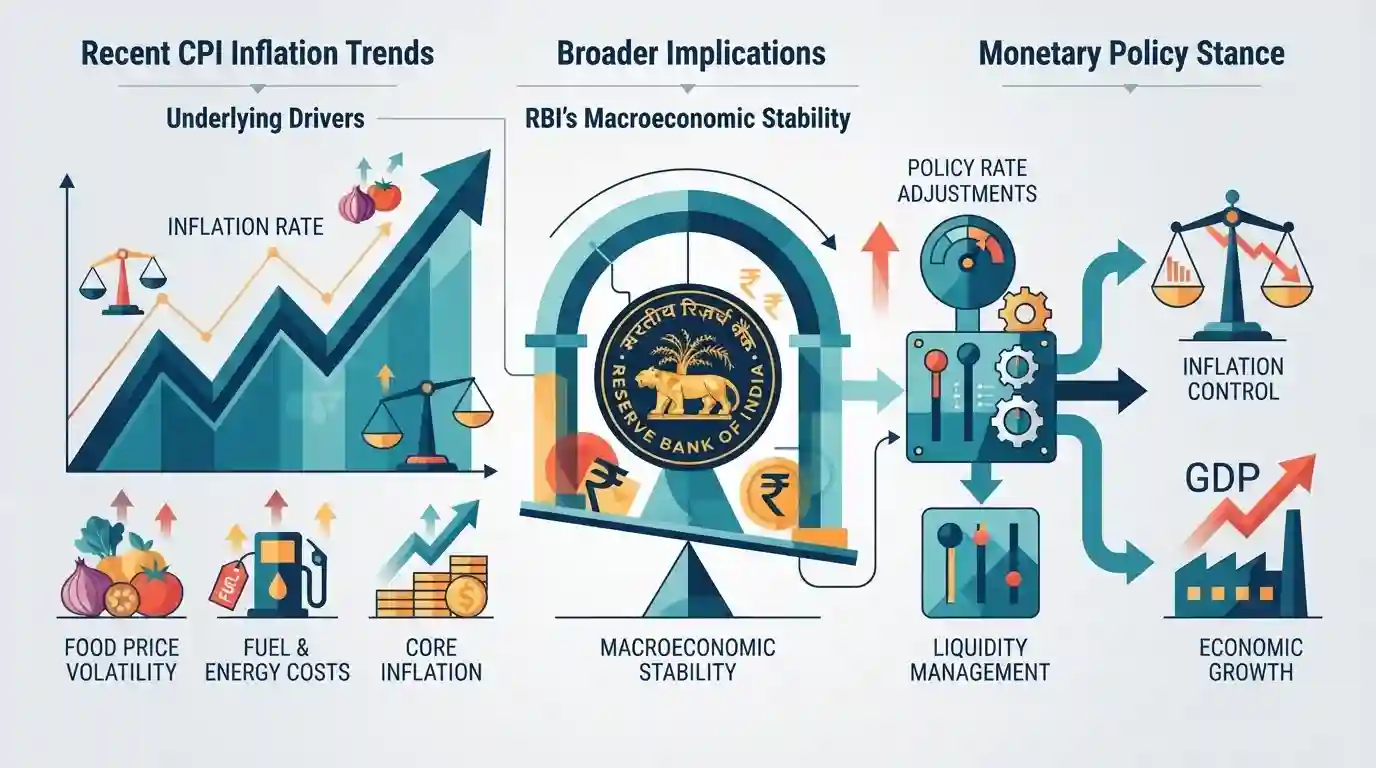
The editorial explores the recent trends in India's retail Consumer Price Index (CPI) inflation, analyzing the underlying drivers such as food price movements and evaluating their broader implications for the Reserve Bank of India's monetary policy stance.
মূল বিষয়
- Retail inflation trends and consumer price index (CPI) dynamics in India.
- The role of food inflation volatility in shaping overall macroeconomic stability.
- Implications for RBI's monetary policy decisions and interest rate management under inflation targeting.
গুরুত্বপূর্ণ শব্দ
Flexible Inflation Targeting Framework

An institutional framework under the RBI Act 1934 where the central bank targets a retail inflation rate of 4% with a tolerance band of +/- 2 percent.
UPSC context
UPSC GS Paper III (Indian Economy - Inflation and Monetary Policy). Tests understanding of monetary policy tools and macroeconomic stability.
Reserve Bank of India
India's central banking institution responsible for regulating the monetary policy, issuing currency, and maintaining macroeconomic and financial stability.
UPSC context
UPSC GS Paper III (Indian Economy - Banking and Central Banking). Tests the institutional mandate of India's apex financial regulator.
Monetary Policy Committee
A statutory six-member body headed by the RBI Governor that determines the benchmark policy interest rate to achieve the inflation target.
UPSC context
UPSC GS Paper III (Indian Economy - Monetary Policy). Tests institutional structure, decision-making, and inflation control mechanisms.
সংযুক্ত স্থির ধারণা
How is the Consumer Price Index (CPI) compiled and managed in India?
- Publishing Agency: NSSO compiles CPI (Rural, Urban, Combined) under the Ministry of Statistics and Programme Implementation (MoSPI).
- High Food Weight: Food and beverages carry the highest weight (~45-50%) in the CPI basket, making headline inflation vulnerable to agricultural supply shocks.
- Inflation Mandate: RBI Act, 1934 mandates keeping CPI inflation at 4% with a tolerance band of +/- 2% (2% to 6%).
আন্তঃবিষয় প্যাটার্ন
Food Inflation Transmission & Fiscal Deficits
Food inflation volatility directly feeds into core inflation expectations and wage-price spirals, complicating the RBI's primary mandate of price stability under the Fiscal Responsibility and Budget Management (FRBM) framework.
Monetary Transmission vs Supply-Side Structural Bottlenecks
Persistent supply-side shocks in perishables undermine transmission of monetary policy, forcing the MPC to decouple interest rate cuts from headline CPI spikes.

Expect a multi-statement prelims question combining MPC voting mechanics, CPI weighting (food vs core), and statutory inflation target bands.
সংযুক্ত PYQ · 3
সংযুক্ত PYQ · 3
- 2024MainsGS3
What are the causes of persistent high food inflation in India? Comment on the effectiveness of the monetary policy of the RBI to control this type of inflation.
- 2020PrelimsGS1
Consider the following statements: 1. The weightage of food in Consumer Price Index (CPI) is higher than that in Wholesale Price Index (WPI). 2. The WPI does not capture changes in the prices of services, which CPI does. 3. Reserve Bank of India has now adopted WPI as its key measure of inflation and to decide on changing the key policy rates. Which of the statements given above is/are correct?
- 2022PrelimsGS1
In India, which one of the following is responsible for maintaining price stability by controlling inflation?
