India Emphasizes Mutual Sensitivities in Bilateral Relations
Source:The Hindu ↗
Why It Matters
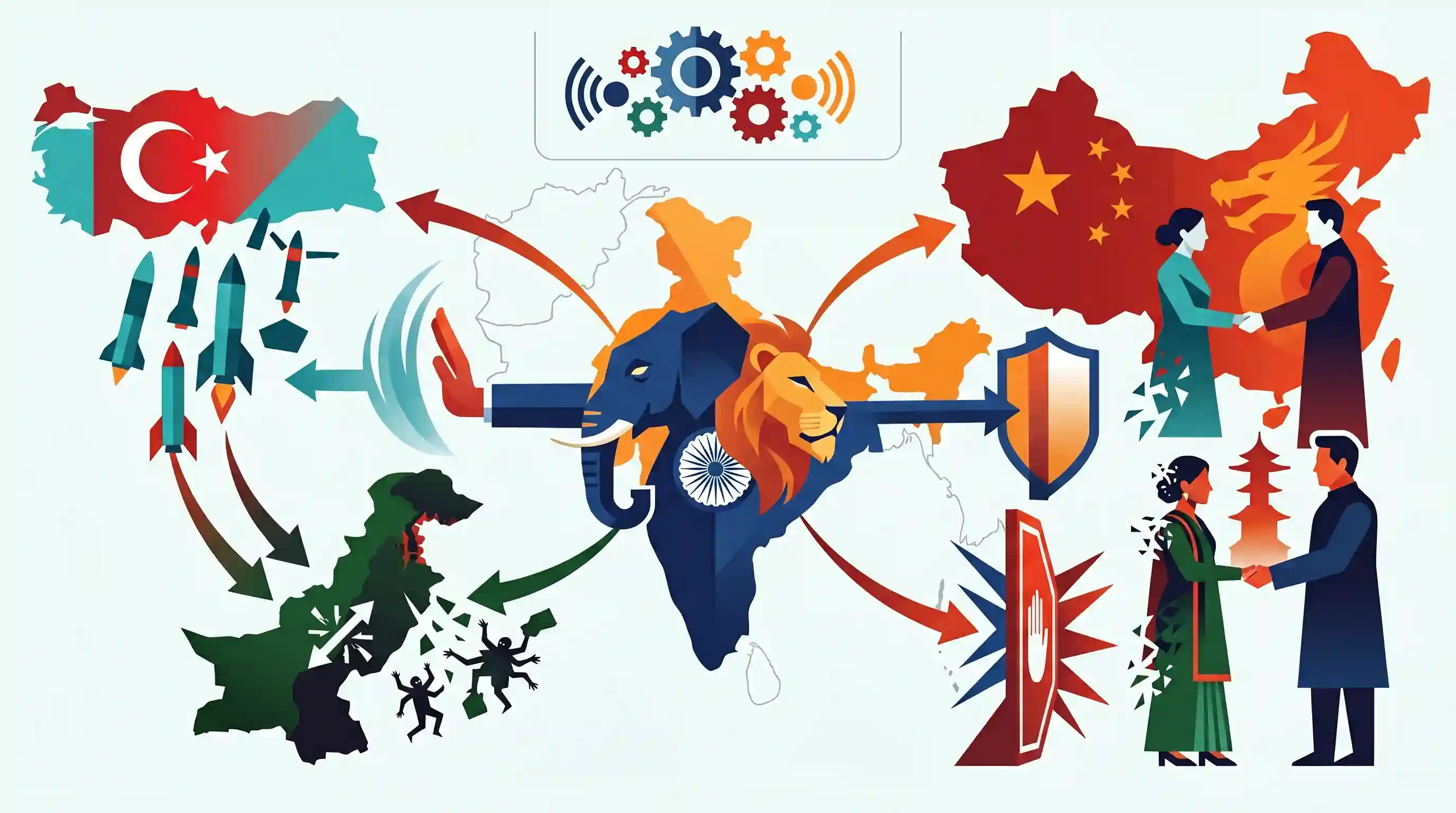
Demonstrates India's evolving diplomatic posture where it explicitly conditions bilateral relationships with third countries (like China and Turkiye) on their alignment with or respect for India's core security concerns regarding Pakistan and state-sponsored terrorism.
Summary
The Ministry of External Affairs (MEA) has reminded China and Turkiye that bilateral ties must be based on "mutual sensitivities," urging them to respect India's core security concerns regarding Pakistan. India explicitly called on Turkiye to pressure Pakistan into dismantling its state-sponsored terror ecosystem, responding to Turkiye's recent weapons deliveries to Islamabad. Concurrently, India reasserted to China that mutual trust and respect are foundational to their relationship, conveying a firm stance against cross-border terrorism during boundary talks, even as Beijing recently hosted the Pakistani Foreign Minister.
Key Points
- India has reminded Turkiye and China that bilateral relations are contingent on mutual trust, respect, and sensitivity to each other's security concerns.
- The MEA urged Turkiye to pressure Pakistan into ending support for cross-border terrorism, a response to Turkiye recently supplying weapons to Islamabad.
- India reaffirmed its resolute stance against cross-border terrorism to China during recent boundary talks between the NSA and China's Special Representative Wang Yi.
- The statements followed China hosting Pakistan's Foreign Minister shortly after a flare-up in India-Pakistan hostilities.
Important Terms
Ministry of External Affairs (MEA)

The central government agency responsible for managing India’s foreign relations, formulating policy, and representing the nation globally through its diplomatic missions.
UPSC context
GS Paper II: Important for understanding India’s foreign policy framework and diplomatic machinery.
Mutual Sensitivities
A diplomatic principle emphasizing that stable bilateral relations depend on mutual respect for each nation’s vital interests, trust, and territorial integrity.
UPSC context
GS Paper II: Key concept in India-China and India-Turkiye bilateral relations.
Cross-border Terrorism
Terrorist activities where territory in one country is used to launch, plan, or support attacks against a neighboring nation, often via non-state proxies.
UPSC context
GS Paper III: A primary security challenge affecting India’s border management and regional stability.
State-sponsored Terrorism
The active support (funding, training, or arms) provided by a government to violent non-state actors to achieve political or strategic foreign policy goals.
UPSC context
GS Paper III: Tests knowledge of internal security and asymmetric warfare tactics used by adversaries.
Core Security Concerns
Fundamental issues vital to a nation's survival and sovereignty, including territorial integrity, protection against terrorism, and stability of border regions.
UPSC context
GS Paper II & III: Critical for analyzing India's "red lines" in international negotiations.
Bilateral Ties
The formal diplomatic, economic, and political relationship between two sovereign states, which forms the basic unit of international engagement.
UPSC context
GS Paper II: Fundamental to questions regarding India’s relations with its neighbors and major powers.
Prelims Trap
"The 'Three Mutuals' framework is a legally binding bilateral agreement signed between India and China."
The "Three Mutuals" is an Indian diplomatic prerequisite and policy posture championed by the MEA, not a formal bilateral treaty signed or ratified by China.
Static Concepts Connected
What is the Special Representatives (SR) mechanism between India and China?
- 2003 Establishment: Created in 2003 during PM Vajpayee's visit to Beijing to establish a framework for a boundary settlement.
- High-level Leadership: Typically led by India's National Security Advisor (NSA) and a high-ranking Chinese official (often the Foreign Minister).
- Political Mandate: Aimed at finding a political and fair resolution to the boundary question from a broader, strategic perspective rather than just tactical border management.
How do Turkiye-Pakistan defense ties impact India's maritime security dynamics?
- MILGEM Project: Turkiye is supplying advanced Babur-class stealth corvettes to Pakistan, boosting its naval and anti-submarine warfare capabilities in the Indian Ocean.
- Tech Transfer: Technology transfers accompanying these arms sales directly challenge India's traditional maritime superiority and regional security architecture.
Cross-Topic Patterns
Defense ties and multilateral geopolitics
Turkiye's growing defense exports to Pakistan (like the MILGEM project) often parallel diplomatic shielding, acting as a recurring hurdle for Indian diplomacy at multilateral forums like the UN and FATF.
IMEC bypass and Turkiye's strategic pushback
India's strong diplomatic messaging on "mutual sensitivities" aligns with Turkiye's broader strategic irritation at being bypassed by the proposed India-Middle East-Europe Economic Corridor (IMEC).

The "Three Mutuals" doctrine and the evolving Turkiye-Pakistan defense nexus are prime candidates for a 15-marker Mains IR question.
Linked PYQs · 4
Linked PYQs · 4
- 2014MainsGS2
With respect to the South China sea, maritime territorial disputes and rising tension affirm the need for safeguarding maritime security to ensure freedom of navigation and over flight throughout the region. In this context, discuss the bilateral issues between India and China.
- 2015MainsGS2
Terrorist activities and mutual distrust have clouded India-Pakistan relations. To what extent the use of soft power like sports and cultural exchanges could help generate goodwill between the two countries? Discuss with suitable examples.
- 2016MainsGS2
Increasing cross-border terrorist attacks in India and growing interference in the internal affairs of several member-states by Pakistan are not conducive for the future of SAARC (South Asian Association for Regional Cooperation)." Explain with suitable examples.
- 2020MainsGS3
Analyze internal security threats and transborder crimes along Myanmar, Bangladesh and Pakistan borders including Line of Control (LoC). Also discuss the role played by various security forces in this regard.
