Home ministry unveils comprehensive anti terror policy Prahaar
Source:The Hindu ↗
Why It Matters
The article highlights the launch of 'PRAHAAR', marking a pivotal shift in India's internal security doctrine to tackle modern, tech-enabled terrorism. Additionally, it touches upon critical governance and economic issues, such as the Supreme Court's stance on mob violence guidelines and land acquisition compensation, as well as the imperative of robust regulatory frameworks in the pharmaceutical sector.
Summary
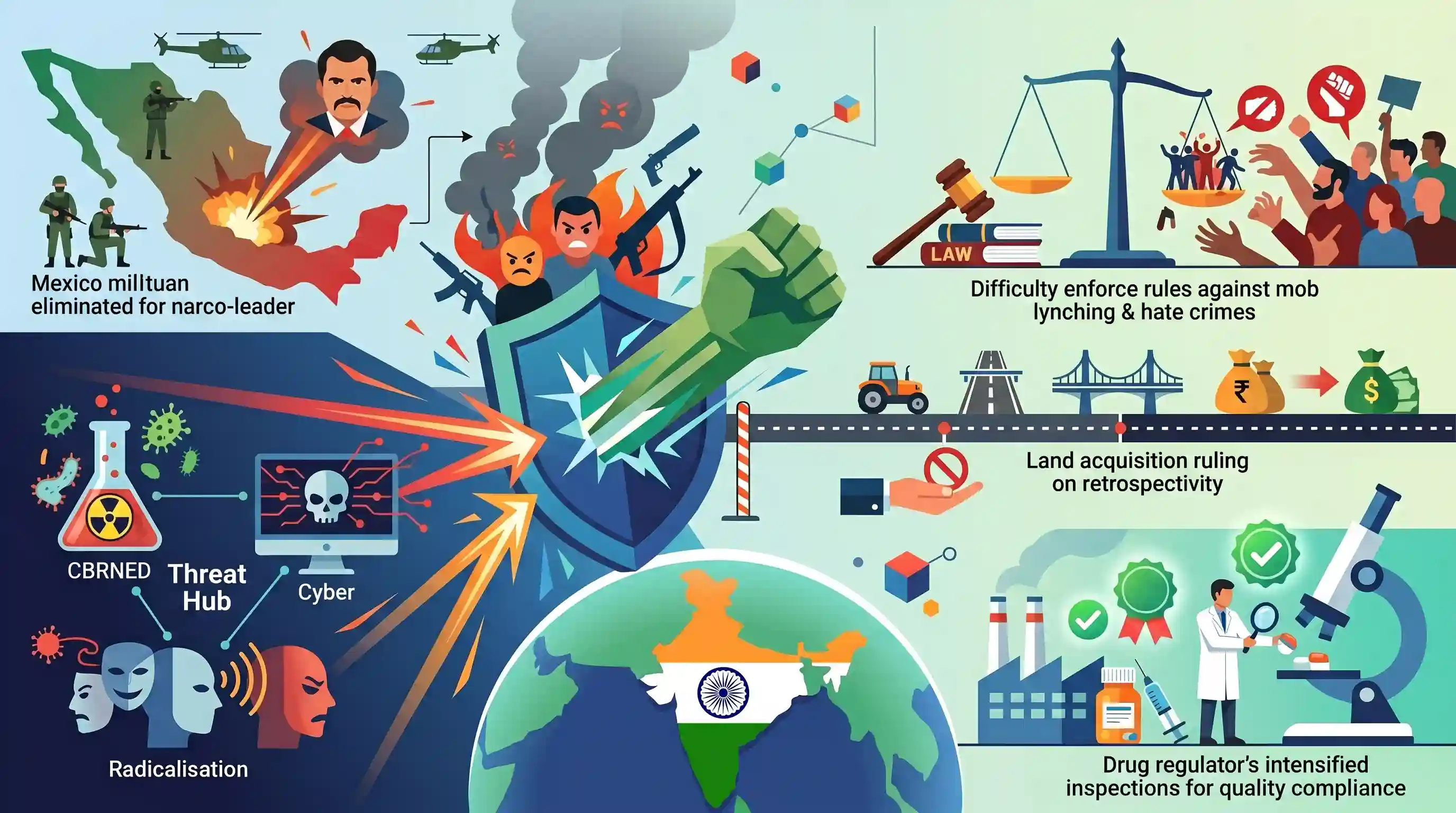
The daily news wrap covers the launch of 'PRAHAAR', India's first comprehensive anti-terror policy aimed at combating multi-domain threats including CBRNED, cyber-attacks, and radicalisation. In the judiciary, the Supreme Court noted the practical difficulties of uniformly enforcing the 2018 guidelines on mob lynching and hate crimes, and clarified that enhanced compensation cannot be retrospectively claimed for pre-2018 NHAI land acquisitions. On the health front, India's drug regulator intensified inspections of pharmaceutical facilities to ensure quality compliance. Internationally, Mexico braced for cartel violence following the military's elimination of a major narco-terrorist leader.
Key Points
- The Union Home Ministry released 'PRAHAAR', India's first anti-terror policy, focusing on modern threats like CBRNED (Chemical, Biological, Radiological, Nuclear, Explosive, Digital), drones, cyber-attacks, and radicalisation.
- A Supreme Court bench expressed that uniformly applying the 2018 Tehseen Poonawalla judgment guidelines for hate crimes is 'unmanageable' and favored case-by-case adjudication.
- The Supreme Court ruled that landowners whose properties were acquired under the NHAI Act before 2018 cannot claim retrospective enhanced compensation with interest under the 2013 Land Acquisition Act.
- India's drug regulator (DCGI) inspected 90% of cough syrup manufacturers to enforce Good Manufacturing Practices (GMP) after global deaths linked to contaminated exports.
- The killing of notorious drug lord 'El Mencho' by the Mexican military brings the challenge of narco-terrorism and organized crime violence into global focus.
Important Terms
PRAHAAR

India's first comprehensive National Counter-Terrorism Policy (2026) adopting a 'zero tolerance' approach. It focuses on intelligence integration, de-radicalisation, and swift response to multi-domain threats like cyber and narco-terrorism.
UPSC context
GS Paper III (Internal Security); tests knowledge of national security doctrines and strategies against evolving hybrid threats.
CBRNED
Acronym for Chemical, Biological, Radiological, Nuclear, and high-yield Explosives; refers to non-conventional weapon threats that require specialised emergency response and disaster management frameworks.
UPSC context
GS Paper III (Internal Security and Disaster Management); focuses on unconventional security challenges and preparedness.
RFCTLARR Act, 2013
Legislation ensuring fair market-linked compensation (up to 4x in rural areas), mandatory rehabilitation, and transparency for families affected by land acquisition for public or private projects.
UPSC context
GS Paper II (Governance) and GS Paper III (Infrastructure); tests understanding of social justice in development.
National Highways Act, 1956
A 1956 law providing the legal framework for declaring and developing National Highways. Recent SC rulings addressed compensation parity between this Act and the 2013 RFCTLARR Act.
UPSC context
GS Paper III (Infrastructure and Economy); relevant for land acquisition disputes and legal evolution.
CDSCO
India's national regulatory authority under the Ministry of Health, responsible for ensuring the safety, efficacy, and quality of pharmaceuticals, medical devices, and cosmetics.
UPSC context
GS Paper II (Statutory Bodies and Health); tests knowledge of institutional frameworks for public health.
DCGI
The statutory head of the CDSCO who serves as the apex authority for approving new drugs, vaccines, and clinical trials in India.
UPSC context
GS Paper II (Health Governance); focuses on executive roles in pharmaceutical regulation and safety.
Mob Lynching Guidelines (2018)
Mandates established by the Supreme Court (Tehseen Poonawalla case) requiring states to implement preventive, punitive, and remedial measures, including nodal officers and fast-track trials, to curb vigilantism.
UPSC context
GS Paper II (Social Justice/Judiciary); tests awareness of judicial interventions to maintain public order and human rights.
Prelims Trap
"PRAHAAR is a newly enacted counter-terrorism legislation by the Parliament."
PRAHAAR is India's first comprehensive National Counter-Terrorism Policy framework launched by the Union Home Ministry, not a statutory legislative Act passed by Parliament.
Static Concepts Connected
What constitutes the expanded CBRNED threat matrix in Internal Security?
- CBRN core: Includes Chemical, Biological, Radiological (dirty bombs), and Nuclear weapons, conventionally recognized globally as weapons of mass destruction.
- The E & D: Adds Explosives and Digital (cyber-attacks targeting critical infrastructure), modernizing the threat spectrum under the new PRAHAAR policy framework.
What is 'Schedule M' under the Drugs and Cosmetics Rules, 1945?
- Mandates GMP: Prescribes Good Manufacturing Practices (GMP) for pharmaceutical units, detailing baseline requirements for plant premises, equipment, and quality control systems.
- WHO alignment: Recently upgraded to mandate strict compliance with WHO-GMP standards to prevent export contamination and protect India's 'Pharmacy of the World' standing.
Cross-Topic Patterns
Anti-Terror Policy + Human Rights Jurisprudence
PRAHAAR’s explicit inclusion of a "Human Rights" pillar reflects the institutionalization of past Supreme Court directives to balance national security imperatives with fundamental rights during counter-insurgency operations.
LARR Act 2013 vs NHAI Act Compensations
The SC ruling highlights the recurring friction between sector-specific acquisition laws (NHAI Act) and the umbrella 2013 LARR Act, specifically regarding the retrospective applicability of enhanced compensation and rehabilitation clauses.

Expect a 2026 prelims question on PRAHAAR testing its non-obvious pillars (Human Rights) and the 'Digital' aspect of CBRNED threats.
Linked PYQs · 5
Linked PYQs · 5
- 2021MainsGS3
Keeping in view India's internal security, analyse the impact of cross-border cyber attacks. Also discuss defensive measures against these sophisticated attacks.
- 2020MainsGS3
Discuss different types of cyber crimes and measures required to be taken to fight the menace.
- 2024MainsGS3
Explain how narco-terrorism has emerged as a serious threat across the country. Suggest suitable measures to counter narco-terrorism.
- 2022MainsGS3
Discuss the types of organised crimes. Describe the linkages between terrorists and organised crime that exist at the national and transnational levels.
- 2015MainsGS2
For achieving the desired objectives, it is necessary to ensure that the regulatory institutions remain independent and autonomous. Discuss in the light of the experiences in recent past.
