India introduces Prahaar as first comprehensive anti terror policy
Source:The Hindu ↗
Why It Matters
As India's first overarching anti-terror policy, Prahaar is a crucial development for Internal Security. It provides a formal framework addressing both traditional terrorism and emerging asymmetric threats like cyber warfare, CBRNED materials, and narco-terrorism, which are frequent subjects in UPSC Mains GS3.
Summary
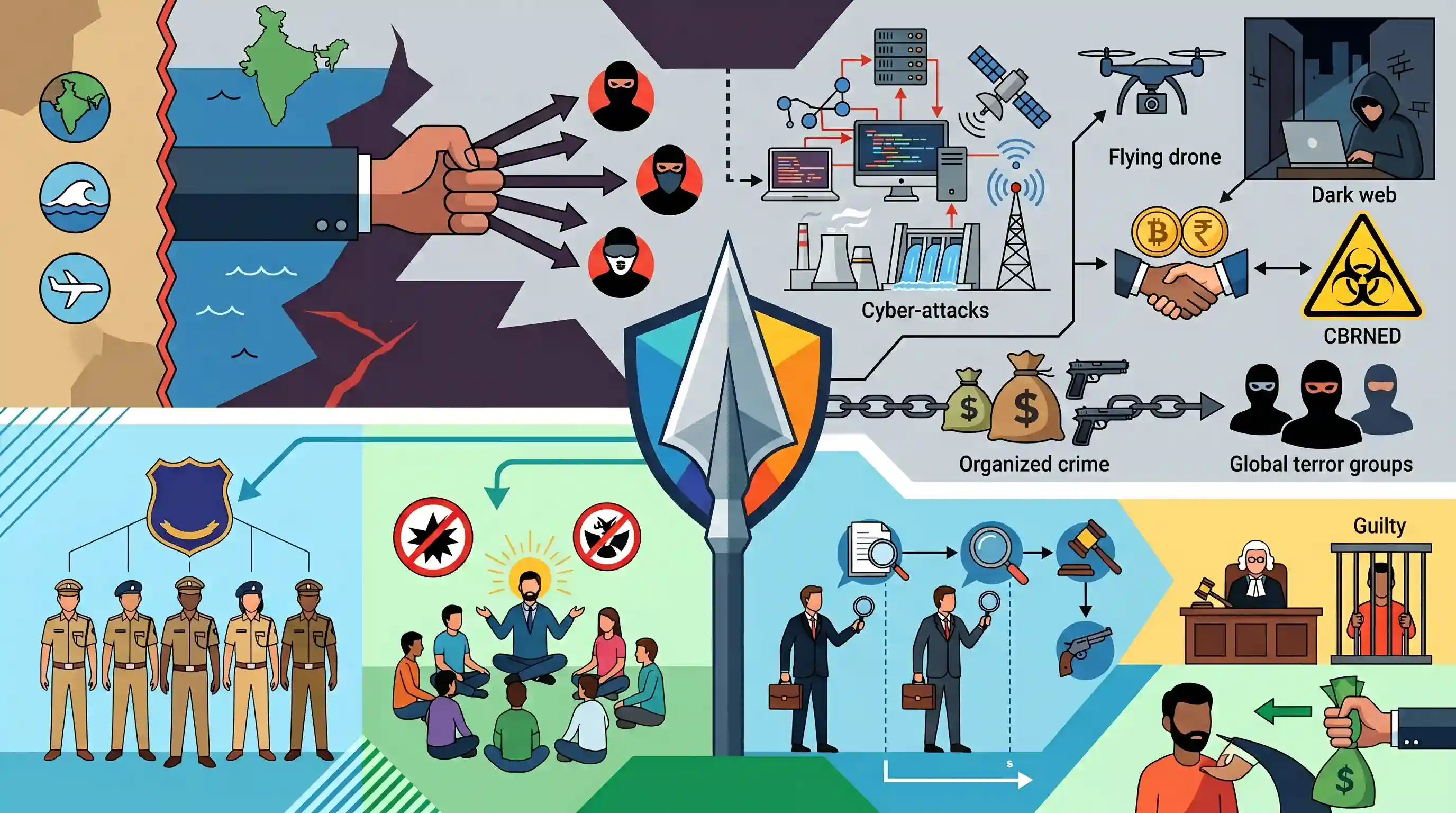
The Ministry of Home Affairs (MHA) has released India's first comprehensive anti-terror policy, named "Prahaar". The policy aims to counter evolving security threats emanating from land, water, and air, addressing traditional cross-border terrorism alongside new-age challenges. It highlights the rising danger of cyber-attacks by state and non-state actors on critical infrastructure, as well as the use of drones, the dark web, cryptocurrency, and CBRNED materials by terrorists. To combat the nexus between organized crime, sleeper cells, and global terror groups, Prahaar advocates for a uniform anti-terrorism structure across States, robust de-radicalisation programs, and the early involvement of legal experts in terror investigations to ensure successful prosecution and denial of terror funding.
Key Points
- The Ministry of Home Affairs has released "Prahaar", India\'s first dedicated anti-terror policy, to establish a unified and standard anti-terrorism structure across all States.
- The policy broadens the scope of threats beyond border-sponsored terrorism to include cyber-attacks by criminal hackers and nation-states targeting critical infrastructure such as power, aviation, and atomic energy.
- It addresses the modern modus operandi of terrorists, including the use of drones, dark web, crypto-wallets, social media, and CBRNED (Chemical, Biological, Radiological, Nuclear, Explosive, Digital) materials.
- It highlights the growing nexus between organized criminal networks and terror logistics/recruitment, warning of sleeper cells incited by global groups like Al-Qaeda and ISIS.
- The policy emphasizes a comprehensive approach that includes de-radicalisation programmes with NGOs and moderate preachers, as well as involving legal experts early in investigations from FIR to prosecution.
Important Terms
Prahaar (Anti-Terror Policy)

India's 2026 National Counter-Terrorism Policy based on a 'zero tolerance' approach. It integrates seven pillars: Prevention, Response, Aggregation, Human rights, Attenuation, Aligning efforts, and Recovery.
UPSC context
GS Paper III: Internal Security. Tests knowledge of national doctrines and institutional frameworks for countering cross-border and hybrid terrorism.
Ministry of Home Affairs (MHA)
The nodal Indian ministry responsible for internal security, central police forces, and border management. It formulated Prahaar to unify central and state agencies against evolving threats.
UPSC context
GS Paper II/III: Governance and Security. Tests understanding of the executive organ managing national security and its jurisdictional role.
CBRNED Materials
Refers to Chemical, Biological, Radiological, Nuclear, high-yield Explosives, and Digital threats. These materials represent unconventional weapons of mass destruction (WMD) targeted by modern counter-terror strategies.
UPSC context
GS Paper III: Security/Science & Tech. Evaluates awareness of non-traditional security threats and the protection of critical national infrastructure.
De-radicalisation
A social and psychological process aimed at reversing extremist ideologies. It involves using counter-narratives, community engagement, and socio-economic support to move individuals away from violent extremism.
UPSC context
GS Paper III: Internal Security. Tests understanding of preventive security measures and the "human-centric" approach to neutralizing extremist recruitment.
Sleeper Cells
Inconspicuous groups of terrorists who lead seemingly normal lives while remaining "dormant" until activated for an attack. They represent a significant challenge for preemptive intelligence operations.
UPSC context
GS Paper III: Internal Security. Focuses on the role of non-state actors and the challenges of intelligence-led policing in urban environments.
Multi-Agency Centre (MAC)
The Intelligence Bureau's nodal platform for real-time sharing of counter-terrorism intelligence between central and state agencies. It is the cornerstone of the Prahaar policy's "Prevention" pillar.
UPSC context
GS Paper III: Security Challenges. Tests knowledge of inter-agency coordination mechanisms and intelligence-sharing infrastructure in India.
Prelims Trap
Prahaar is a joint military operation launched by armed forces against Left Wing Extremism.
Aspirants may confuse the new MHA anti-terror policy 'Prahaar' with the older 'Operation Prahaar' conducted by security forces against Maoists in central India.
Static Concepts Connected
What constitutes the core counter-terrorism legal and institutional framework in India?
- Legal framework:: The Unlawful Activities (Prevention) Act (UAPA) serves as the primary anti-terror law, allowing the designation of both individuals and organizations as terrorists.
- NIA:: The National Investigation Agency (NIA) acts as the central counter-terrorism law enforcement agency, empowered to investigate specific terror cases across states without prior state permission.
- Intelligence sharing:: The Multi-Agency Centre (MAC) under the IB and NATGRID facilitate real-time intelligence gathering and sharing among various central and state security agencies.
How is Critical Information Infrastructure (CII) protected in India?
- Legal backing:: Section 70 of the IT Act, 2000 defines CII as resources whose incapacitation severely impacts national security, economy, public health, or safety.
- Nodal agency:: The National Critical Information Infrastructure Protection Centre (NCIIPC), functioning under the NTRO, acts as the nodal agency for protecting designated CII sectors.
Cross-Topic Patterns
Federalism vs. Internal Security
Prahaar's push for a 'uniform anti-terrorism structure' across States touches GS2 Centre-State relations, as 'Public Order' and 'Police' are constitutionally State subjects.
Cyber-attacks as Terrorism
By categorizing attacks on critical infrastructure as terror threats, the policy formally bridges GS3 Cyber Security with conventional Counter-Terrorism and non-state actor frameworks.
Adding 'Digital' to CBRNE
The policy evolves the traditional CBRNE (Chemical, Biological, Radiological, Nuclear, Explosive) threat matrix into 'CBRNED', formally integrating the dark web and crypto-financing into counter-terror operations.

Prahaar’s addition of 'Digital' to the CBRNE matrix and focus on crypto-financing makes it a highly probable 15-marker in GS3 Mains 2026.
Linked PYQs · 5
Linked PYQs · 5
- 2025MainsGS3
Terrorism is a global scourge. How has it manifested in India? Elaborate with contemporary examples. What are the counter measures adopted by the State? Explain.
- 2021MainsGS3
Analyse the complexity and intensity of terrorism, its causes, linkages and obnoxious nexus. Also suggest measures required to be taken to eradicate the menace of terrorism.
- 2022MainsGS3
Discuss the types of organised crimes. Describe the linkages between terrorists and organised crime that exist at the national and transnational levels.
- 2022MainsGS3
What are the different elements of cyber security ? Keeping in view the challenges in cyber security, examine the extent to which India has successfully developed a comprehensive National Cyber Security Strategy.
- 2017MainsGS3
Discuss the potential threats of Cyber attack and the security framework to prevent it.
