RBI Bulletin Highlights Resilience of Indian Macroeconomy
Source:The Hindu ↗
Why It Matters
The RBI Bulletin provides the central bank's official assessment of India's macroeconomic health. Understanding the interplay between domestic growth engines, inflation dynamics, and external vulnerabilities—such as trade protectionism, global supply chain shifts, and monetary policy spillovers—is fundamental to the GS-3 Economy syllabus.
Summary
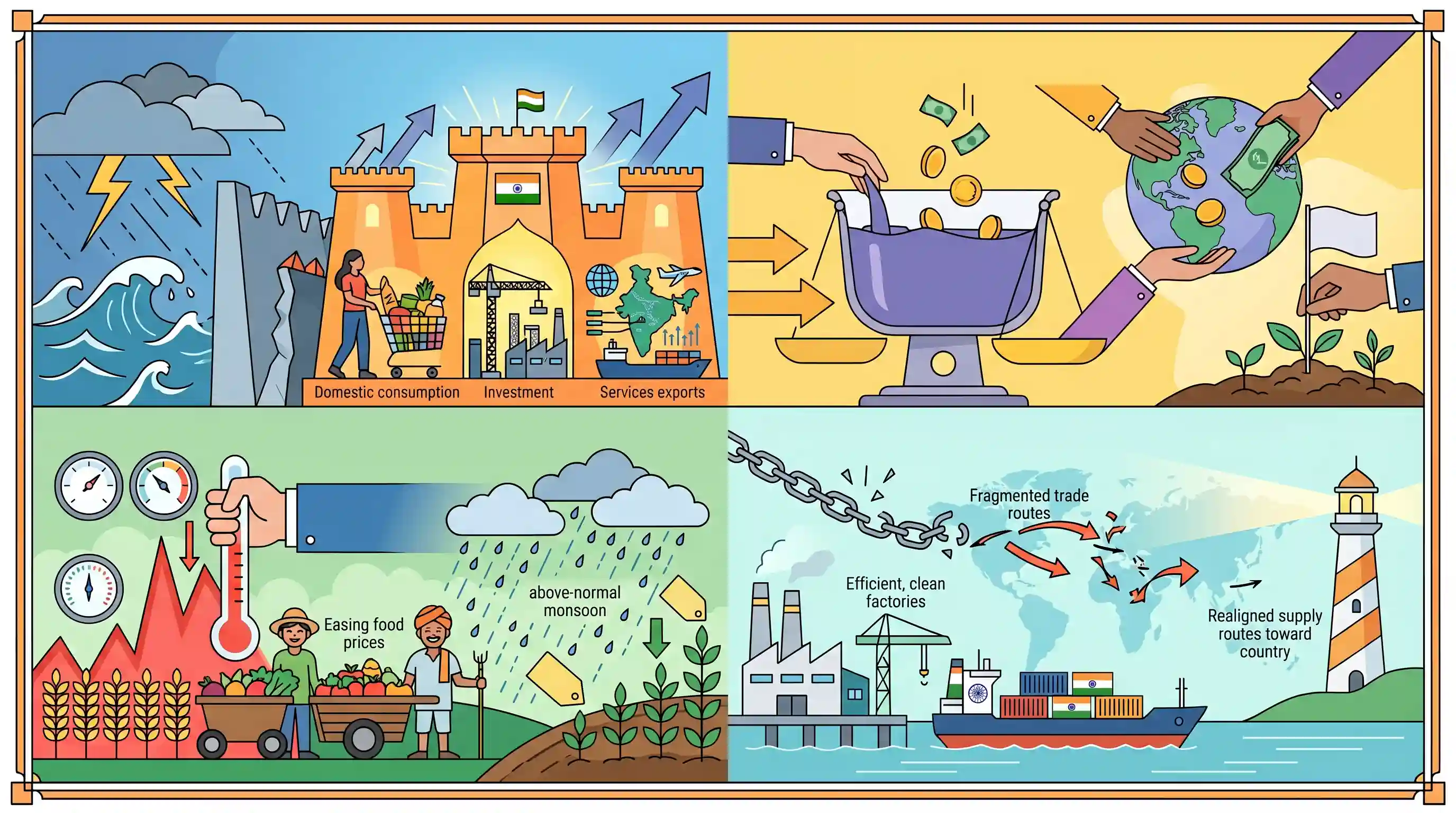
According to the April 2025 RBI Bulletin, India remains relatively resilient against external headwinds such as a subdued global economic outlook, volatile financial conditions, and rising trade tariffs. The country's macroeconomic stability is driven by robust domestic consumption, investment, and strong services exports alongside remittances, which collectively act as a buffer for the current account. The RBI highlighted a significant moderation in headline inflation, aided by easing food prices, and projected favorable agricultural prospects due to an expected above-normal monsoon. Consequently, India stands out as a stable destination amid global supply-chain realignments and shifting Foreign Direct Investment (FDI) patterns.
Key Points
- India exhibits robust macroeconomic fundamentals, remaining relatively insulated from volatile global financial conditions and geopolitical headwinds.
- Domestic consumption and investment continue to act as the primary engines of economic growth.
- Strong performance in services exports and healthy remittance inflows are providing a critical buffer for the Current Account Deficit (CAD).
- Headline inflation moderated to a 67-month low of 3.3% in March 2025, largely driven by easing food prices.
- An expected above-normal southwest monsoon is projected to boost agricultural output and rural demand.
- India is structurally positioned to benefit from ongoing global supply-chain realignments and diversified Foreign Direct Investment (FDI).
Important Terms
Reserve Bank of India (RBI)

India's central bank and regulatory body responsible for monetary policy, banking supervision, and maintaining financial stability. It publishes the monthly 'Bulletin' analyzing domestic and global economic trends.
UPSC context
GS Paper III (Indian Economy). Essential for understanding monetary policy, inflation targeting, and central banking functions.
Headline Inflation
A measure of the total inflation in an economy, including volatile components like food and energy. It is typically calculated via the Consumer Price Index (CPI).
UPSC context
GS Paper III (Economy). The primary metric for the RBI's 4% (+/- 2%) inflation targeting framework.
Current Account Deficit (CAD)
A component of the Balance of Payments that records the value of imports versus exports of goods, services, and net transfers (like remittances) over a specific period.
UPSC context
GS Paper III (External Sector). Vital for assessing currency stability and the 'Twin Deficit' challenge.
Foreign Direct Investment (FDI)
Long-term capital investment made by a foreign entity into a domestic company, typically involving a lasting interest and significant managerial control (often defined as >10% stake).
UPSC context
GS Paper III (Investment Models). Tests knowledge of non-debt creating flows and their impact on growth.
Remittances
Money or goods sent home by migrants working abroad. India is the world's largest recipient, with these funds acting as a significant cushion for the current account.
UPSC context
GS Paper III (External Sector). Key for understanding the Indian diaspora's contribution to the Balance of Payments.
External Headwinds
Global economic risks such as high commodity prices, volatile financial markets, trade protectionism, or geopolitical tensions that can negatively impact a country's growth and stability.
UPSC context
GS Paper III (Economy). Used to analyze India's resilience in the face of global economic volatility.
Prelims Trap
FDI inflows act as a direct buffer to reduce India's Current Account Deficit.
FDI is a Capital Account component. It finances the CAD but does not reduce it. Services exports and remittances (Current Account invisibles) directly reduce the CAD.
Static Concepts Connected
How do services and remittances factor into India's Balance of Payments?
- Current Account Invisibles: Both are recorded under the 'Invisibles' section of the Current Account, alongside net income (profits, dividends, interest).
- Trade Deficit Buffer: India typically runs a merchandise trade deficit. A net surplus in invisibles (services + remittances) offsets this shortfall, keeping the CAD manageable.
Why does the RBI struggle to control food-driven inflation using standard monetary tools?
- Supply-Side Nature: Food inflation is usually driven by supply shocks (weather, logistics). Repo rate hikes primarily suppress aggregate demand rather than resolving supply constraints.
- High CPI Weight: Food and beverages constitute roughly 46% of India's CPI basket. High food prices keep headline inflation elevated even if the RBI successfully cools core inflation.
Cross-Topic Patterns
China-plus-one & FDI shifts
Geopolitical de-risking pushes global manufacturers to diversify. India leverages its macroeconomic stability and PLI schemes to attract non-debt-creating FDI away from China.
Monsoon anomalies & rural demand
Above-normal monsoon predictions link physical geography (ENSO/IOD) directly to macroeconomic recovery, easing food inflation and boosting rural FMCG consumption.

Expect an assertion-reason question in 2026 linking India's high CPI food weight to the structural limits of RBI's inflation targeting.
Linked PYQs · 5
Linked PYQs · 5
- 2022PrelimsGS1
Consider the following statements: 1. Tight monetary policy of US Federal Reserve could lead to capital flight. 2. Capital flight may increase the interest cost of firms with existing External Commercial Borrowings (ECBs). 3. Devaluation of domestic currency decreases the currency risk associated with ECBs. Which of the statements given above are correct?
- 2023PrelimsGS1
Consider the following statements: Statement-I: In the post-pandemic recent past, many Central Banks worldwide had carried out interest rate hikes. Statement-II: Central Banks generally assume that they have the ability to counteract the rising consumer prices via monetary policy means. Which one of the following is correct in respect of the above statements?
- 2025MainsGS3
What are the challenges before the Indian economy when the world is moving away from free trade and multilateralism to protectionism and bilateralism? How can these challenges be met?
- 2024MainsGS3
What are the causes of persistent high food inflation in India? Comment on the effectiveness of the monetary policy of the RBI to control this type of inflation.
- 2018MainsGS3
How would the recent phenomena of protectionism and currency manipulations in world trade affect macroeconomic stability of India?
