RBI Bulletin Asserts India Insulated from External Headwinds
Source:The Hindu ↗
Why It Matters
This article is highly relevant for understanding India's macroeconomic stability in the face of global uncertainties (protectionism, tariff wars, and inflation). It provides key data points and analytical arguments for GS3 Mains answers related to the external sector, current account deficit, and inflation targeting.
Summary
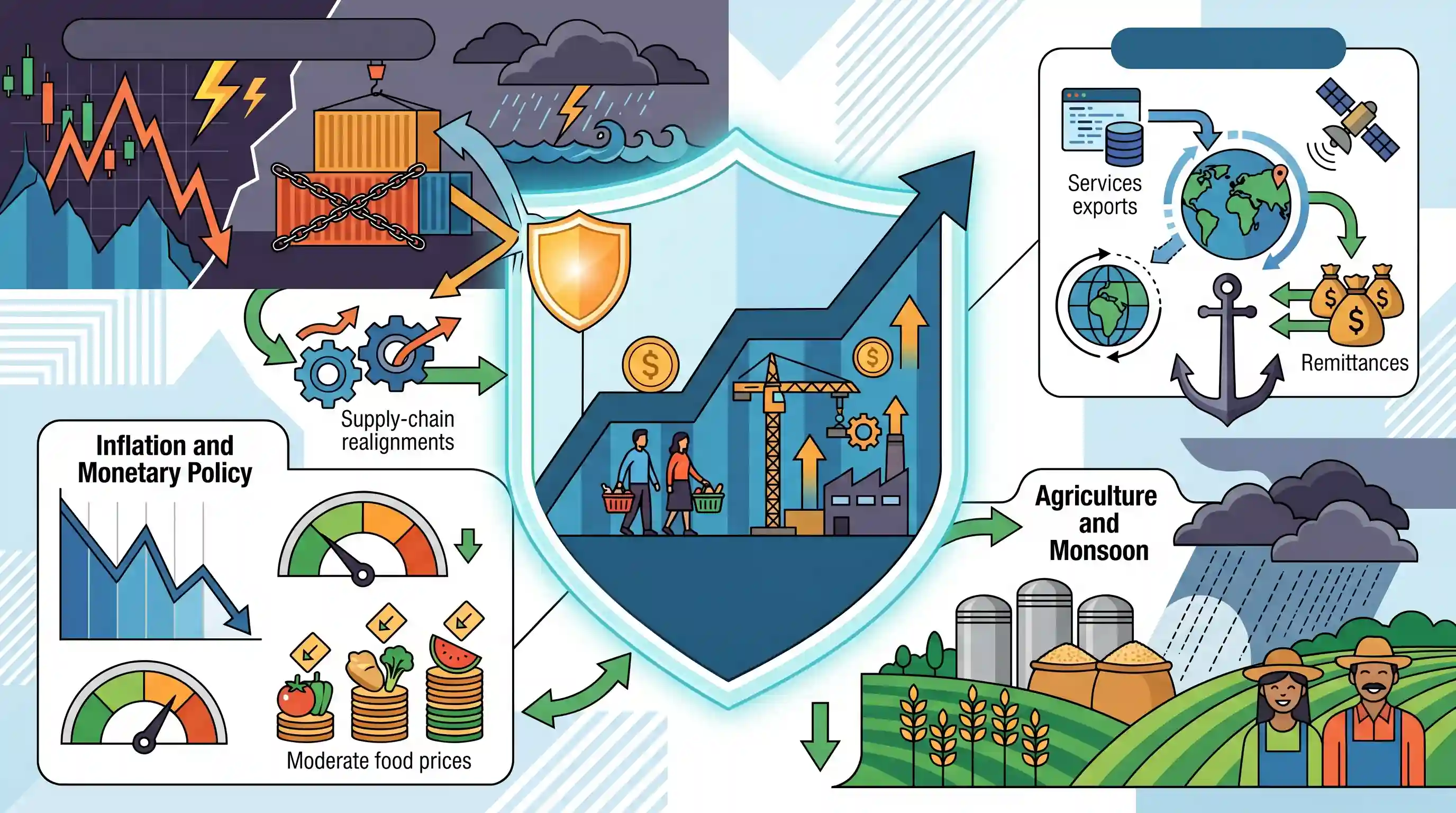
According to the latest RBI Bulletin, the Indian economy exhibits strong resilience against external headwinds like escalating global trade tariffs, financial market volatility, and a dampening global economic outlook. This stability is underpinned by robust domestic growth engines, including consumption and investment. Furthermore, India's external sector remains secure, with a current account deficit (CAD) buffered by strong services exports and steady remittance inflows. On the domestic front, headline inflation has dropped to a 67-month low of 3.3%, driven by moderating food prices, and an above-normal southwest monsoon forecast promises further agricultural growth. While global spillovers challenge many emerging market economies, India's robust macroeconomic framework and potential gains from supply-chain realignments position it favorably.
Key Points
- The RBI Bulletin asserts that India is relatively insulated from external economic headwinds, such as global trade tensions and financial volatility, due to strong domestic consumption and investment.
- India's current account deficit (CAD) is well-buffered by robust services exports and steady remittance inflows.
- Headline inflation has moderated to a 67-month low of 3.3%, largely driven by a decline in food prices.
- Forecasts of an above-normal southwest monsoon are expected to boost agricultural prospects, further helping to keep food inflation in check.
- While emerging market economies are vulnerable to global spillovers, India stands to benefit from declining global commodity prices and ongoing supply-chain realignments.
Important Terms
Reserve Bank of India (RBI)

India's central bank and regulatory body established in 1935, responsible for monetary policy, currency issuance, and ensuring the country's financial stability.
UPSC context
GS Paper III (Economy); essential for questions on monetary policy, inflation targeting, and banking regulation.
Current Account Deficit (CAD)
A measurement in the Balance of Payments where the total value of imported goods, services, and transfers exceeds the total value of exports.
UPSC context
GS Paper III (Economy); tests knowledge of external stability and the Balance of Payments (BoP) framework.
Headline Inflation
The total inflation figure reported via the Consumer Price Index (CPI), encompassing all categories including volatile food and energy prices.
UPSC context
GS Paper III (Economy); vital for understanding the RBI’s primary target for its inflation-control mandate.
Remittances
Funds transferred by the Indian diaspora to their home country; India is the world’s largest recipient, significantly supporting its foreign exchange reserves.
UPSC context
GS Paper III (Economy); relevant for discussing the significance of the diaspora and sources of external financing.
External Sector
The portion of the national economy that interacts with the rest of the world through trade, capital flows, and international investments.
UPSC context
GS Paper III (Economy); covers India's global trade relations and resilience to international economic shocks.
Global Spillovers
Economic events in one nation that impact others through integrated trade links, financial market volatility, or changes in global commodity prices.
UPSC context
GS Paper III (Economy/IR); tests the ability to analyze how global macro-volatility affects India’s domestic growth.
Prelims Trap
India's Current Account Deficit remains stable primarily due to a consistent surplus in merchandise trade.
India consistently runs a merchandise trade deficit. The CAD is buffered by strong net invisibles, specifically IT services exports and steady inward remittances, not physical goods.
Static Concepts Connected
What components comprise the Current Account in India's Balance of Payments?
- Merchandise Trade: Export and import of physical goods, which historically runs a structural deficit for India.
- Services Trade: Software, travel, and business services, providing a consistent and crucial surplus that buffers the CAD.
- Transfers and Income: Unilateral transfers (primarily worker remittances and grants) and net income (profits, interest, and dividends).
How does Headline CPI differ from Core Inflation in India's monetary policy?
- Headline CPI: Measures the total inflation basket. The RBI uses this as the statutory target for monetary policy (4% ± 2%).
- Core CPI: Excludes volatile food and fuel components. It helps the RBI gauge underlying macroeconomic price pressures without seasonal supply shocks.
- Food Weightage: Food and beverages comprise nearly 46% of the CPI basket, making headline inflation highly sensitive to agricultural outputs.
Cross-Topic Patterns
Monsoon geography + Monetary policy
The southwest monsoon's performance directly ties physical geography to macroeconomic stability, as food inflation dictates RBI's interest rate decisions under the flexible inflation targeting framework.
Protectionism + Supply chain realignments
Rising global tariffs and trade fragmentation act as external headwinds but paradoxically accelerate the 'China+1' strategy, benefiting India's structural manufacturing push and PLI schemes.

BOP components (services/remittances) shielding CAD amidst global tariff wars is highly likely to appear as a GS3 or Prelims 2026 concept.
Linked PYQs · 5
Linked PYQs · 5
- 2025MainsGS3
What are the challenges before the Indian economy when the world is moving away from free trade and multilateralism to protectionism and bilateralism? How can these challenges be met?
- 2016MainsGS3
Justify the need for FDI for the development of the Indian economy. Why there is gap between MOUs signed and actual FDIs? Suggest remedial steps to be taken for increasing actual FDIs in India.
- 2022PrelimsGS1
With reference to the Indian economy, consider the following statements: 1. If the inflation is too high, Reserve Bank of India (RBI) is likely to buy government securities. 2. If the rupee is rapidly depreciating, RBI is likely to sell dollars in the market. 3. If interest rates in the USA or European Union were to fall, that is likely to induce RBI to buy dollars. Which of the statements given above are correct?
- 2020PrelimsGS1
Consider the following statements: 1. The weightage of food in Consumer Price Index (CPI) is higher than that in Wholesale Price Index (WPI). 2. The WPI does not capture changes in the prices of services, which CPI does. 3. Reserve Bank of India has now adopted WPI as its key measure of inflation and to decide on changing the key policy rates. Which of the statements given above is/are correct?
- 2021PrelimsGS1
With reference to Indian economy, demand-pull inflation can be caused/ increased by which of the following? 1. Expansionary policies 2. Fiscal stimulus 3. Inflation-indexing wages 4. Higher purchasing power 5. Rising interest rates Select the correct answer using the code given below.
