India rejects UN committee observations on racial discrimination
Source:The Hindu ↗
Why It Matters
The article sheds light on India's engagement with international human rights mechanisms (like ICERD) and its firm defense of domestic constitutional and legal safeguards against external criticism. It connects directly to UPSC topics regarding minority rights, UN bodies, and mechanisms for protecting vulnerable sections.
Summary
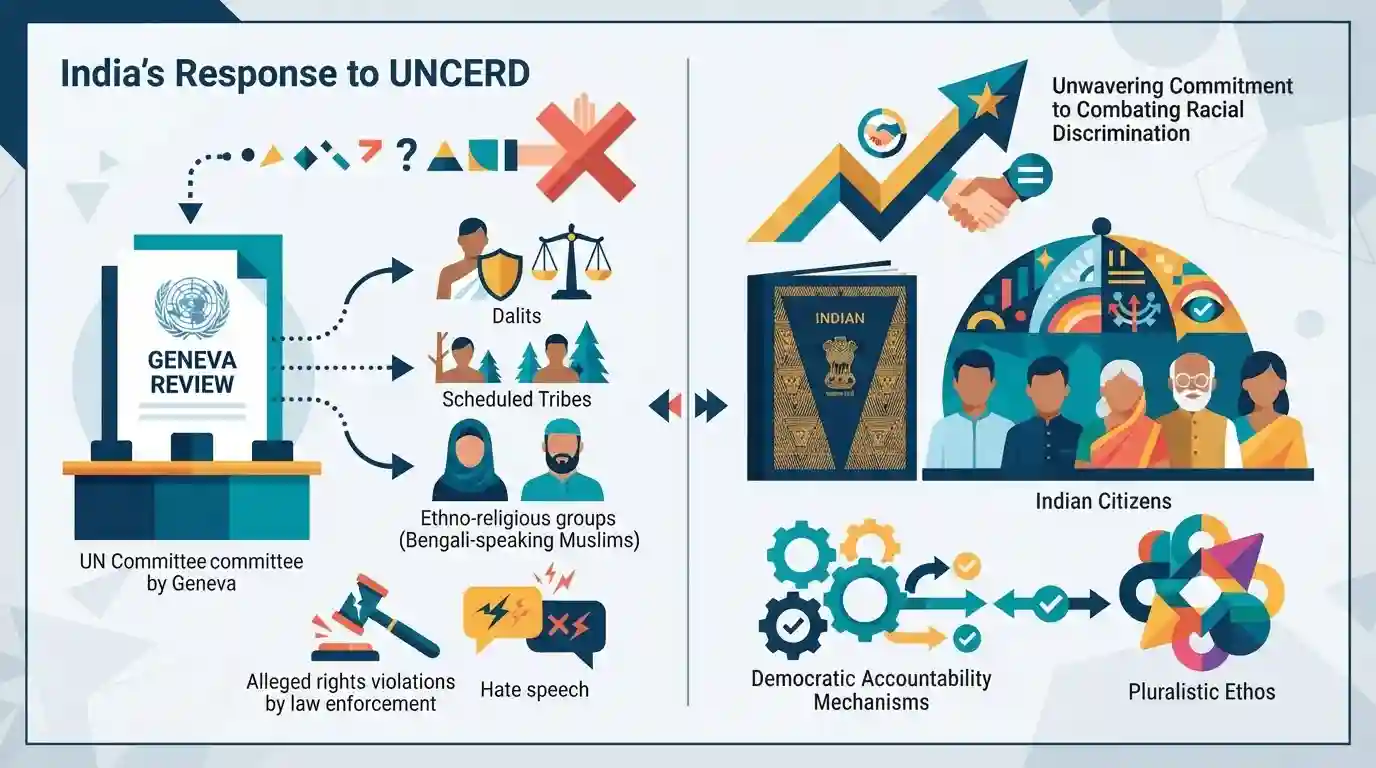
India formally rejected the observations made by the United Nations Committee on the Elimination of Racial Discrimination (UNCERD) following a periodic review in Geneva, calling them "politically motivated" and "malicious." The Committee had raised concerns about alleged rights violations by law enforcement against vulnerable communities, including Dalits, Scheduled Tribes, and ethnic/ethno-religious groups like Bengali-speaking Muslims, while also urging India to address hate speech. In response, the Ministry of External Affairs affirmed India's unwavering commitment to combating racial discrimination and underscored its robust constitutional safeguards, pluralistic ethos, and democratic accountability mechanisms.
Key Points
- India dismissed UNCERD observations as politically motivated and highly malicious during its 11th periodic review under the ICERD in Geneva.
- The UN Committee raised concerns over alleged large-scale violations by law enforcement against ethnic groups, Scheduled Castes (Dalits), Scheduled Tribes, and Bengali-speaking Muslims.
- UNCERD called for the Indian government to address hate speech and hate crimes and ensure accountability.
- The Indian delegation, led by Solicitor General Tushar Mehta, emphasized the country's comprehensive constitutional safeguards, affirmative action, and pluralistic framework for minority protection.
Important Terms
ICERD (International Convention on the Elimination of All Forms of Racial Discrimination)

A key United Nations human rights treaty adopted in 1965 that commits state parties to eliminate racial discrimination and criminalize hate speech.
UPSC context
GS Paper II: International Relations. Tests understanding of global human rights treaties, sovereign commitments, and India's compliance with international frameworks.
United Nations Committee on the Elimination of Racial Discrimination (UNCERD)
An independent body of 18 international experts that monitors the implementation of the International Convention on the Elimination of All Forms of Racial Discrimination.
UPSC context
GS Paper II: Important International Institutions. Tests knowledge of treaty-monitoring bodies, international oversight mechanisms, and India's bilateral relations with UN forums.
Ministry of External Affairs (MEA)
The government department responsible for conducting India's foreign relations, managing diplomatic missions, and presenting India's official stance on global human rights reviews.
UPSC context
GS Paper II: Executive/Foreign Policy. Tests understanding of governmental ministries administering foreign affairs, international diplomatic responses, and sovereign delegation structures.
Prelims Trap
India is bound to refer any dispute under ICERD to the International Court of Justice (ICJ).
India ratified ICERD in 1968 with a reservation to Article 22, making referral of disputes to the ICJ conditional upon the consent of all parties involved.
Static Concepts Connected
What is the difference between UN Charter-based and Treaty-based human rights bodies?
- Charter-based Bodies: Established under the UN Charter (e.g., UN Human Rights Council); they have broad political mandates and apply to all UN member states.
- Treaty-based Bodies: Established by specific international treaties (e.g., UNCERD under ICERD); they monitor implementation only in states that have ratified that treaty.
- UNCERD Composition: Consists of 18 independent experts serving in their personal capacity, not as representatives of their home governments.
Which key constitutional articles safeguard citizens against discrimination on grounds of race or descent?
- Article 15(1): Prohibits the State from discriminating against any citizen on grounds 'only' of religion, race, caste, sex, or place of birth.
- Article 16: Guarantees equality of opportunity in public employment and prohibits discrimination based on race or descent.
- Article 29(2): Ensures no citizen is denied admission to state-run/aided educational institutions on grounds of religion, race, caste, or language.
Cross-Topic Patterns
Tribal protection vs. Strategic Infrastructure
The Great Nicobar project highlights the policy conflict between national strategic infrastructure and the ecological/cultural rights of PVTGs like the Shompen.
Treaty interpretation vs. State Sovereignty
The 'caste vs. descent' debate illustrates how nations defend domestic social policy boundaries against expansive interpretations by UN human rights treaty bodies.

Questions may test ICERD’s treaty status, India's reservation on ICJ dispute referral, and the caste-versus-descent debate.
Linked PYQs · 3
Linked PYQs · 3
- 2014MainsGS2
What do you understand by the concept "freedom of speech and expression"? Does it cover hate speech also ? Why do the films in India stand on a slightly different plane from other forms of expression ? Discuss.
- 2018MainsGS2
Whether National Commission for Scheduled Castes (NCSC) can enforce the implementation of constitutional reservation for the Scheduled Castes in the religious minority institutions? Examine.
- 2014MainsGS2
National Human Rights Commission (NHRC) in India can be most effective when its tasks are adequately supported by other mechanisms that ensure the accountability of a government. In light of the above observation assess the role of NHRC as an effective complement to the judiciary and other institutions in promoting and protecting human rights standards.
