India Rejection of Third Party Intervention on Jammu and Kashmir
Source:Indian Express ↗
Why It Matters
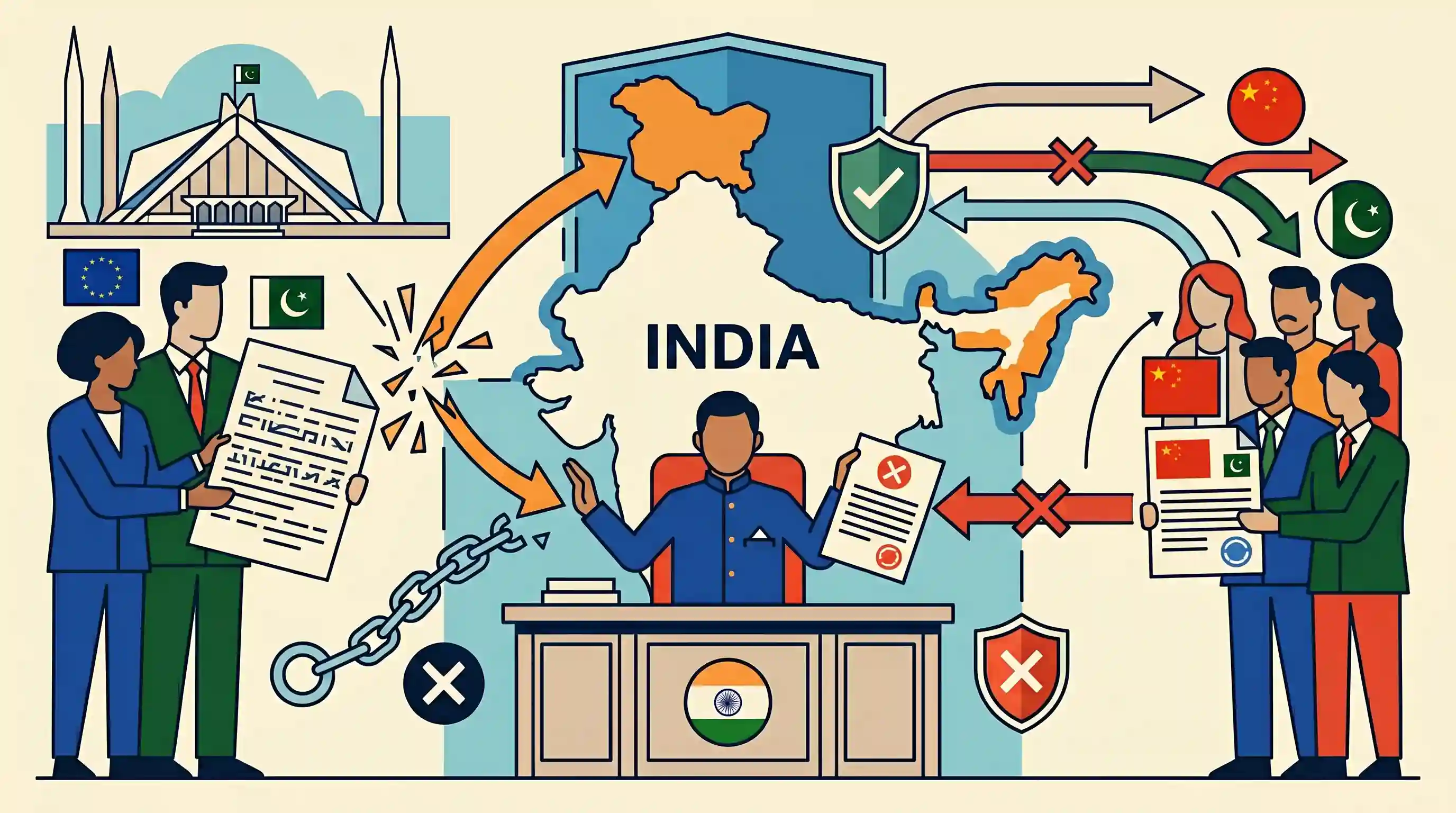
The article highlights India's steadfast diplomatic posture against the internationalization of the Kashmir issue and its rejection of third-party commentary on matters of internal sovereignty. This is crucial for understanding India's contemporary foreign policy principles and responses under GS2 International Relations.
Summary
India has firmly rejected references to Jammu and Kashmir in a recent joint statement issued by Pakistan and the European Union. The Ministry of External Affairs (MEA) reiterated its longstanding position that the Union Territories of Jammu & Kashmir and Ladakh are integral and inalienable parts of India. The MEA spokesperson stressed that foreign entities with "no locus standi" should refrain from commenting on India’s internal affairs. The joint statement was a product of the 8th round of the EU-Pakistan Strategic Dialogue held in Islamabad, co-chaired by Pakistan's Deputy Prime Minister Ishaq Dar and the EU's High Representative Kaja Kallas. This development follows India's similar rebuke of a China-Pakistan joint statement, underscoring New Delhi's consistent diplomatic policy against the internationalization of the Kashmir dispute and uninvited third-party interventions.
Key Points
- India categorically rejected references to Jammu and Kashmir in a joint statement issued by Pakistan and the European Union.
- The Ministry of External Affairs reiterated that the Union Territories of Jammu and Kashmir, and Ladakh, remain inalienable parts of India.
- India emphasized that external parties have "no locus standi" to comment on its internal matters, reinforcing its stance against third-party interference.
- The joint statement followed the 8th EU-Pakistan Strategic Dialogue, co-chaired by EU High Representative Kaja Kallas and Pakistan Deputy PM Ishaq Dar in Islamabad.
- India had previously rejected a similar China-Pakistan joint statement in May, demonstrating a consistent diplomatic pushback against the internationalization of the Kashmir issue.
Important Terms
Locus Standi

A Latin term meaning 'place to stand'; in law and diplomacy, it refers to the legal right or capacity of a party to appear or be heard in a forum.
UPSC context
GS Paper II (International Relations/Polity); tests understanding of legal standing and India's policy of non-interference in internal affairs.
Ministry of External Affairs (MEA)
The government agency responsible for implementing India's foreign policy and representing the country in global forums and bilateral negotiations.
UPSC context
GS Paper II (International Relations); central to questions on India's diplomatic responses and foreign policy machinery.
European Union (EU)
A political and economic union of 27 European countries that acts as a significant global trade and political bloc.
UPSC context
GS Paper II (Global Groupings); important for understanding regional dynamics and major powers' influence on India's interests.
Integral and Inalienable Part
India's official diplomatic and legal position asserting that Jammu & Kashmir and Ladakh are permanent, non-negotiable territories of the Indian Union.
UPSC context
GS Paper II (International Relations/Polity); tests knowledge of India's sovereign claims and constitutional position on territorial integrity.
Internationalization of Dispute
The strategic effort to move a dispute from a bilateral context to international forums (like the UN) or involve third-party mediators.
UPSC context
GS Paper II (International Relations); focuses on India's adherence to the Simla Agreement and rejection of third-party mediation.
EU-Pakistan Strategic Dialogue
A high-level institutional mechanism for political engagement between the EU and Pakistan, covering trade, security, and regional cooperation.
UPSC context
GS Paper II (International Relations); illustrates how external bilateral agreements can impact India's regional and internal security interests.
Prelims Trap
The 1972 Simla Agreement permits UN or third-party mediation if bilateral negotiations over Kashmir fail.
The Simla Agreement strictly binds India and Pakistan to settle differences through peaceful bilateral negotiations, legally precluding any third-party or UN mediation.
Static Concepts Connected
What is the significance of the 1972 Simla Agreement?
- Bilateralism: Binds both nations to resolve their differences through peaceful, strictly bilateral negotiations, precluding uninvited third-party mediation.
- Line of Control: Converted the UN ceasefire line in J&K into the mutually recognized Line of Control (LoC).
What does the diplomatic term "No Locus Standi" mean?
- Legal Standing: The recognized right or capacity of a person or entity to bring an action or to appear/be heard in a matter.
- Sovereignty Defense: India systematically employs this phrase to legally and diplomatically dismiss external comments on its internal affairs, upholding absolute territorial sovereignty.
Cross-Topic Patterns
CPEC, PoK, and Territorial Sovereignty
India's objection to China-Pakistan statements mirrors its stance on CPEC passing through PoK, intertwining border disputes with regional infrastructure projects and sovereignty claims.
EU's Normative Policy vs Strategic Reality
The EU frequently issues normative statements (human rights/Kashmir) with Pakistan, while simultaneously pursuing deep strategic and trade ties (like BTIA) with India, creating a complex dual-track diplomacy.

Expect a 2026 multi-statement question contrasting the Tashkent Declaration with the strict bilateral mandate of the 1972 Simla Agreement.
Linked PYQs · 3
Linked PYQs · 3
- 2015MainsGS2
Terrorist activities and mutual distrust have clouded India-Pakistan relations. To what extent the use of soft power like sports and cultural exchanges could help generate goodwill between the two countries? Discuss with suitable examples.
- 2016MainsGS2
To what extent is Article 370 of the Indian Constitution, bearing marginal note "Temporary provision with respect to the State of Jammu and Kashmir", temporary? Discuss the future prospects of this provision in the context of Indian polity.
- 2023MainsGS2
‘The expansion and strengthening of NATO and a stronger US-Europe strategic partnership works well for India.’ What is your opinion about this statement ? Give reasons and examples to support your answer.
