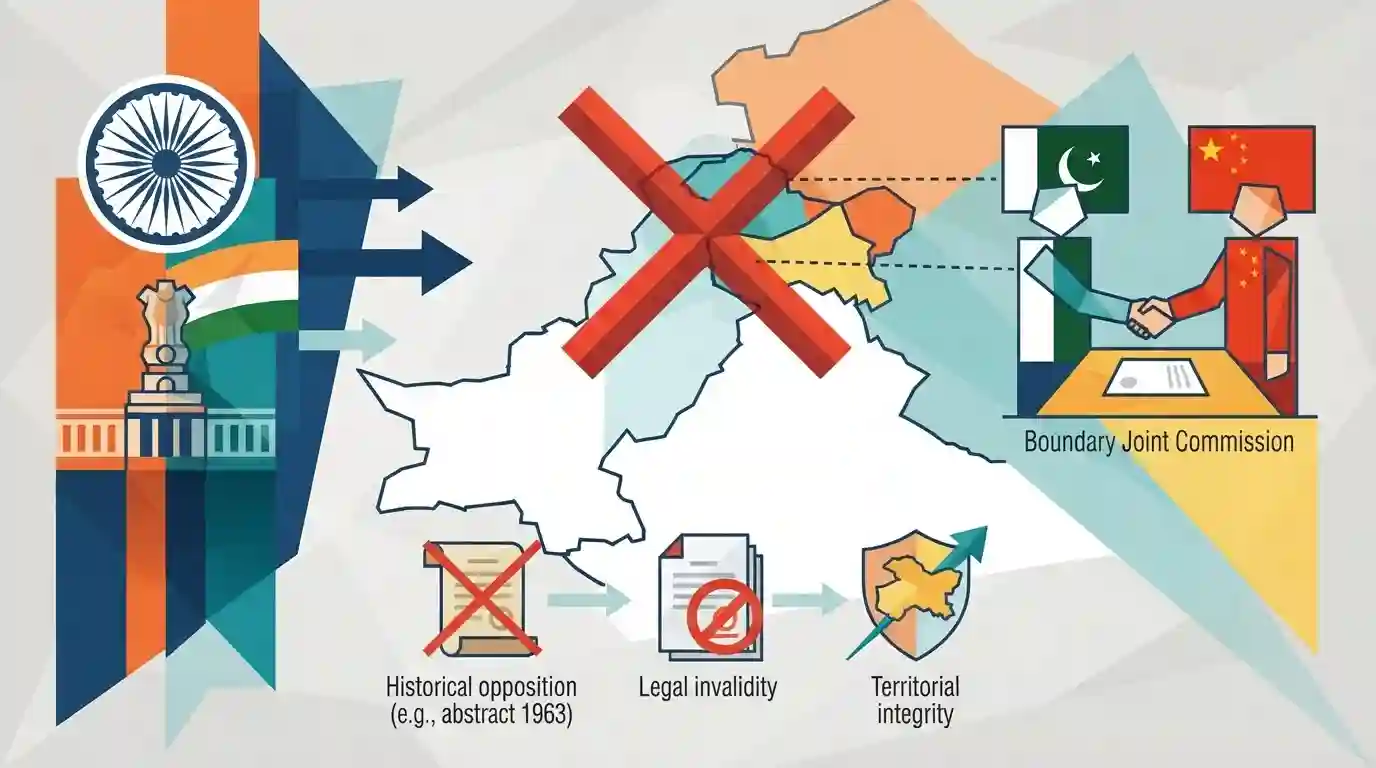
Pakistan China boundary joint commission and India sovereignty stand
Source:The Hindu ↗
কেন এটি গুরুত্বপূর্ণ
This development directly concerns India's core national sovereignty and territorial integrity, highlighting New Delhi's diplomatic stance against the collusion of neighboring countries on disputed border regions like Pakistan-occupied Jammu and Kashmir (PoJK) and the Shaksgam Valley.
সারসংক্ষেপ
India firmly rejected the establishment of a Pakistan-China Boundary Joint Commission, terming it legally invalid and a violation of its territorial sovereignty. The Ministry of External Affairs emphasized that Jammu, Kashmir, and Ladakh remain integral parts of India, while reiterating its historical opposition to the 1963 Sino-Pak boundary agreement involving the ceded Shaksgam Valley.
মূল বিষয়
- India has strongly rejected the Pakistan-China Boundary Joint Commission, calling it devoid of any legal basis.
- The MEA stated that the entire Union Territories of Jammu and Kashmir and Ladakh are, and have always been, an integral and sovereign part of India.
- India specifically denounced the 1963 Pakistan-China Boundary Agreement, under which Pakistan unlawfully ceded Indian territory in the Shaksgam Valley to China.
- New Delhi reiterated that any bilateral acts or institutional mechanisms between third countries regarding Indian territories are completely unacceptable and legally untenable.
গুরুত্বপূর্ণ শব্দ
Pakistan-China Boundary Agreement of 1963

A 1963 bilateral pact in which Pakistan illegally ceded ~5,180 sq km of Shaksgam Valley (part of Jammu & Kashmir) to China. India views it as legally invalid.
UPSC context
GS Paper II (International Relations - India's neighbors/China and Pakistan policy, boundary disputes).
Pakistan-China Boundary Joint Commission
A joint body formed by Pakistan and China to discuss border matters, rejected by India as legally invalid because it deals with Indian territory in Pakistan-occupied Jammu and Kashmir.
UPSC context
GS Paper II (International Relations - Bilateral groupings and territorial sovereignty).
Ministry of External Affairs (MEA)
The nodal government department responsible for executing India's foreign policy, formulating diplomatic responses, and articulating India's territorial sovereignty stands on global platforms.
UPSC context
GS Paper II (Governance / International Relations - Indian foreign policy framework).
সংযুক্ত স্থির ধারণা
What is the historical and legal status of the 1963 Sino-Pakistan Boundary Agreement?
- Territorial Cession: Pakistan signed a boundary agreement with China ceding ~5,180 sq km of territory in the Shaksgam Valley (Trans-Karakoram Tract) of PoK.
- Provisional Clause: Article 6 of the 1963 agreement explicitly states the boundary is provisional, subject to renegotiation after the Kashmir dispute is settled.
- India's Stance: India has consistently maintained that Pakistan had no legal title to cede Indian territory, rendering the agreement null and void ab initio.
আন্তঃবিষয় প্যাটার্ন
Shaksgam Valley and CPEC Strategic Convergence
The Shaksgam Valley transfer sits adjacent to CPEC routing through PoK, creating a dual-layered sovereignty challenge for Indian strategic planners in High Asia.

Expect statement-based questions on the legal status of the 1963 Sino-Pak Agreement and Shaksgam Valley in Prelims.
সংযুক্ত PYQ · 1
সংযুক্ত PYQ · 1
- 2014MainsGS2
With respect to the South China sea, maritime territorial disputes and rising tension affirm the need for safeguarding maritime security to ensure freedom of navigation and over flight throughout the region. In this context, discuss the bilateral issues between India and China.
