Pakistan China Boundary Commission Rejection and Legal Validity
Source:The Hindu ↗
ఇది ఎందుకు ముఖ్యం
This article addresses vital geopolitical concerns regarding India's territorial sovereignty, bilateral frictions with China and Pakistan, and India's consistent legal stance against illegal third-party agreements over Pakistan-occupied territories.
సారాంశం
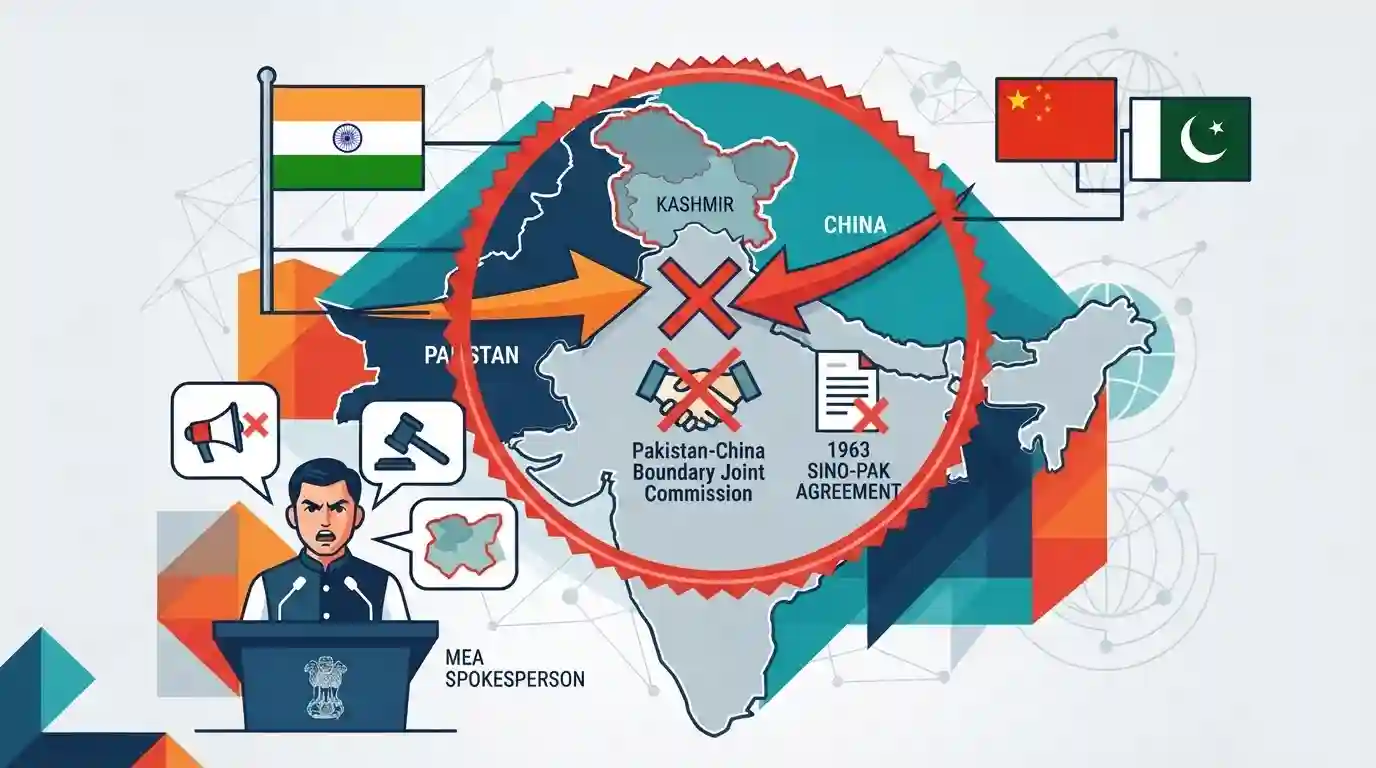
India has strongly rejected the establishment of a Pakistan-China Boundary Joint Commission, terming it legally invalid and a violation of India's sovereignty over Jammu, Kashmir, and Ladakh. The MEA spokesperson criticized the ongoing collusion between Pakistan and China, specifically pointing to the illegal 1963 Sino-Pakistan boundary agreement concerning Pakistan-occupied territories.
ముఖ్య అంశాలు
- India strongly rejected the Pakistan-China Boundary Joint Commission, calling it devoid of any legal basis.
- The Ministry of External Affairs (MEA) reiterated that Jammu and Kashmir and Ladakh are integral and inalienable parts of India.
- India objected to the 1963 Sino-Pakistan "so-called" boundary agreement, under which Pakistan illegally ceded parts of Pakistan-occupied Kashmir (PoK) to China.
- India maintains that Pakistan and China have no locus standi to enter into any arrangements regarding Indian territory.
ముఖ్యమైన పదాలు
1963 Sino-Pakistan Boundary Agreement

A 1963 pact where Pakistan unlawfully ceded around 5,180 sq km of the Shaksgam Valley (Trans-Karakoram Tract) to China. India rejects it entirely as Pakistan had no legal authority to negotiate Indian territory.
UPSC context
GS Paper 2 (International Relations — India and its neighborhood). Tests candidate's understanding of bilateral boundary disputes and territorial sovereignty claims.
Pakistan-China Boundary Joint Commission
A bilateral panel formed by Pakistan and China to address boundary matters concerning illegally occupied Indian territories. India has firmly rejected its validity as legally baseless and a violation of sovereignty.
UPSC context
GS Paper 2 (International Relations — Bilateral Groupings involving India and its neighbors). Evaluates strategic challenges from Sino-Pak axis.
Ministry of External Affairs (MEA)
The nodal government agency responsible for executing India's foreign policy, formulating diplomatic positions, and handling official interactions with international bodies and foreign governments.
UPSC context
GS Paper 2 (Polity and Governance / International Relations). Essential for understanding India's institutional framework for foreign policy articulation and diplomatic responses.
ప్రిలిమ్స్ ఉచ్చు
India implicitly recognizes the 1963 Sino-Pakistan boundary in northern Ladakh for administrative purposes.
Aspirants may assume India recognizes parts of the 1963 border arrangement or treats it as an administrative boundary; India rejects it entirely as having zero legal basis.
అనుసంధానమైన స్థిర భావనలు
What is the legal status and historical background of the 1963 Sino-Pakistan Boundary Agreement?
- Territorial Cession: Pakistan illegally ceded about 5,180 sq km of territory from Pakistan-occupied Kashmir (PoK), including the Shaksgam Valley, to China.
- Provisional Nature: Article 6 of the agreement stipulated that after the settlement of the Kashmir dispute, the sovereign authority would reopen negotiations with China.
- India's Stance: India has consistently maintained that the agreement is null and void ab initio as Pakistan has no legal sovereignty over Jammu and Kashmir.
అంతర-అంశ నమూనాలు
Bilateral border disputes vs. Trilateral strategic collusion
The Shaksgam Valley transfer illustrates how bilateral border disputes morph into trilateral geostrategic challenges, directly impacting India's two-front war doctrine and infrastructure planning in Ladakh.

Expect a statement-based prelims question pairing the 1963 Sino-Pak agreement with the legal status of the Shaksgam Valley.
అనుసంధాన PYQలు · 1
అనుసంధాన PYQలు · 1
- 2023MainsGS2
Compare and contrast the British and Indian approaches to Parliamentary sovereignty.
