India Rejects Court of Arbitration Award on Indus Waters Treaty
Source:The Hindu ↗
Why It Matters
The Indus Waters Treaty is widely considered one of the most successful water-sharing pacts globally, but the current deadlock threatens its operational survival. Understanding the technicalities of run-of-river projects and the graded dispute settlement mechanism (Neutral Expert vs. Court of Arbitration) is crucial for UPSC candidates analyzing India-Pakistan relations and international water law.
Summary
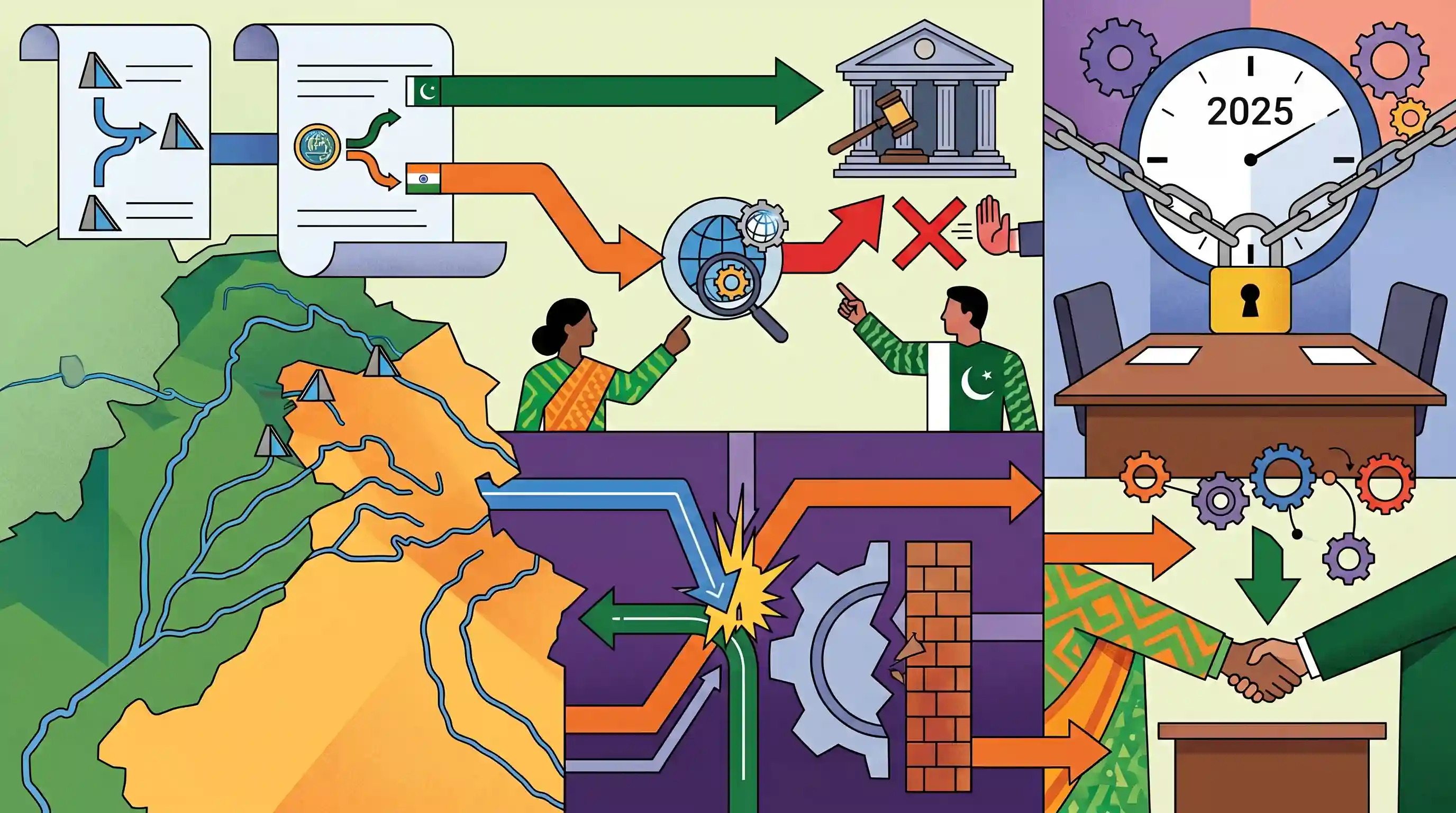
India has formally rejected an award by the Court of Arbitration in The Hague regarding water storage (pondage) limits for the Kishenganga and Ratle hydroelectric projects. India maintains that it does not recognize the jurisdiction of the tribunal, arguing that Pakistan bypassed the sequential dispute resolution mechanism mandated by the 1960 Indus Waters Treaty (IWT). India insists that the parallel proceedings are legally untenable and instead recognizes only the World Bank-appointed Neutral Expert to adjudicate the technical dispute. As a consequence of the ongoing deadlock, India has kept the operation of the Permanent Indus Commission in abeyance since 2025, demanding that Pakistan return to bilateral, treaty-compliant mechanisms.
Key Points
- The Court of Arbitration at The Hague issued an award regarding the 'maximum pondage' allowable for Indian hydroelectric projects (Kishenganga and Ratle) on the Indus river system.
- India outright rejected the award, asserting it does not recognize the unilaterally constituted tribunal and labeling the proceedings as an 'ex parte' violation of the Indus Waters Treaty.
- India argues Pakistan bypassed the Treaty's sequential, graded dispute resolution mechanism by demanding a Court of Arbitration while a Neutral Expert process was already viable.
- India continues to participate in the alternative dispute resolution process led by a World Bank-appointed Neutral Expert, considering it the only legitimate avenue.
- The dispute highlights severe strain on the 1960 Indus Waters Treaty, with India suspending Permanent Indus Commission meetings since 2025 pending bilateral resolution.
Important Terms
Indus Waters Treaty (IWT)

A 1960 water-sharing agreement between India and Pakistan, brokered by the World Bank, dividing the Indus system rivers (Eastern: India; Western: Pakistan).
UPSC context
GS-II: India & neighborhood relations; critical for understanding transboundary water diplomacy and bilateral historical frameworks.
Permanent Indus Commission (PIC)
A bilateral body established under the IWT to manage water sharing, conduct site inspections, and resolve technical issues through regular meetings.
UPSC context
GS-II: International Relations; tests knowledge of institutional mechanisms for conflict resolution in international treaties.
Neutral Expert
A World Bank-appointed independent technical authority tasked with resolving technical 'differences' between India and Pakistan regarding project designs under the IWT.
UPSC context
GS-II: Dispute resolution; relevant for the hierarchical legal stages (Questions, Differences, Disputes) of the IWT.
Court of Arbitration (CoA)
A seven-member arbitral tribunal serving as the third and final tier of the IWT dispute resolution mechanism for broader legal or treaty-interpretation 'disputes.'
UPSC context
GS-II: Important international institutions; tests clarity on the procedural hierarchy of international arbitration versus technical expertise.
Permanent Court of Arbitration (PCA)
An intergovernmental organization in The Hague that provides administrative support and a forum for international arbitration and dispute resolution between states.
UPSC context
GS-II: International institutions; tests understanding of global legal infrastructure and jurisdictional challenges in treaty-based disputes.
World Bank
The international financial institution that mediated the IWT and remains a signatory, holding a specific procedural role in appointing adjudicators for disputes.
UPSC context
GS-II: Global groupings and institutions; relevant for the role of third-party mediation in protracted bilateral conflicts.
Prelims Trap
"Under the IWT, parties can directly approach the Court of Arbitration for binding dispute resolution."
The treaty mandates a strictly sequential three-tier mechanism: Permanent Indus Commission, then a Neutral Expert for technical differences, and only then a Court of Arbitration.
Static Concepts Connected
What is the dispute resolution mechanism under the Indus Waters Treaty?
- Tier 1 (Questions): The Permanent Indus Commission (PIC) resolves initial 'questions' through bilateral negotiations.
- Tier 2 (Differences): A World Bank-appointed Neutral Expert adjudicates unresolved technical 'differences' (like pondage limits).
- Tier 3 (Disputes): A formally constituted Court of Arbitration (CoA) handles overarching legal 'disputes' if prior steps fail.
What are India's rights on the Western Rivers under the IWT?
- River Allocation: While Eastern rivers (Ravi, Beas, Sutlej) are India's, Western rivers (Indus, Jhelum, Chenab) are largely allocated to Pakistan.
- Non-consumptive use: India retains limited rights for domestic, agricultural, and non-consumptive uses, specifically run-of-the-river (RoR) hydroelectric projects.
- Pondage limits: India is permitted limited operational water storage (pondage) to generate electricity, provided it does not deliberately obstruct downstream flow.
Cross-Topic Patterns
Mapping Chenab and Jhelum tributaries
Disputes over Ratle (Chenab) and Kishenganga (Jhelum) often translate into Prelims geography questions on the Indus river system, its right/left bank tributaries, and glacier origins.
Bilateralism in International Law
India's rejection of parallel arbitration mirrors its broader diplomatic stance (e.g., UNCLOS or WTO) that strictly defends sequential or bilateral dispute resolution over unilateral tribunal appointments.

Expect a 2026 Prelims multi-statement question combining IWT's 3-tier dispute mechanism with the exact rivers of Kishenganga & Ratle.
Linked PYQs · 2
Linked PYQs · 2
- 2012MainsGS2
The situation today is far different to that prevalent fifty years back when the Indus Water Treaty was signed." Highlight the complexity of the current challenges on both sides of the border in this regard. Do you think that a review of the Treaty is in India's best interests?
- 2021PrelimsGS1
With reference to the Indus river system, of the following four rivers, three of them pour into one of them which joins the Indus direct. Among the following, which one is such river that joins the Indus direct?
