Prime Minister Offers Support Following Dhaka Aircraft Crash Tragedy
Source:The Hindu ↗
Why It Matters
This incident highlights the application of India's "Neighbourhood First" policy through rapid-response solidarity and disaster diplomacy. It serves as an example for GS-2 answers regarding India's role as a first responder and supportive ally in the South Asian region during humanitarian crises and disasters.
Summary
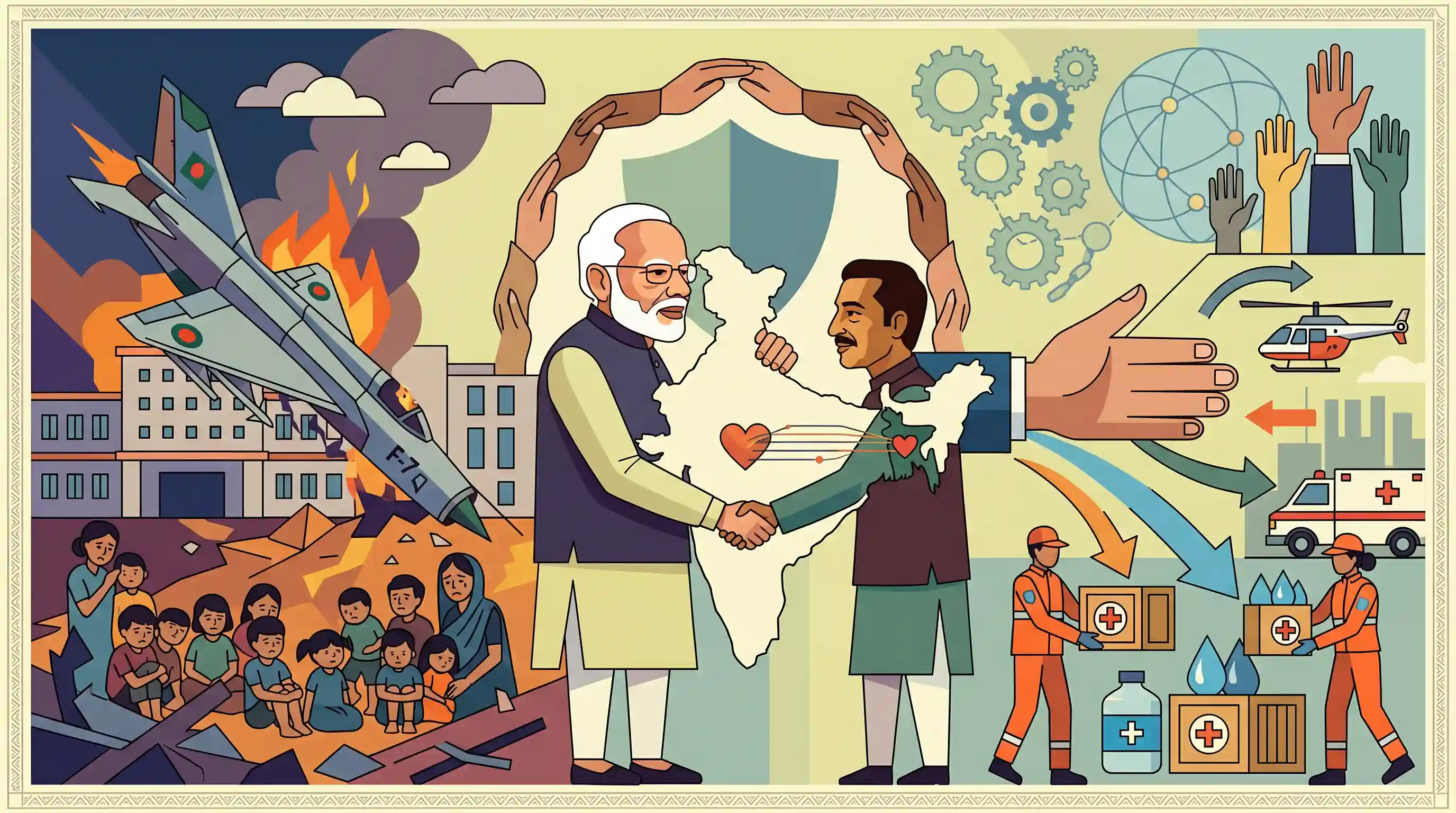
Prime Minister Narendra Modi expressed deep sorrow and solidarity with Bangladesh after a Bangladesh Air Force F-7 BGI training aircraft crashed into the Milestone School and College campus in Dhaka. The tragedy claimed the lives of at least 19 people, predominantly children. Reaffirming India's role as a supportive neighbor, PM Modi offered all possible assistance to Bangladesh, highlighting India's commitment to standing by its regional partners during crises and emergencies.
Key Points
- Prime Minister Narendra Modi expressed deep shock and solidarity with Bangladesh following a tragic aircraft crash in Dhaka.
- A Chinese-made Bangladesh Air Force training aircraft (F-7 BGI) crashed into the Milestone School and College campus in Dhaka's Uttara area.
- The crash resulted in the deaths of at least 19 people, the majority of whom were children, and injured dozens.
- India offered all possible support and assistance for relief efforts, reinforcing its diplomatic commitment to the region.
Important Terms
Neighbourhood First Policy

India's primary foreign policy framework prioritizing relations with immediate neighbors like Bangladesh to ensure regional stability, physical connectivity, and economic interdependence.
UPSC context
GS Paper II: International Relations. Core strategy for South Asian diplomacy and regional leadership.
Sonali Adhyay
A phrase meaning 'Golden Chapter' used by Indian and Bangladeshi leaders to characterize the current era of unprecedented trust and bilateral cooperation.
UPSC context
GS Paper II: Bilateral Relations. Describes the depth of India-Bangladesh strategic partnership.
Disaster Management (Bilateral Cooperation)
A technical/humanitarian framework, bolstered by a 2021 MoU, for mutual relief, early warning systems, and joint capacity building between India and Bangladesh.
UPSC context
GS Paper III: Disaster Management. Tests cooperation on human-induced and natural calamities.
BIMSTEC
A regional grouping of seven nations (including India and Bangladesh) around the Bay of Bengal, focusing on economic and technical cooperation.
UPSC context
GS Paper II: Regional Groupings. Important as a bridge between South and Southeast Asia.
F-7 BGI (Chengdu)
A Chinese-manufactured fighter jet used by the Bangladesh Air Force; its presence highlights the significant Chinese defense footprint in India's neighborhood.
UPSC context
GS Paper II: International Relations. Relevant to security dynamics and Chinese influence in South Asia.
Bangladesh Air Force
The primary aerial warfare branch of the Bangladesh Armed Forces, responsible for air defense and rescue operations during national emergencies.
UPSC context
GS Paper II/III: Security/Bilateral Relations. Key defense partner for India's regional stability efforts.
Prelims Trap
India's HADR assistance to Bangladesh is mandated under a bilateral mutual defense treaty.
India acts as a 'First Responder' based on its "Neighbourhood First" policy and diplomatic goodwill, not through legally binding mutual defense or disaster treaties.
Static Concepts Connected
What is India's 'First Responder' paradigm in HADR?
- Strategic Vision: The SAGAR vision (Security and Growth for All in the Region) drives India's swift deployment of crisis assistance across South Asia and the IOR.
- Disaster Diplomacy: India leverages its military assets (Navy/Air Force) for humanitarian missions (e.g., Op Maitri, Op Dost) to project soft power and generate diplomatic goodwill.
- Capacity Building: Beyond immediate relief, India focuses on joint exercises (like PANEX) and sharing early warning data to build local resilience in neighboring states.
How are disaster resilience institutions structured in South Asia?
- SDMC (IU): The SAARC Disaster Management Centre (SDMC-IU) operates from the Gujarat Institute of Disaster Management, providing policy advice and capacity building for member states.
- CDRI: An India-led global initiative that explicitly aids neighboring countries in safeguarding critical social infrastructure (like schools and hospitals) against climate and disaster risks.
- BIMSTEC Framework: Disaster Management is a core sector under BIMSTEC, which facilitates regional cooperation and joint Humanitarian Assistance and Disaster Relief (HADR) exercises.
Cross-Topic Patterns
Defense Diplomacy vs. Disaster Diplomacy
While Dhaka relies heavily on Chinese military hardware (like the crashed F-7 BGI), India leverages HADR and "Disaster Diplomacy" to maintain strategic trust and offset Beijing's regional influence.
Urban Zoning and Critical Infrastructure Resilience
The crash of a military jet into a school links GS3 Disaster Management with GS1 Urbanization, highlighting the urgent need for buffer zones around South Asian aviation corridors.

Expect Mains questions on India's 'Disaster Diplomacy' and 'First Responder' role offsetting extra-regional military footprints in South Asia.
Linked PYQs · 4
Linked PYQs · 4
- 2022MainsGS2
India is an age-old friend of Sri Lanka.’ Discuss India's role in the recent crisis in Sri Lanka in the light of the preceding statement.
- 2019MainsGS3
Disaster preparedness is the first step in any disaster management process. Explain how hazard zonation mapping will help disaster mitigation in the case of landslides.
- 2020MainsGS3
Discuss the recent measures initiated in disaster management by the Government of India departing from the earlier reactive approach.
- 2024MainsGS3
What is disaster resilience? How is it determined? Describe various elements of a resilience framework. Also mention the global targets of Sendai Framework for Disaster Risk Reduction (2015–2030).
