India Updated Nationally Determined Contributions and Clean Energy
Source:The Hindu ↗
Why It Matters
This updates India's core climate commitments on the international stage (NDCs). Understanding India's specific energy mix goals (60% non-fossil by 2035), carbon sink targets, and its diplomatic stance at the UNFCCC (highlighting CBDR-RC and equity) is vital for GS-III (Environment) and GS-II (International Relations). UPSC frequently asks direct questions on India's progress toward these stated NDC targets.
Summary
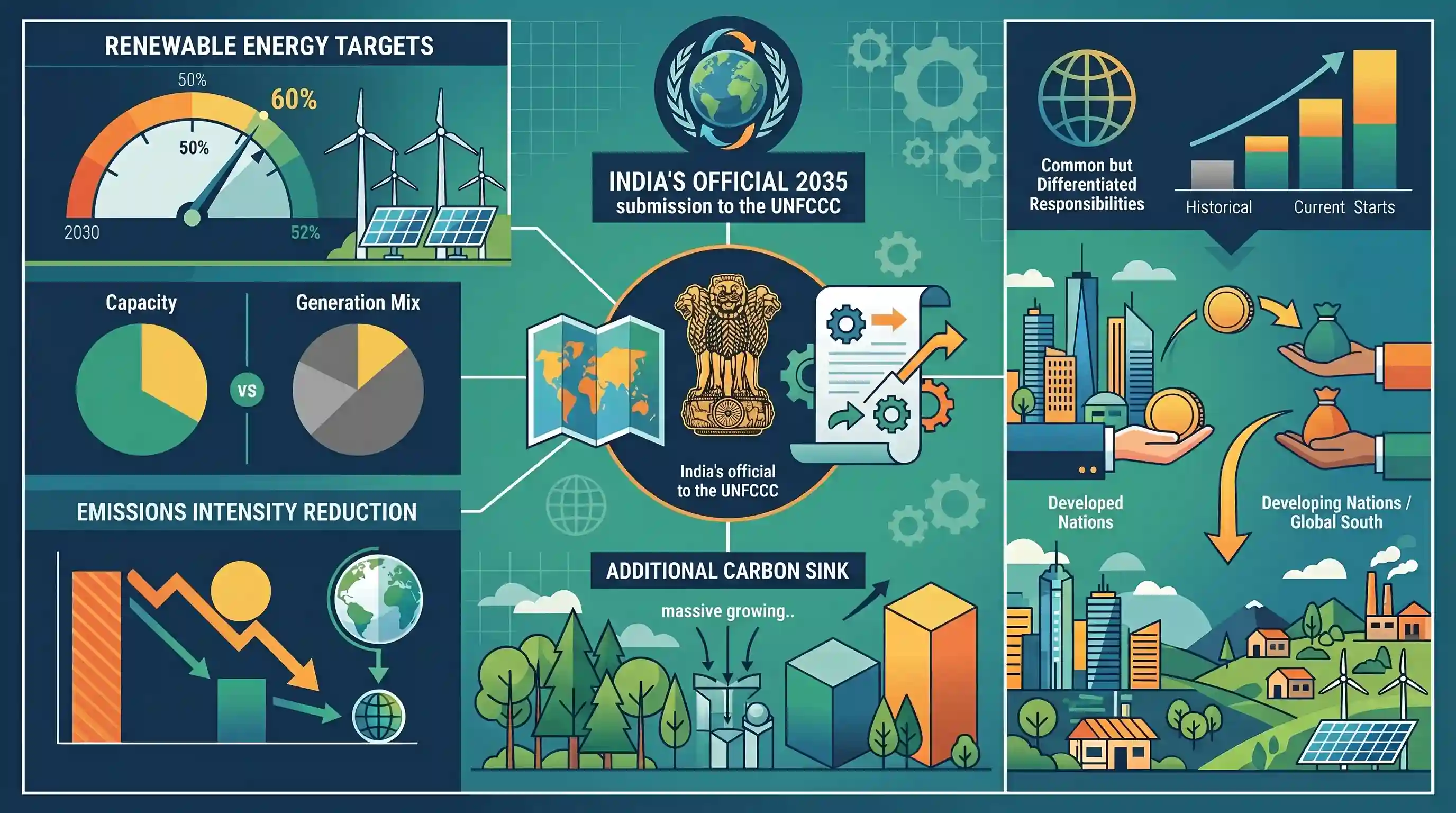
India has officially submitted its updated 2035 Nationally Determined Contributions (NDCs) under the Paris Agreement to the UNFCCC. The ambitious new targets aim to achieve 60% of total installed electrical capacity from non-fossil fuel sources, reduce the emissions intensity of GDP by 47% from 2005 levels, and create an additional carbon sink of 3.5 to 4 billion tonnes by 2035. While India has already surpassed its previous 2030 target of 50% non-fossil capacity (currently at 52%), the actual generation mix remains dominated by fossil fuels. The submission underscores the importance of 'Common but Differentiated Responsibilities' (CBDR-RC) and calls for greater climate financing from developed nations to support the global south's energy transition.
Key Points
- India submitted its updated Nationally Determined Contribution (NDC) for 2035 to the UNFCCC.
- The new target aims for 60% of installed electric capacity to come from non-fossil fuel sources by 2035, up from the 2030 goal of 50%.
- India has already reached 52% non-fossil installed capacity, though actual power generated from non-fossil sources remains at 25%.
- The updated NDC aims to reduce the emissions intensity of GDP by 47% from 2005 levels by 2035.
- An additional carbon sink of 3.5 billion to 4 billion tonnes of CO2 equivalent is planned by 2035 through increased forest and tree cover.
- India reiterated the principle of Common but Differentiated Responsibilities and Respective Capabilities (CBDR-RC), emphasizing the need for developed nations to provide adequate climate finance and technology.
Important Terms
Nationally Determined Contributions (NDCs)

Voluntary national climate action plans under the Paris Agreement, updated every five years to communicate targets for reducing emissions and adapting to climate impacts.
UPSC context
GS Paper 3: Environment. Crucial for understanding India's international climate commitments and domestic policy alignment.
Common but Differentiated Responsibilities and Respective Capabilities (CBDR-RC)
A principle acknowledging that while all nations must address climate change, developed countries have a greater responsibility due to historical emissions and higher capacity.
UPSC context
GS Paper 2 & 3. Core to climate justice, equity, and India's North-South diplomatic positioning.
Paris Agreement
A 2015 legally binding international treaty aimed at limiting global warming to well below 2°C through collective national commitments (NDCs).
UPSC context
GS Paper 3: Environment. The fundamental framework governing modern global climate action and international environmental law.
Global Stocktake (GST)
A periodic review mechanism under the Paris Agreement to assess collective global progress every five years, informing countries to enhance their future climate actions.
UPSC context
GS Paper 3. Key for evaluating the "ambition gap" and the effectiveness of international climate cooperation.
UNFCCC
The 1992 framework treaty aimed at stabilizing greenhouse gas concentrations, serving as the parent treaty to the Paris Agreement and host for COPs.
UPSC context
GS Paper 3. The foundational institutional framework for global environmental governance and climate negotiations.
Emissions Intensity
The volume of greenhouse gas emissions produced per unit of Gross Domestic Product (GDP), reflecting the carbon efficiency of an economy's growth.
UPSC context
GS Paper 3: Economy & Environment. Vital for analyzing India's strategy to decouple growth from environmental degradation.
Carbon Sink
A natural or artificial reservoir, like forests or oceans, that absorbs more carbon dioxide from the atmosphere than it releases.
UPSC context
GS Paper 3. Relevant to India’s forestry targets and the "Panchamrit" goal of achieving Net-Zero by 2070.
Prelims Trap
"India's updated NDC aims to generate 60% of its total electricity from non-fossil fuel sources by 2035."
UPSC frequently swaps 'installed capacity' with 'actual generation'. The 60% target applies strictly to installed capacity. Actual generation from non-fossils is currently much lower (~25%) due to intermittency.
Static Concepts Connected
What is the 'Ratchet Mechanism' under the Paris Agreement?
- Increasing Ambition: Mandates member nations to submit updated, progressively stricter Nationally Determined Contributions (NDCs) every five years.
- No Backsliding: Countries cannot downgrade their climate targets; each new submission must reflect their highest possible ambition to limit warming to 1.5°C.
What is the principle of Common but Differentiated Responsibilities (CBDR-RC)?
- Origin: Formalized during the 1992 Earth Summit within the United Nations Framework Convention on Climate Change (UNFCCC).
- Shared but Differentiated: All nations must address climate change, but developed countries bear greater responsibility due to their historical greenhouse gas emissions.
- Financial Obligations: Places a binding obligation on developed nations to lead in emission reductions and provide essential climate finance and technology to the Global South.
Cross-Topic Patterns
Installed Capacity vs Grid Reality
Links GS3 Environment to Energy Infrastructure. While non-fossil capacity surges, baseload power relies heavily on coal, highlighting the critical need for grid-scale battery energy storage systems (BESS).
Carbon Sinks & Afforestation Schemes
The massive 3.5-4 billion tonne carbon sink target draws immediate attention to the Green India Mission, CAMPA funds, and the legal definition of compensatory afforestation for prelims.

Expect a 2026 prelims question explicitly swapping 'installed capacity' with 'generation' alongside a Paris Agreement Ratchet mechanism hook.
Linked PYQs · 5
Linked PYQs · 5
- 2025MainsGS3
Write a review on India's climate commitments under the Paris Agreement (2015) and mention how these have been further strengthened in COP26 (2021). In this direction, how has the first Nationally Determined Contribution intended by India been updated in 2022?
- 2022MainsGS3
Do you think India will meet 50 percent of its energy needs from renewable energy by 2030 ? Justify your answer. How will the shift of subsidies from fossil fuels to renewables help achieve the above objective ? Explain.
- 2021MainsGS3
Describe the major outcomes of the 26th session of the Conference of the Parties (COP) to the United Nations Framework Convention on Climate Change (UNFCCC). What are the commitments made by India in this conference?
- 2016PrelimsGS1
The term 'Intended Nationally Determined Contributions' is sometimes seen in the news in the context of
- 2022PrelimsGS1
"Climate Action Tracker" which monitors the emission reduction pledges of different countries is a :
